What Documents Prove My Residence in Ireland?
Oh, the age-old question that sends shivers down the spine of every expat in Ireland: "Can you please provide proof of address?" It's a rite of passage, often feeling like a bureaucratic game of whack-a-mole where every institution asks for something slightly different. If you've ever found yourself with an IRP card, a job offer, and a place to live, but still hitting a wall because you don't have that elusive Irish utility bill in your name, then trust me, you're not alone. This guide is here to walk you through exactly what documents prove your residence in Ireland, why it's so tricky, and how to navigate this uniquely Irish administrative challenge.
Why Proving Residency is Such a Big Deal in Ireland
Moving to a new country is full of hurdles, but the "proof of address" requirement in Ireland often feels like one of the most persistent and illogical. You’re here, you’re breathing Irish air, you’re paying taxes, but without the right piece of paper, it’s like you don’t officially exist. It’s a foundational requirement for almost everything significant you'll do here, and if you're not prepared, it can seriously delay your settlement.
Common Situations Requiring Proof of Address
You might think once you’ve secured your visa or employment permit and found a place, you’re golden. Not quite. The need for proof of address will pop up again and again. For instance, imagine you've just arrived and sorted out your The Complete Guide to Moving to Ireland: Your First 90 Days (2027). The very next step for many is opening a bank account. Most Irish banks will ask for at least two forms of ID, and guess what? One of them is always proof of address. Without an Irish bank account, everyday life becomes unnecessarily complicated.
Then there's the essential task of getting your Personal Public Service Number (PPSN) sorted. While the PPSN itself isn't proof of address, the letter confirming your PPSN often contains your address, making it a valuable document for other administrative tasks. You'll also need proof of address when you go to Registering with a GP in Ireland: The Complete Expat Guide (2027), apply to How to Exchange a Foreign Driving Licence in Ireland, or even renew your immigration permission and How to Register for an IRP Card with Immigration in Ireland. The list goes on, from car insurance to utility services, all needing that magic piece of paper. It’s a bit like a circular argument at times – you need proof of address to get proof of address!
The Frustration Factor: What Makes It Tricky
Let’s be honest, it’s infuriating. I remember trying to open a bank account shortly after moving here. I had my passport, my employment contract, my Understanding the Irish Immigration Stamp System (Stamp 1, 2, 4) (2027) showing I was legally resident, and even a letter from my employer. But because I hadn't yet received a utility bill in my name, the bank wouldn't budge. "We need an Irish utility bill, less than six months old, showing your address," they'd say. It's a classic catch-22 that leaves many newcomers scratching their heads, wondering how anyone actually manages to get settled.
One of the biggest issues is the lack of uniformity. What one bank accepts, a different government office might reject. Some places are fine with a digital statement, others demand a physical paper copy mailed to your address. Landlords, particularly in the competitive rental market, might be reluctant to provide specific letters or change utility accounts into your name if you're only on a short-term lease or sharing. And if you've just arrived and used a service like Sirelo to move your belongings, you'll have an address, but probably no official bills associated with it yet. This initial period, often the first few weeks or months, is where the challenge is most pronounced.
The Go-To Documents for Proving Your Address
When it comes to proving your residential address in Ireland, certain documents carry more weight than others. Think of them as the 'gold standard' – documents that most institutions will readily accept, provided they meet specific criteria regarding their recency and format.
Utility Bills and Bank Statements: The Gold Standard
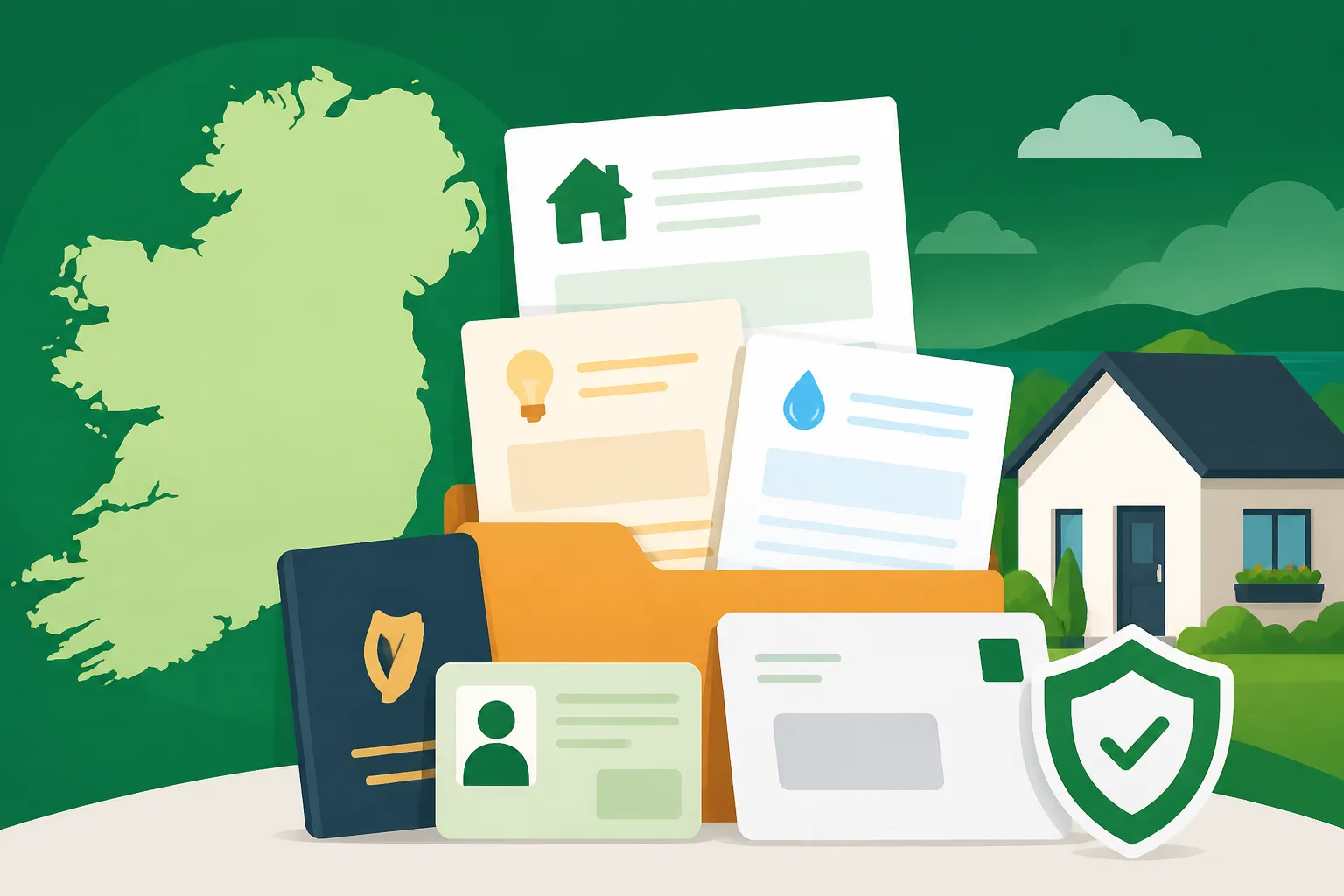
When an Irish institution asks for proof of address, their mind almost always jumps to a utility bill. These include:
- Electricity Bills: From providers like ESB Networks or Electric Ireland.
- Gas Bills: From companies such as Bord Gáis Energy or Flogas.
- Broadband/Landline Bills: From providers like Eir, Virgin Media, or Vodafone.
The key here is that the bill must be in your name and show your Irish residential address. It also needs to be recent, typically issued within the last three to six months. A digital bill printed out is usually acceptable, but some old-school places might still prefer an original paper statement.
Similarly, Irish bank statements are highly regarded. Once you manage to open an account (a challenge in itself, I know!), the monthly statements, either physical or digital, become excellent proof. Again, they need to be recent – usually within the last six months. While some institutions might accept a foreign bank statement, especially if you're very new to Ireland, it's often preferred that it’s an Irish one, and sometimes a certified translation is required if it's not in English.
Official Letters from Government Bodies and Employers
Beyond utilities and bank statements, official correspondence from recognised bodies also serves as strong proof. These documents demonstrate that an official entity acknowledges your address.
- Revenue Letters: Any official correspondence from Revenue, such as your Statement of Liability (P21) or a tax credit certificate, which clearly shows your name and address, is usually accepted. This is why getting your How to Register for Tax and Get a PPS Number in Ireland sorted early is so crucial.
- PPSN Letter: The letter confirming your PPSN assignment, if it has your address printed on it, can be a useful document, especially for initial registrations.
- Employer Letters: An official letter from your employer, printed on company letterhead, explicitly stating your full name, your residential address in Ireland, and dated, can often be used. It should ideally confirm your employment and that the address provided is your current residence. This can be a lifesaver for new arrivals who haven’t had time to build up other forms of proof.
- Immigration Service Delivery (ISD) Letters: Any official letters from ISD related to your visa, immigration permission, or IRP card renewal, which clearly display your residential address, are usually accepted as proof.
Tenancy Agreements and Property Documents
Your actual living arrangement documentation is, unsurprisingly, often excellent proof of address.
- Residential Tenancy Board (RTB) Registration Proof: If your tenancy is registered with the RTB (and it should be!), a copy of the RTB registration details, showing your name and address, is a solid document. For more details on this, check out How to Sign a Tenancy Agreement and Register with the RTB in Ireland.
- Signed Lease Agreement: A formal tenancy agreement or lease, signed by both you and your landlord, clearly stating your full name, the property address, and the lease start date, is usually accepted. Ensure it’s a reasonably long-term agreement; very short-term holiday lets are generally not.
- Mortgage Statements: For those lucky enough to buy property in Ireland, your annual or quarterly mortgage statement from your lender will serve as robust proof of address.
Navigating Tricky Situations and Alternative Proofs
The reality for many expats, especially when they first land, is that they won’t have the perfectly aged utility bill or the pristine bank statement. Ireland's rental crisis and the delay in setting up accounts can put you in a tough spot. But don't despair – there are ways to navigate these initial challenges.
When You're a Newcomer with No Bills Yet
This is where the infamous "Catch-22" really bites. You need an address to get a bank account, but you need a bank account (or utility bill) to prove your address. It’s enough to make you want to pull your hair out! However, there are a few options you can try:
- Letter from Your Host/Accommodation Provider: If you’re staying with friends, family, or in temporary accommodation, an official letter from them can sometimes work. This letter should state that you reside at their address, include their name and contact details, and ideally be accompanied by their proof of address (like their utility bill). It’s not universally accepted, but it’s worth a try for initial steps like opening a digital bank account or getting your PPSN.
- Short-Term Rental Bookings: For a few administrative tasks, like an initial IRP card registration appointment, a confirmed booking for a hotel, B&B, or even a long-term Airbnb stay might be accepted as temporary proof of residence. However, this is usually only for the very short term and for specific purposes.
- Employer Letter with Accommodation Details: As mentioned before, an official letter from your employer on company letterhead, explicitly stating your residential address, is a strong alternative. If your employer helped you arrange accommodation, they might be willing to include those details.
- Digital Banks: Services like Revolut or N26 can be absolute lifesavers for new arrivals. While they are still banks and will require identity verification, their processes for proving residence are often less stringent initially. You might be able to open an account and receive a statement with an address that other traditional banks won't accept, which then becomes your initial proof to use elsewhere. I know many expats who used a Revolut statement to finally get their foot in the door at a traditional Irish bank.
Shared Accommodation and Subletting Challenges
Living in shared accommodation is common in Ireland, but it can complicate proving your address if the utility bills aren't in your name.
- Letter from Primary Tenant: If you're sharing and the utilities are in your housemate's name, they can write a letter confirming you reside at the property. This letter should be dated, signed by them, and crucially, accompanied by their own proof of address (e.g., a recent utility bill in their name for that property) and perhaps a copy of their ID.
- Utility Bills with Multiple Names: Some utility providers allow for multiple names on an account. If you can get your name added, even as a secondary account holder, this will generate a bill that directly proves your residency. It’s worth checking with the provider to see if this is an option.
- Formalising Arrangements: While often done informally, if you're subletting, try to get a formal agreement from the primary tenant and, ideally, their landlord. A formal agreement, even for a sublet, can carry more weight than a casual arrangement. Always ensure you are on the up-and-up with the terms of the main lease – you don't want to fall foul of your landlord or the Understanding the Irish Rental Market and the Housing Shortage (2027).
Best Practices for Presenting Your Proof of Residency
After all the hassle of obtaining these documents, how you present them can make a big difference. Believe me, you don't want to be turned away because you forgot a copy or brought the wrong type.
Always Have Multiple Options Ready
My best advice as a seasoned expat is to always have at least two, preferably three, different types of proof of address ready to go. And make sure they're all recent! Keep both digital copies (scanned PDFs) and physical copies handy.
For instance, if you're going to a bank appointment, bring:
- A recent utility bill in your name (like an electricity bill or How to Set Up Electricity and Gas in Your Irish Home).
- A recent bank statement from another Irish bank (if you have one) or a digital bank like Revolut/N26.
- An official letter from Revenue or your employer confirming your address.
This "belt and braces" approach minimises the chances of being told, "Sorry, that's not quite what we need." Having multiple, varied documents shows that you are indeed established at that address, even if one specific document isn't deemed sufficient. When dealing with healthcare providers, for example, registering with a GP might accept one form of proof, but claiming certain benefits through the HSE might require another. Even understanding what private health insurance covers with providers like Cigna Global might require confirming your Irish address for policy administration, though not for healthcare access directly.
Understand the Specific Requirements of Each Institution
This is probably the most frustrating part: there's no single, universally accepted list of "proof of address" documents across Ireland. Each institution – banks, government departments, medical practices, car insurance companies – will have its own slightly different set of criteria.
Before you head out to an appointment or send off an application, do yourself a huge favour and check their specific requirements. Most will have a list on their website, or you can call ahead.
Ask:
- What specific documents do they accept?
- How recent do they need to be (e.g., within 3, 4, or 6 months)?
- Do they accept digital printouts, or do they require an original paper copy?
- Do they need one document or two? If two, do they need to be from different categories (e.g., one utility, one bank)?
Being prepared for the specific asks of, say, opening an account at Bank of Ireland versus Ulster Bank, or registering for a library card versus applying for a visa renewal, will save you immense time and stress.
Here’s a quick overview of common institutions and their typical document preferences:
| Institution/Service | Primary Preferred Proofs (Typically 1-2 needed) | Alternative/Secondary Proofs (May be accepted or required in addition) | Recency Requirement |
|---|---|---|---|
| Irish Bank Account | Utility bill (electricity, gas, broadband), Irish bank statement (from another bank) | Official government letter (Revenue/ISD), signed tenancy agreement, employer letter (on letterhead) | 3-6 months |
| Registering with a GP | Utility bill, bank statement, official government letter (PPSN, Revenue) | Signed tenancy agreement, employer letter | 3-6 months |
| Immigration (IRP Card Renewal) | Utility bill, bank statement, signed tenancy agreement, official ISD letters | Employer letter, Revenue correspondence (e.g., Statement of Liability) | Varies, usually within 6 months |
| Driver's Licence Exchange | Utility bill, bank statement, official government letter (PPSN, Revenue) | Tenancy agreement, car insurance policy document | 6 months |
| Car Insurance | Utility bill, bank statement, driver's licence (if it has address) | Tenancy agreement, mortgage statement, official government letter | 3-6 months |
| Setting Up Utilities | Signed tenancy agreement, mortgage statement, proof of property ownership | Passport/ID with current address, letter from solicitor (for property purchase) | Varies |
| Revenue (Tax Registration) | Utility bill, bank statement, tenancy agreement | Passport/ID, PPSN letter (if issued to current address) | 3-6 months |
Remember, this table is a general guide. Always verify with the specific body you're dealing with. The effort you put into understanding their exact requirements will save you countless headaches and repeated trips back and forth. You've got this, but a bit of planning goes a very long way!
Disclaimer
The information provided in this guide is for general informational purposes only and does not constitute legal or financial advice. While we strive to keep the information up-to-date and accurate, regulations and requirements in Ireland can change. Always consult official government websites, relevant authorities, or professional advisors for the most current and specific advice pertaining to your individual circumstances.