How Much Does an Ambulance Cost in Ireland?
One of the many worries that can plague you as an expat in a new country is the thought of a medical emergency. What happens if you suddenly need an ambulance? Beyond the immediate fear for your health, the practical question often rears its head: "How much is this going to cost me?" It's a valid concern, and navigating the Irish healthcare system, especially in a crisis, can feel like trying to solve a Rubik's Cube in the dark. This guide aims to shed some light on ambulance costs in Ireland, so you can breathe a little easier knowing what to expect.
Understanding Emergency Medical Services in Ireland
When you first move to Ireland, the healthcare system can feel like a labyrinth of public and private options, cards, and charges. Emergency services are no exception, and knowing how they operate is your first line of defense against both medical and financial stress.
When to Call an Ambulance and When Not To
In Ireland, just like in many other countries, the emergency services are there for genuine life-threatening situations. This might sound obvious, but it's crucial to understand the distinction. You call an ambulance for things like:
- Chest pain or suspected heart attack: Think crushing pain, pain spreading to the arm, shortness of breath.
- Stroke symptoms: Sudden weakness on one side, difficulty speaking, facial drooping (remember FAST: Face, Arm, Speech, Time to call 999/112).
- Severe bleeding that can't be stopped.
- Serious head injuries or loss of consciousness.
- Breathing difficulties, severe asthma attacks.
- Major trauma, like from a car accident or a fall from a height.
- Serious allergic reactions (anaphylaxis).
For less severe issues – a bad cold, a sprained ankle where you can still walk, or a persistent cough – calling an ambulance isn't the appropriate course of action. In these cases, you should contact your General Practitioner (GP), go to an Urgent Care Centre if one is available nearby, or even visit a local pharmacy for advice. Over-relying on ambulances for non-emergencies can delay response times for those truly in critical need, and frankly, it's not what they're for.
The emergency numbers in Ireland are 112 and 999. Both connect you to the same emergency services operator who will then route your call to ambulance, Gardaí (police), or fire services as needed. It's good practice to have these numbers saved, but honestly, in a real panic, you'll probably just dial. Knowing that you have options beyond an ambulance, particularly for non-life-threatening incidents, can save you a lot of worry and, indeed, potential cost. For a deeper dive into what constitutes an emergency and how to react, you might find our article on Emergency Medical Care in Ireland: What Every Expat Needs to Know incredibly helpful.
The Role of the HSE National Ambulance Service
The Health Service Executive (HSE) is the publicly funded healthcare system in Ireland. Their National Ambulance Service (NAS) is the primary provider of emergency ambulance services across the country. These are the ambulances you typically see on the road, lights flashing, sirens blaring.
The NAS is staffed by highly trained paramedics and advanced paramedics who are equipped to provide immediate life-saving care at the scene and during transport to a hospital. They operate 24/7, covering every corner of Ireland. When you call 112 or 999 for a medical emergency, it's generally the HSE NAS that will respond.
It's important to understand that the HSE NAS is part of the public health system. This means their services, while not "free" in all circumstances, are heavily subsidised compared to private options you might find in some other countries. Unlike in some places where private ambulance companies dominate, the HSE is the backbone of Ireland's emergency pre-hospital care. This distinction is crucial because the charges, which we'll get into, are largely tied to the public system. For a broader understanding of how the entire system is structured, our guide on How Ireland's Health System Works: The HSE vs Private Explained (2027) offers a complete overview.
The Actual Cost of an Ambulance in Ireland
Alright, let's get down to brass tacks: what's the damage? This is often the question expats dread asking, fearing an astronomical bill. Thankfully, in Ireland, for a public ambulance, it's generally not as terrifying as it might be in some other countries, but there are important details to grasp.
Public Ambulances: Fees and Charges
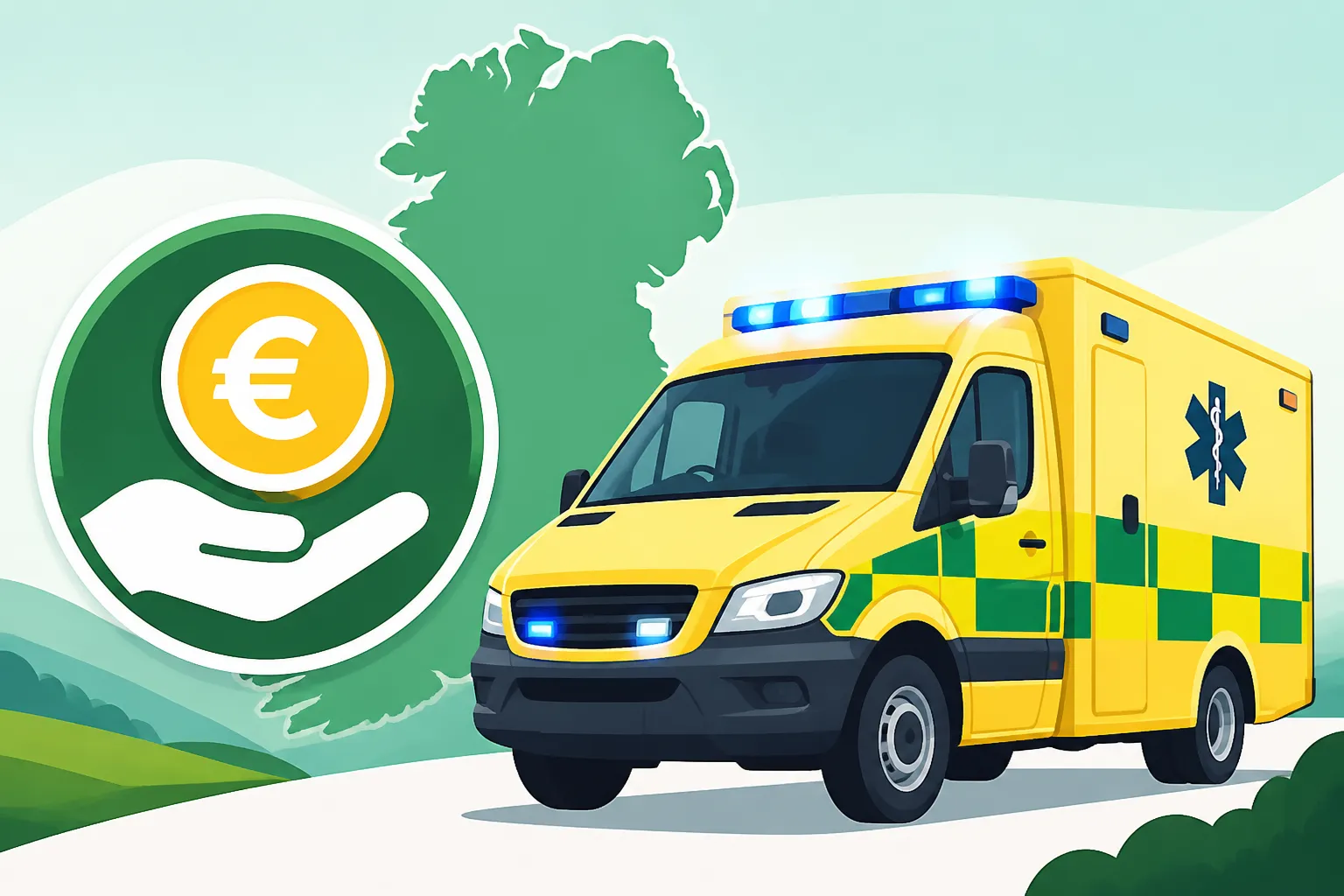
The standard charge for an ambulance service provided by the HSE National Ambulance Service (NAS) in Ireland is currently €100. This fee is specifically for transport to an Accident & Emergency (A&E) department of a public hospital.
Now, let's break down what that means:
- You're only charged if you are transported: If an ambulance crew arrives, assesses you, and determines you don't need hospital transport – perhaps they treat you on the scene, or advise you to see your GP – you generally won't be charged the €100 ambulance fee. The fee is tied to the act of transporting you to an A&E.
- The €100 often covers the A&E charge too: This is a key point that often confuses people. If you are brought to a public hospital A&E by a HSE ambulance and are charged the €100 ambulance fee, you generally won't then be hit with the separate €100 A&E attendance charge. It's often consolidated. So, even though it feels like two separate services, the bill for both tends to cap at €100 in many situations. However, if you walk into A&E yourself, you would pay a separate €100 A&E charge, unless you're exempt (which we'll cover shortly).
- Transfers between hospitals: If you're already an inpatient in one hospital and are transferred by HSE ambulance to another public hospital for specialised treatment, you are typically not charged for this transfer. The charge applies to initial transport to an A&E.
So, while it's not "free" for everyone, €100 for emergency ambulance transport and A&E access is considerably less than what you might face in countries with entirely privatised emergency services. This is a common relief for many expats who move from systems where an ambulance ride can cost thousands.
Private Ambulances: What to Expect
While the HSE NAS handles the vast majority of emergency calls, there are some private ambulance services operating in Ireland. However, these are typically used for:
- Non-emergency patient transfers: For example, transporting a patient from a nursing home to a hospital appointment, or between private hospitals.
- Event medical cover: Providing medical teams and ambulances at concerts, sporting events, or festivals.
- Repatriation services: Moving patients across international borders.
It's quite rare for a private ambulance to respond to a 112/999 emergency call. If you explicitly call a private service yourself for an emergency (which isn't the typical route), the costs would be significantly higher than the HSE's €100 charge and could run into hundreds, if not thousands, of euros, depending on the service provided, distance, and level of care required. Most private health insurance plans in Ireland would have very specific (and often limited) coverage for private ambulance services, so always check your policy.
For most expats, particularly in an unexpected, acute emergency, your interaction will be with the HSE National Ambulance Service. This means the €100 fee is the figure you should keep in mind.
Factors Influencing the Final Bill
While the standard HSE ambulance fee is €100, a few factors can influence whether you pay this, or potentially nothing at all.
- Medical Card holders: If you hold a valid Medical Card, you are exempt from the €100 ambulance charge. Your healthcare costs, including emergency ambulance services, are covered by the state. This is a huge relief for those who qualify. Our comprehensive guide on The Expat Guide to the Medical Card and GP Visit Card in Ireland (2027) explains eligibility and benefits in detail.
- GP Visit Card holders: Unfortunately, a GP Visit Card does not exempt you from the €100 ambulance or A&E charge. It only covers the cost of seeing a GP.
- Private Health Insurance: Most private health insurance policies in Ireland (from providers like VHI, Laya Healthcare, and Irish Life Health) do not directly cover the €100 HSE ambulance charge. This charge is considered an "excess" or a standard public health system charge that you would typically pay out of pocket. However, if your medical emergency leads to hospital admission and you opt to be treated privately within a public hospital or are transferred to a private hospital, your private insurance would then kick in for the subsequent hospital costs. It's always a good idea to thoroughly understand your specific policy's terms regarding emergency services. You can get a lot more information on this in our guide, Health Insurance in Ireland: VHI, Laya, Irish Life and Options Explained.
- EHIC (European Health Insurance Card): If you are an EU/EEA or Swiss citizen and have a valid EHIC from your home country, you are entitled to receive state-provided healthcare in Ireland on the same terms as an Irish resident. This means you would also be subject to the €100 ambulance charge, unless you are otherwise exempt (e.g., if you also held an Irish Medical Card). The EHIC isn't a substitute for travel insurance for non-EU citizens, and even for EU citizens, it's not a private insurance policy.
- Tourists and Non-EU Visitors: If you are visiting Ireland from outside the EU/EEA and don't have private travel health insurance, you will be liable for the €100 ambulance charge if transported to a public A&E. You'll also be responsible for all subsequent hospital costs. This is where comprehensive travel insurance, perhaps from a provider like SafetyWing, becomes absolutely vital. While SafetyWing primarily focuses on travel and nomad insurance, it’s designed to cover unexpected medical emergencies that could arise during your travels, including ambulance services, which could be a significant financial relief for short-term visitors or new arrivals waiting for their Irish health coverage to kick in.
In summary, the most common scenario for an expat needing an ambulance in a true emergency is a €100 charge, unless you have a Medical Card.
Navigating Payment and Potential Relief
Getting an ambulance bill can be unsettling, especially when you're still recovering or dealing with the aftermath of an emergency. But don't panic! The Irish system has mechanisms in place to manage these charges.
The Impact of Medical Cards and GP Visit Cards
Let's reiterate, because it's a critical point for many:
- Medical Card: If you are a Medical Card holder, you are completely exempt from the €100 ambulance charge and the €100 A&E attendance charge. This card truly is a lifesaver, covering most public health services for those who qualify based on a means test. If you are eligible, it's worth the effort to apply. It makes a significant difference to your financial peace of mind when it comes to healthcare in Ireland.
- GP Visit Card: While fantastic for covering your GP visits, a GP Visit Card does not extend to covering ambulance or A&E charges. You would still be liable for the €100 fee.
This distinction highlights the importance of understanding the benefits of each card if you are eligible. Many expats might initially assume any state-issued health card covers all state services, but that's not quite how it works in Ireland.
How Private Health Insurance Helps
This is where it gets a little nuanced. As mentioned, the €100 HSE ambulance charge is typically not covered by standard private health insurance policies from VHI, Laya, or Irish Life Health. Think of it as a basic public access fee that even those with private insurance usually pay.
However, your private health insurance becomes incredibly important for what happens after the ambulance ride. If you are admitted to a hospital and choose to be treated as a private patient in a public hospital, or if you are transferred to a private hospital (like the Mater Private, Beacon Hospital, or Blackrock Clinic), your private health insurance will then cover a significant portion, or all, of your hospital costs, depending on your plan. This can include:
- Consultant fees
- Hospital accommodation (private or semi-private rooms)
- Diagnostic tests (MRIs, CT scans)
- Surgical procedures
So, while it doesn't usually erase the €100 ambulance fee, private health insurance is absolutely essential for mitigating the potentially much higher costs of subsequent hospital treatment. It allows you to access faster treatment, choose consultants, and have more comfortable facilities, especially considering how long waiting lists can be in the public system for non-emergency care. For expats, having good private health insurance is often a non-negotiable for peace of mind.
For those just arriving or on a temporary stay, travel insurance like SafetyWing can fill a crucial gap. It’s designed to cover emergency medical expenses, including ambulance transport, up to certain limits while you’re abroad, which can be invaluable before you establish residency and secure comprehensive Irish health insurance. Always check the specific terms and conditions of any travel insurance policy for ambulance coverage limits.
Dealing with the Bill: Payment Options and Waivers
If you receive an ambulance bill, don't ignore it. The HSE will send an invoice to your address. The invoice will clearly outline the €100 charge.
- Payment options: The bill will usually provide instructions on how to pay, which can include online payment, bank transfer, or by post.
- Payment plans: If you are facing financial hardship, you can contact the hospital's billing department (as the ambulance charge is often linked to the hospital visit) or the HSE directly. They may be able to arrange a payment plan or discuss potential waivers depending on your circumstances. It's always better to communicate with them than to let the bill go unpaid.
- Complaints and queries: If you believe you have been incorrectly charged (e.g., you are a Medical Card holder but were still billed), you should contact the hospital's billing department or the HSE patient advocacy service to resolve the issue. Keep all documentation, including your Medical Card details, handy.
Remember, the Irish public health system aims to provide care first and foremost. While charges exist, they are generally manageable compared to some other countries, and there are avenues for discussion if you are genuinely struggling to pay.
Practical Advice for Expats on Ambulance Costs
Moving to a new country like Ireland means wrapping your head around a whole new set of rules, particularly when it comes to something as vital as healthcare. Here’s some practical advice to help you navigate ambulance costs and emergency care effectively.
Essential Tips for New Arrivals
When you first land in Ireland, everything feels new, and healthcare might not be your top priority amidst finding accommodation and setting up your bank account. But a little preparation goes a long way.
- Get your PPS Number ASAP: This Personal Public Service (PPS) number is fundamental to accessing many public services, including healthcare entitlements like the Medical Card, if you qualify. You can't even apply for certain health cards without it. Our guide on How to Register for Tax and Get a PPS Number in Ireland is a great starting point.
- Register with a GP: Even if you feel perfectly healthy, register with a local GP as soon as possible. This is your primary point of contact for non-emergency medical issues and essential for continuity of care. It also means you have a doctor who knows your history, should you need one. You can read more about this process in our article, How to Register with a GP (Family Doctor) in Ireland.
- Understand your insurance options: Whether you're coming from the EU with an EHIC, relying on travel insurance like SafetyWing for the initial period, or looking to purchase private health insurance, know exactly what your coverage entails. Don't assume anything. Many expats get caught out by unforeseen medical costs because they didn't fully grasp their policy.
- Save emergency numbers: While 112/999 is easy to remember, also have your GP's number, your insurance provider's emergency line, and a trusted contact person's number readily available.
Preparing for the Unexpected
Life has a way of throwing curveballs, and medical emergencies are definitely in that category. Being prepared isn't about being paranoid; it's about being pragmatic.
- Invest in good private health insurance (if you can): While it might not cover the €100 ambulance fee, private health insurance is invaluable for accessing specialist care, avoiding long public waiting lists, and ensuring you have options for comfortable hospital stays. It's a significant investment, but for many expats, the peace of mind it offers is worth every penny. Explore options from providers like VHI, Laya Healthcare, and Irish Life Health to find a plan that suits your needs and budget. Our article, How to Buy Private Health Insurance as a Newcomer in Ireland, can guide you through the process.
- Keep emergency information handy: Create a small card or a note on your phone with essential medical information: your blood type (if you know it), any allergies, current medications, existing medical conditions, and emergency contact details. This can be crucial if you're unable to communicate in an emergency.
- Learn basic first aid: Knowing how to perform CPR or handle choking can make a difference in those critical first few minutes before an ambulance arrives.
- Understand how the overall system works: The more you educate yourself about Navigating the Irish Healthcare System: An Expat's Roadmap (2027), the less daunting it will seem when you actually need to use it. Knowing the difference between A&E, Urgent Care, and your GP is fundamental.
Being an expat in Ireland is an incredible experience, but it comes with its unique set of challenges. By understanding the practicalities of emergency services and ambulance costs, you can remove one significant source of anxiety and focus on enjoying your new life here.
Ambulance Costs and Coverage in Ireland: A Quick Overview
| Service / Scenario | Standard HSE Ambulance Charge | Medical Card Holder | Private Health Insurance (VHI, Laya, Irish Life) | Travel Insurance (e.g., SafetyWing) | Notes |
|---|---|---|---|---|---|
| Emergency Ambulance | €100 (for transport to A&E) | Covered (No Charge) | Generally NOT covered directly | Often covered for emergencies | Charge applies only if transported to a public A&E. Often includes the A&E attendance fee. |
| A&E Attendance | €100 (if self-presenting) | Covered (No Charge) | May cover some A&E charges if admitted privately | Varies, check policy | If brought by HSE ambulance and pay the €100 ambulance fee, usually no separate A&E fee. If you walk in, the €100 A&E charge applies (unless exempt). For more, see How Much Does an A&E Visit Cost in Ireland?. |
| Inpatient Hospital Stay | Not applicable | Covered (No Charge) | Varies greatly by plan, often covers most costs | Varies, check policy | For public patients, typically covered (some statutory charges may apply). Private insurance is key for private care (consultants, rooms) in public or private hospitals. |
| Inter-Hospital Transfer | Usually no charge | Covered (No Charge) | Not applicable | Not applicable | For patients already admitted to a public hospital being transferred to another public hospital. |
| Non-Emergency Transport | Varies, often private | Not typically covered (unless specific referral) | Varies, check policy for specific transfers | No | If you need transport but it's not a 999/112 emergency, you might need to arrange private transport at your own cost, which can be significantly more expensive than the HSE emergency ambulance. |
Disclaimer
The information provided in this article is intended for general guidance only and does not constitute professional medical, legal, or financial advice. Healthcare costs and policies in Ireland can change, and individual circumstances vary. Always consult with official HSE resources, your specific insurance provider, or a qualified professional for the most accurate and up-to-date information regarding your personal situation.