How Ireland’s Health System Works: The HSE vs Private Explained (2027)
The most jarring realization for any new arrival in Ireland is that the healthcare system is neither a fully free service like the UK’s NHS nor a completely private model like in the United States. It is a complex, two-tier hybrid where even public patients often pay out-of-pocket for basic care. This guide demystifies the relationship between the HSE and private providers to ensure you receive the care you need without unnecessary delays or unexpected costs.
Understanding the Dual System Public vs Private
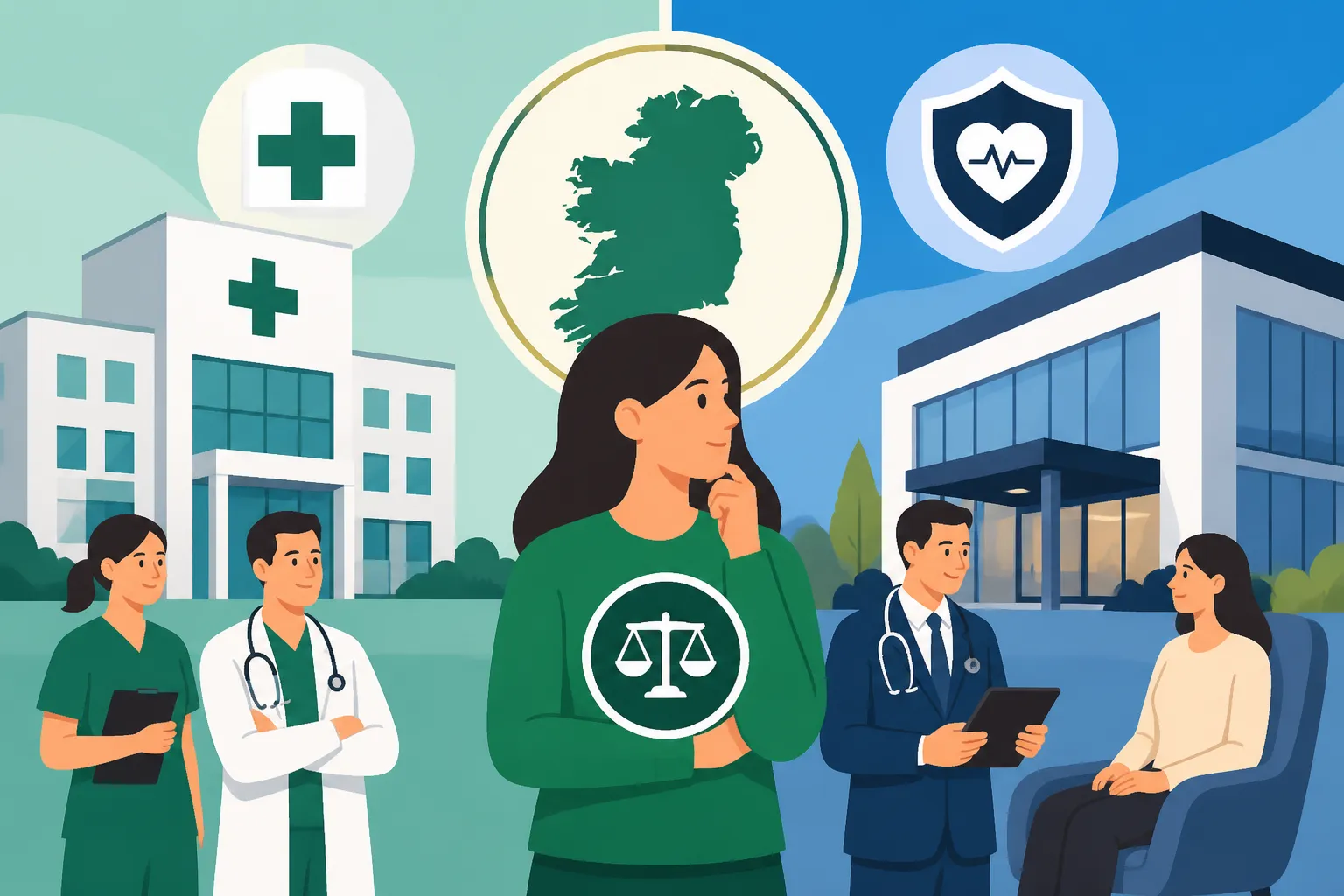
The Irish healthcare system is famously described as a two-tier system. This means that both public and private healthcare services operate side by side, often within the very same hospital buildings. As an expat, understanding this overlap is the key to navigating the system effectively. You aren't strictly "in" one or the other; many residents use a mix of both depending on the urgency and nature of their medical needs.
The Health Service Executive HSE Ireland Public Spine
The Health Service Executive, commonly known as the HSE, is the government body responsible for providing all public health and social services in Ireland. If you are living in Ireland and meet the criteria for being "ordinarily resident," you are entitled to a wide range of services through the HSE. However, "entitled" does not always mean "free." Unlike systems where taxes cover everything at the point of use, the HSE often requires co-payments for GP visits, emergency room attendance, and prescriptions unless you hold a specific low-income card.
The public system is designed to be a safety net. It provides excellent care for emergency situations and chronic illnesses. If you are in a major car accident or suffer a sudden cardiac event, the public system will provide world-class acute care. The struggle within the HSE typically lies in elective or non-life-threatening procedures, where wait times can be significant. For a deeper dive into these nuances, you might want to read The Complete Guide to Healthcare in Ireland for Expats (2027) to see how the administrative side of the HSE functions for newcomers.
The Private Healthcare Sector Why It Exists
Private healthcare in Ireland exists primarily to offer faster access to consultants and elective surgeries. It is managed by private insurance companies and private hospital groups like the Mater Private or the Blackrock Clinic. About 40% of the Irish population carries some form of private health insurance, not because the public care is medically inferior, but because the public waiting lists are notoriously long. Private care allows you to bypass these queues for things like hip replacements, dermatological consultations, or specialized diagnostic imaging.
For expats, the private sector often feels more familiar. You get choice over your consultant, a private or semi-private room in a hospital, and significantly shorter wait times for outpatient appointments. Many international workers find that while they are waiting for their local PPS number and HSE registration to settle, having a global plan like SafetyWing can provide necessary peace of mind, especially if they are moving between countries or haven't yet committed to a long-term Irish private insurance provider.
How the Two Interact and Overlap
The most confusing part of the Irish system is that private care often happens inside public hospitals. Many consultants working in the public HSE system are also permitted to see private patients. This means you could be lying in a ward in a public hospital, but because you are a private patient, you have a different billing structure and perhaps a slightly faster track to your procedure.
This hybridity means that even if you have the best private insurance, you may still find yourself in a public Accident & Emergency (A&E) department because private hospitals in Ireland do not always have 24/7 emergency facilities. Understanding this overlap is vital when you are deciding Public vs Private Healthcare in Ireland: Which Should Expats Choose? for your family's specific needs. You are essentially paying for "queue-jumping" privileges and comfort, rather than a completely separate medical infrastructure.
Eligibility and the Concept of Ordinary Residence
One of the first hurdles you will face when dealing with the Irish health system is proving your right to access it. Eligibility for public health services in Ireland is not based on your nationality or whether you have paid taxes (PRSI) in Ireland. Instead, it is based on a concept called "Ordinary Residence." This is a frequent point of frustration for expats who assume their work permit automatically grants them full, free medical access.
What is Ordinary Residence
To be considered "ordinarily resident," you must be able to prove to the HSE that you intend to live in Ireland for at least one year. This isn't just a verbal promise; you will often need to provide a lease agreement, a contract of employment, or evidence of your children being enrolled in a local school. Once you are deemed ordinarily resident, you are entitled to the same public healthcare services as an Irish citizen.
If you have just arrived and cannot yet prove your one-year intention, you may be treated as a private patient, which means you could be charged the full economic cost of any hospital stay. This is another scenario where having a flexible insurance option like SafetyWing is highly beneficial, as it can cover you during those first few months while you are gathering the paperwork to satisfy the HSE’s residency requirements.
The Medical Card vs GP Visit Card
Even if you are ordinarily resident, you will generally have to pay for your own GP visits and medications unless you qualify for a Medical Card or a GP Visit Card. These are means-tested cards issued by the HSE to people whose income falls below a certain threshold. A Medical Card covers almost everything—GP visits, hospital stays, and most medications—for a very small nominal charge per item. A GP Visit Card only covers the cost of seeing the doctor, but you still pay for your own prescriptions.
For most working expats, your income will likely be too high to qualify for a full Medical Card. However, the government has recently expanded the income limits for the GP Visit Card, so it is always worth checking your eligibility. If you are unsure about the application process, refer to The Expat Guide to the Medical Card and GP Visit Card in Ireland (2027) for a step-by-step walkthrough of the means test and the online application portal.
Entitlements for Non-EU/EEA Nationals
If you are moving to Ireland from outside the EU/EEA (for example, from the US, Canada, or Australia), your visa requirements might actually mandate that you have private health insurance before you even arrive. For Stamp 0 or certain student visas, proof of private coverage is a prerequisite. It is important to note that even with this insurance, you are still eligible for HSE services once you meet the ordinary residence rule, but your insurance will likely be the primary way you interact with the system to avoid the public wait times.
It is also worth noting that the "one-year rule" is applied strictly. If you are on a short-term contract of six months, the HSE may categorize you as a "temporary visitor," which carries different (and often higher) cost implications for hospital care. Always keep a file of your residence documents, such as utility bills and your IRP card, as you will need these every time you register with a new medical provider or apply for health-related benefits.
Navigating Primary Care Your First Point of Contact
In Ireland, the General Practitioner (GP) is the gatekeeper to the entire healthcare system. You cannot simply walk into a hospital to see a specialist or get a non-emergency blood test; you must be referred by a GP. For many expats, the biggest shock is that GPs are private businesses. They are not government employees, even though they treat public patients on behalf of the HSE.
Finding and Registering with a GP
The "GP crisis" is a term you will hear often in Irish media. In many parts of the country, particularly in Dublin, Cork, and Galway, GP practices are at full capacity and are not taking new patients. This can be incredibly stressful for a newcomer who just needs a repeat prescription or has a sick child. My advice is to start calling every practice within a 5-mile radius the moment you have a permanent address.
When you find a doctor, you don't "register" in the way you might in other countries where you are officially assigned to a clinic. You simply become a patient of that practice. If you have a GP Visit Card or Medical Card, the process is slightly more formal as the doctor must agree to take you on as a GMS (General Medical Services) patient. For more practical tips on this, see Registering with a GP in Ireland: The Complete Expat Guide (2027).
GP Fees and the Pay-as-you-go Model
Unless you have one of the HSE cards mentioned earlier, you will pay for every single visit to the doctor. In 2026, the standard fee for a 15-minute consultation ranges between €60 and €80. Follow-up appointments or quick visits for results might be slightly cheaper, but the costs add up quickly. If you need a blood test, there is often an additional "phlebotomy fee" of €20 to €30 on top of the consultation price.
Many expats find this "pay-at-the-desk" culture surprising. Most GP practices accept card payments, but some older rural practices may still prefer cash. If you have private health insurance through an Irish provider, you might be able to claim a portion of these fees back (typically 50% depending on your plan), but you still have to pay the full amount upfront and submit your receipt later.
Prescriptions and the Drugs Payment Scheme
Once your GP gives you a prescription, you can take it to any pharmacy (locally called a chemist) in Ireland. If you do not have a Medical Card, you will pay the full retail price for your medication. However, Ireland has a fantastic safety net called the Drugs Payment Scheme (DPS). Under this scheme, no individual or family has to pay more than a set monthly cap (currently €80) for approved prescription medicines.
To benefit from this, you must apply for a DPS card. It is not means-tested; everyone who is ordinarily resident is entitled to it. Even if your monthly meds only cost €20, you should still have the card just in case you ever face a sudden, expensive medical requirement. Understanding how this works can save you hundreds of euros, so I highly recommend reading up on Understanding the Drugs Payment Scheme (DPS) in Ireland.
The Reality of Public Hospital Care and Waiting Lists
While the quality of medical staff in Irish public hospitals is exceptional, the infrastructure is under significant pressure. This is where the "two-tier" reality becomes most apparent. If you are a public patient, you are subject to the national waiting list system, which is managed by the National Treatment Purchase Fund (NTPF).
Inpatient vs Outpatient Services
It is important to distinguish between inpatient care (where you are admitted to a bed) and outpatient care (where you visit for a consultant appointment or a scan). If you are a public patient, outpatient appointments for specialists like neurologists or orthopedists can have waiting times of 12 to 24 months. This is the primary reason people buy private insurance; it reduces that wait to a matter of weeks.
Inpatient care is handled differently. If you need urgent surgery, you will be prioritized. However, if your surgery is "elective" (like a gallbladder removal or a cataract surgery), you might find your date being pushed back if the hospital becomes overcrowded with emergency cases. This unpredictability is a common frustration for those used to more streamlined systems.
Emergency Departments and the Famous Fee
If you find yourself at an Accident & Emergency (A&E) department in a public hospital, be prepared for two things: a long wait and a €100 bill. The A&E charge applies to everyone who does not have a Medical Card and who has not been referred by a GP. If your GP sees you first and writes a letter of referral, the €100 fee is waived. This is a crucial "pro-tip" for expats—always try to see a GP or an out-of-hours doctor (like D-Doc or South-Doc) before heading to the hospital unless it is a life-threatening emergency.
The wait times in A&E can be upwards of 10 to 12 hours during peak times (winter months or weekends). You will be triaged based on severity, not on the time you arrived. If you have private insurance, you might still end up in a public A&E, but once you are admitted, your insurance might allow you to be transferred to a private facility or a semi-private ward. For a detailed breakdown of these costs, check Understanding Public Hospital Charges and the A&E Fee in Ireland.
The Chronic Issue of Public Waiting Lists
The waiting list issue is the "elephant in the room" of Irish healthcare. Hundreds of thousands of people are on various lists for scans and procedures. The government occasionally "buys" space in private hospitals to clear these lists, but it remains a slow process. If you are an expat with a pre-existing condition that requires regular specialist monitoring, relying solely on the public system can be risky due to these delays.
This is where the value of private coverage, or even a robust international plan like SafetyWing for those in transition, becomes clear. Being able to book a private MRI for €250 and have the results in three days is often worth the expense compared to waiting six months for a "free" public scan.
Private Health Insurance Luxury or Necessity
In many countries, private insurance is a luxury for the wealthy. In Ireland, many middle-income families view it as a necessity due to the state of the public waiting lists. The market is highly regulated, which leads to some unique rules that expats need to be aware of, particularly regarding age and "loading."
The Main Players VHI Laya and Irish Life
There are three main providers of private health insurance in Ireland: VHI (which is semi-state owned), Laya Healthcare, and Irish Life Health. They all offer hundreds of different plans, which can make comparing them a nightmare. Generally, plans are divided into "corporate" style plans (which offer good day-to-day money back on GP visits) and "hospital" plans (which focus on covering the costs of private hospital stays).
When you are looking for How Much Does Private Health Insurance Cost in Ireland in 2026?, you will find that a basic adult plan starts at around €1,200 per year, while comprehensive plans can exceed €2,500. Most large multinational employers in Ireland provide health insurance as a benefit, but be careful: this is considered a "Benefit in Kind" (BIK), meaning you will be taxed on the value of the premium.
Understanding Lifetime Community Rating LCR
Ireland uses a "Community Rating" system, which means everyone pays the same price for the same plan, regardless of their age or health status. However, to encourage people to buy insurance early, there is a "Lifetime Community Rating" (LCR) loading. If you are aged 35 or older and you buy private health insurance in Ireland for the first time, you will pay a 2% loading on your premium for every year you are over age 34.
For expats, there is a "grace period." If you move to Ireland and buy insurance within nine months of arriving, you can often provide proof of previous coverage from your home country to waive this loading. This is a critical step; failing to do this could mean paying 20% or 30% more for your insurance for the rest of your life in Ireland.
Benefits of Private Care Speed and Selection
The primary benefit of private insurance is the ability to choose your consultant and the hospital where you are treated. Ireland has several world-class private hospitals that feel more like hotels than medical facilities. Beyond the comfort, the speed of access to diagnostic tools like CT scans, MRIs, and PET scans is the real winner. In the private system, these are usually available within days.
Furthermore, private insurance often includes "digital doctor" services, which allow you to have a video consultation with a GP for free. In a country where getting a physical GP appointment is difficult, this is an invaluable feature. If you are working remotely or are a digital nomad, you might find that services like SafetyWing offer similar telehealth benefits that bridge the gap between your home country and the Irish system.
Specialized Care Maternity Mental Health and Dental
Specialized care in Ireland follows the same public-private split, but with some notable exceptions, particularly in maternity services, which are quite robust and highly subsidized.
The HSE Maternity and Infant Care Scheme
Maternity care is one area where the Irish public system shines. Every resident is entitled to the Maternity and Infant Care Scheme, which provides a program of shared care between your GP and a hospital obstetrician. This service is free of charge. It covers your prenatal visits, the birth, and postnatal check-ups for both mother and baby.
However, even here, many choose the "Private" or "Semi-Private" route. Private maternity care means you see the same consultant at every visit and have a better chance of a private room after delivery. The fees for private maternity care can be substantial (often €3,000 to €5,000 on top of your insurance). If you are expecting, you should carefully weigh the options in How to Choose Between Public and Private Maternity Care in Ireland.
Accessing Mental Health Services
Mental health services in Ireland are primarily accessed through your GP. The public system (Child and Adolescent Mental Health Services – CAMHS and adult services) is unfortunately underfunded and has very long wait times for non-acute issues. Many people choose to see therapists or psychologists privately, where fees range from €60 to €150 per session.
Private health insurance plans have improved their mental health coverage in recent years, often covering a set number of counseling sessions or a stay in a private psychiatric facility like St. Patrick’s Hospital. However, for immediate, day-to-day support, many expats find they have to navigate the private market themselves to find a therapist with availability.
Dental and Optical Care under the PRSI Scheme
Dental and optical care are almost entirely private in Ireland. You will not find many "HSE dentists." However, if you are working and paying social insurance (PRSI), you are entitled to one free dental exam per year and a subsidized teeth cleaning. You are also entitled to a free eye test and a contribution toward glasses every two years.
For anything beyond a basic exam—like fillings, crowns, or braces—you will pay the full market rate. Dental costs in Ireland are high, leading many residents to travel to Northern Ireland or Eastern Europe for major work. To understand how to maximize your PRSI benefits, read Understanding Dental Care, the PRSI Scheme and Costs in Ireland.
Cost Breakdown What You Will Actually Spend in 2026
To help you budget for your move, here is a realistic look at the typical costs associated with healthcare in Ireland for a resident without a Medical Card.
| Service | Public (HSE) Cost | Private Cost (Without Insurance) |
|---|---|---|
| GP Consultation | €60 – €80 | Same |
| A&E Visit | €100 (Free with GP referral) | €200 – €500 (Private Urgent Care) |
| Overnight Hospital Stay | €80 per night (Capped at €800/yr) | €1,000 – €2,000+ per night |
| Specialist/Consultant Visit | Free (Wait 12-24 months) | €200 – €350 (Wait 2-4 weeks) |
| MRI Scan | Free (Wait 6 months) | €200 – €300 |
| Prescription Meds | Capped at €80/month (DPS) | Full Market Price |
Tax Relief on Medical Expenses
One silver lining to the high cost of Irish healthcare is that you can claim tax relief on almost all unreimbursed medical expenses. You can claim back 20% of the cost of GP visits, prescriptions, consultant fees, and non-routine dental work (like braces or root canals). You do this at the end of the year through the Revenue Commissioners' online portal (myAccount).
This 20% refund essentially means the government is subsidizing your private healthcare costs. It is vital to keep all your receipts—either physically or by scanning them into the Revenue receipts tracker app. For a full guide on how to get your money back, see How to Claim Tax Relief on Medical Expenses in Ireland.
Summary of the Expat Journey
Moving to Ireland involves an administrative dance with the HSE. You start by proving your residence, then you hunt for a GP, apply for your Drugs Payment Scheme card, and likely negotiate a health insurance plan with your employer. While the system can be frustratingly slow, the medical expertise available is world-class.
During your first few weeks, don't leave yourself exposed. Whether it's through a temporary policy like SafetyWing or a formal Irish plan, ensure you have coverage from day one. The "I'll be fine" attitude can lead to a €100 A&E bill or a €1,000 overnight stay charge if you haven't yet cleared the "ordinary residence" hurdle. Ireland is a beautiful place to live, and once you understand the "rules of the game" for healthcare, you can focus on enjoying your new life in the Emerald Isle.
Disclaimer
The information provided in this guide is for informational purposes only and does not constitute professional medical or legal advice. Healthcare regulations, costs, and eligibility criteria in Ireland are subject to change. Always consult with the Health Service Executive (HSE) or a qualified insurance professional for the most up-to-date information regarding your specific circumstances.