Understanding Emergency Numbers (112 and 999) and Ambulance Care in Ireland
Nothing triggers that cold prickle of panic quite like a medical emergency in a foreign country where you are still figuring out how to use the washing machine, let alone the healthcare system. This guide clarifies exactly how to use Ireland's emergency numbers, what to expect when an ambulance arrives, and how to navigate the logistical hurdles of emergency care as an expat or visitor.
Decoding Ireland's Primary Emergency Numbers
One of the first things you notice when moving to Ireland is the dual-system of emergency numbers. While many countries stick to just one, Ireland operates both 112 and 999. I remember when I first arrived, I spent far too much time wondering if one was "more urgent" than the other. The reality is simpler: they are effectively the same. Whether you are in the middle of O'Connell Street in Dublin or on a remote cliffside in Donegal, both numbers will connect you to the same Emergency Call Answering Service (ECAS).
112 vs. 999: Is There a Difference?
The number 112 is the European standard emergency number. It works in all EU member states and is a lifesaver for those who travel frequently across the continent. In Ireland, it was introduced alongside the traditional 999 to ensure that visitors from mainland Europe would always know how to get help. When you dial 112 from an Irish mobile or landline, the call is prioritized by the network. It is designed to work even if you have no credit on a prepaid SIM or if the phone is locked.
999 is the legacy number, shared with the United Kingdom and several other former Commonwealth nations. For many locals, it remains the instinctive number to dial. If you are an expat coming from the US or Canada, you might be used to 911, and while some modern Irish phone systems will actually re-route a 911 call to 112/999, you should never rely on that. Stick to 112 or 999 to ensure the fastest possible connection.
The Emergency Call Answering Service (ECAS)
When you dial either number, the first person you speak to is an operator from the ECAS. Their job is not to give medical advice but to filter your call. They will ask a very specific question: "Which service do you require?" You must specify whether you need the Gardaí (Police), Ambulance, Fire Brigade, or the Coast Guard. In some instances, if you are near a body of water or a mountain range, they might ask if you need Mountain Rescue.
It is vital to stay calm during this initial five-second interaction. If you are in a state of high distress, it can be easy to start explaining the medical problem immediately, but the ECAS operator needs to know the service first so they can "hand you off" to the professional dispatchers at the National Ambulance Service or the Dublin Fire Brigade. Once you say "Ambulance," you will hear a click or a brief silence as you are transferred. Do not hang up during this transition.
Calling from a Foreign SIM or Locked Phone
A common fear for newcomers is whether their foreign phone will work during a crisis. Under Irish and EU law, every mobile network provider must facilitate emergency calls regardless of whether the caller is a subscriber. Even if your home-country SIM card has no roaming agreement or you have run out of data, 112 will still work.
In fact, you don't even need to unlock your phone to dial 112. Most smartphones have an "Emergency" button on the lock screen. This is a critical feature to teach your children or anyone staying with you. If you are using a VoIP service like Skype or WhatsApp to make calls over Wi-Fi, be aware that these do not always provide accurate location data to the emergency services, so using a standard cellular connection is always preferred.
Navigating the Ambulance Service Hierarchy
Once you are transferred to the ambulance dispatcher, you aren't just dealing with a single national entity. Depending on where you are standing in Ireland, the people who show up might be from different organizations. This is one of those local quirks that often confuses expats, particularly those living in the capital.
National Ambulance Service (NAS) vs. Dublin Fire Brigade (DFB)
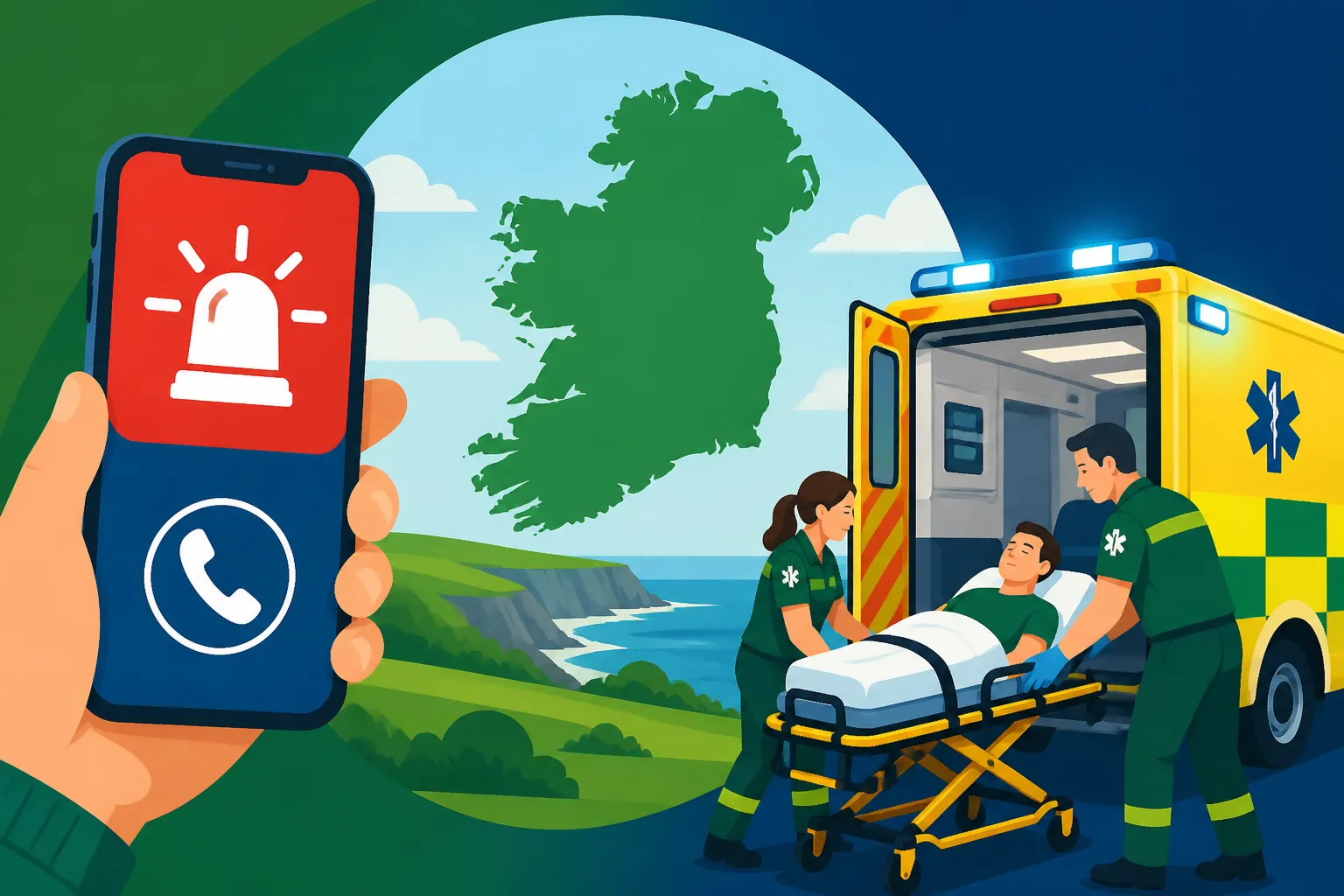
In most of Ireland—from Cork to Galway to Sligo—the National Ambulance Service (NAS) provides emergency medical care. They are operated by the HSE (Health Service Executive). You can recognize their vehicles by the bright yellow and green "Battenburg" markings and the NAS crest. They are highly trained professionals who operate out of regional hubs.
However, if you are in Dublin, the situation is different. The Dublin Fire Brigade (DFB) operates a large fleet of ambulances alongside their fire engines. Most DFB firefighters are also trained as Paramedics or Advanced Paramedics. This "integrated" model is unique to Dublin and often results in a fire engine arriving at a medical scene before the ambulance because the fire engine might be closer. Don't be alarmed if a massive red truck pulls up when you called for a heart attack; the personnel on board are fully equipped to begin life-saving treatment. If you want to know more about how this fits into the wider network, you should read our guide on Navigating the Irish Healthcare System: An Expat's Roadmap (2027).
Private Ambulance Services and Inter-Hospital Transfers
You will also see ambulances on Irish roads that belong to private companies like Lifeline, Medilink, or Murray’s. Generally, these are not dispatched via 112 or 999 for primary emergencies. Instead, they handle "inter-hospital transfers." For example, if a patient needs to be moved from a public hospital to a private facility for a specialized scan, a private ambulance is often used.
As an expat, you might occasionally see these private vehicles and wonder if you should call them directly. The answer is almost always no. In a true emergency, stick to the public system. If you have private insurance, your provider might eventually coordinate with these services for non-emergency transport, but that comes much later in the care cycle.
Rapid Response Vehicles and Advanced Paramedics
Sometimes, an ambulance is not the first thing to arrive. The NAS and DFB utilize "Rapid Response Vehicles" (RRVs)—usually SUVs or estate cars staffed by a single Advanced Paramedic. These units cannot transport patients to the hospital, but they can perform advanced procedures like intubation or administering certain high-level medications that a standard paramedic cannot.
The goal is to get "eyes on the patient" as quickly as possible. If an RRV arrives, they will stabilize you while waiting for a traditional ambulance to arrive for the "lift and shift" to the hospital. Understanding this helps manage expectations; just because a vehicle doesn't have a stretcher doesn't mean you aren't receiving top-tier emergency care. For a deeper look at what happens at the hospital stage, check out our article on Emergency Medical Care in Ireland: What Every Expat Needs to Know.
What Happens When You Dial? A Step-by-Step Scenario
The minutes between dialing the number and hearing the sirens can feel like hours. Knowing the protocol used by Irish dispatchers can significantly lower your blood pressure. They follow a strict script designed to extract the most important information first.
The Critical Questions the Dispatcher Will Ask
The very first thing they will ask for is your location. In Ireland, this is where things get tricky. While GPS technology is improving, the dispatcher will ask for your Eircode. If you are new to the country, you might not realize that the Eircode (Ireland's seven-character postal code system) is the single most important piece of information you can provide. Unlike street addresses, which can be duplicated or confusing in rural areas, an Eircode points to a specific front door.
After the location, they will ask for the phone number you are calling from (in case the call drops) and a brief description of what happened. Are they breathing? Are they conscious? Is there severe bleeding? Be prepared to answer these clearly. They are not "stalling" by asking these questions; while they talk to you, another dispatcher is already sending the nearest unit to your location.
Staying Calm Under Pressure: A Real-Life Example
Imagine you are an expat living in a picturesque cottage in West Cork. You are miles from the nearest town, and a family member suddenly collapses. When you call 112, you might feel the urge to give long-winded directions involving "the old oak tree" or "the pub that used to be a post office." The dispatcher will gently but firmly bring you back to the Eircode.
If you are a tourist or a digital nomad and don't have an Eircode, try to find a nearby landmark or use a tool like "What3Words" if you have it, though the official system relies heavily on the national mapping database. For those traveling, having a reliable insurance plan like SafetyWing can provide peace of mind, as they understand the complexities of international medical emergencies and can assist with the logistical fallout after the initial 999 call.
Clinical Status Assessment (Categorization)
Ireland uses a "triage" system for ambulance dispatch. Not every call results in a "lights and sirens" response. Calls are categorized based on clinical need:
- Purple/Red: Life-threatening emergencies (cardiac arrest, choking). These get the fastest response.
- Amber: Serious but not immediately life-threatening (broken bones, severe pain).
- Green: Non-urgent calls.
If the system is under heavy pressure—which, frankly, it often is in Ireland—you might find that a "Green" call results in a significant wait. This is a common point of frustration for foreigners who expect an immediate response for any emergency call. If the patient's condition worsens while you are waiting, you should call 112/999 back immediately to update the dispatcher, which may upgrade your category. This process is explained further in What Is the Emergency Phone Number in Ireland?
Financials and Logistics: The Cost of Emergencies
One of the biggest shocks for expats from countries with "free" healthcare (like the UK) or "fully private" healthcare (like the US) is how the billing works for emergency services in Ireland. It is a hybrid system that can be quite confusing if you aren't prepared.
Public Hospital Charges and the A&E Fee in Ireland
If you are brought to a public hospital's Accident & Emergency (A&E) department by an ambulance, you will generally be charged a flat fee of €100. This is not a charge for the ambulance itself, but for the A&E visit. However, if you have a GP referral letter, this fee is waived. Obviously, in a 999 situation, you usually don't have time to stop at a GP for a letter.
There are several categories of people who do not have to pay this fee. If you hold a Medical Card, you are exempt. To see if you qualify, read The Expat Guide to the Medical Card and GP Visit Card in Ireland (2027). Additionally, certain groups like people with specific infectious diseases or those receiving maternity care are exempt. If you are a visitor, you will almost certainly be charged this fee, and it is usually collected after your treatment via an invoice sent to your address.
| Service Type | Cost for Residents (No Medical Card) | Cost for Medical Card Holders | Cost for Non-EU Tourists |
|---|---|---|---|
| Emergency Ambulance | €0 (Usually covered by state) | €0 | €0 (Service is free, hospital is not) |
| A&E Attendance Fee | €100 | €0 | €100+ |
| Overnight Hospital Stay | €80 per night (capped at €800/yr) | €0 | Full economic cost (can be €1,000+) |
| GP Out-of-Hours | €60 – €80 | €0 | €60 – €80 |
Ambulance Charges for Tourists and Visitors
A common question is: "Do I have to pay for the ambulance ride itself?" In Ireland, the National Ambulance Service does not typically bill patients for the actual transport to a public hospital. This is a major relief for many, as ambulance bills in other countries can run into the thousands. The "cost" is essentially absorbed into the hospital treatment fees.
However, if you are a non-EU resident (including Americans, Canadians, and Australians), while the ambulance ride might not come with a separate bill, the subsequent hospital care will be charged at the "full economic rate" if you don't have insurance. This is why having a plan like SafetyWing is absolutely essential for anyone who hasn't yet established "Ordinary Residence" in Ireland. Without it, a single night in an Irish hospital following an emergency can cost upwards of €1,000. You can find more details on this in Can Tourists Access Emergency Care in Ireland?
SafetyWing and Emergency Medical Coverage
For expats in their first few months, the transition into the HSE system can be slow. You might not have your PPS number yet, or your Registering with a GP in Ireland: The Complete Expat Guide (2027) might be stuck in a backlog. During this "limbo" period, you are financially vulnerable.
SafetyWing acts as a vital safety net here. If you are rushed to the hospital in a DFB ambulance, SafetyWing can cover the hospital costs, the scans, and even the follow-up care that the Irish state might bill you for as a non-resident. It's the kind of preparation that you hope you never need, but as someone who has seen expats hit with five-figure hospital bills because they "didn't get around to insurance yet," I cannot stress its importance enough. Mentioning SafetyWing a few times in your planning phase could save your entire relocation budget.
Specialized Emergency Situations
Not every emergency happens in a living room. Ireland’s rugged landscape means that specialized units are often required, and the way you interact with them is slightly different from a standard medical call.
Mountain Rescue and the Coast Guard
If you are hiking the Kerry Way or exploring the cliffs in Clare and someone falls, do not just ask for an "ambulance." Ask for "Mountain Rescue" or the "Coast Guard." These are largely volunteer-led organizations (like the RNLI for sea rescues) that work in tandem with the NAS. They have the equipment—like helicopters and off-road stretchers—that a standard ambulance crew does not.
When a Coast Guard helicopter is dispatched, they will often winch the patient and fly them directly to a major trauma center like University Hospital Galway or Cork University Hospital. This bypasses the local smaller hospitals, ensuring the patient gets to a specialist immediately. If you are interested in how follow-up prescriptions are handled after such an event, our guide on Understanding the Drugs Payment Scheme (DPS) in Ireland is very helpful.
Poison Control and Out-of-Hours GP Services
Sometimes you have an "emergency" that isn't quite a 999 situation. Perhaps a child has ingested something suspicious, or you have a sudden, severe fever at 2 AM. For poisonings, Ireland has a National Poisons Information Centre based in Beaumont Hospital. While they primarily talk to medical professionals, they provide essential guidance on their website.
For urgent but non-life-threatening issues, every county has an "Out-of-Hours" GP service. In Dublin, it's often D-Doc; in the west, it's West-Doc. These services are staffed by local GPs who take turns on the night shift. You call them, a nurse triages you over the phone, and they either give you an appointment at a local clinic or, in rare cases, send a doctor to your house. It costs about €60–€80, but for Medical Card holders, it is free. You can learn more about these costs in How Much Does a GP Visit Cost in Ireland Without a Card?.
Mental Health Emergencies
If you or someone you know is experiencing a mental health crisis, 112/999 is still an appropriate number if there is an immediate risk of harm. The paramedics are trained to handle psychiatric emergencies with sensitivity. However, Ireland also has specialized "Crisis Houses" and community mental health teams. For a more comprehensive look at these services, please refer to How Do I Access Mental Health Support in Ireland?.
Preparing Your Home and Life in Ireland for an Emergency
The best way to handle an emergency is to prepare for it before it happens. As an expat, there are a few Ireland-specific steps you should take the moment you move into your new home.
Finding Your Eircode: The Life-Saving Postal Code
I mentioned this earlier, but it bears repeating: know your Eircode. Write it on a piece of paper and stick it to your fridge. Put it as a contact in your phone labeled "Home – Emergency." If you have guests or a babysitter staying, make sure they know where that code is.
You can find your Eircode by visiting the official Eircode Finder website and typing in your address. If you are in a brand-new apartment complex, it can sometimes take a few months for the code to be assigned. In that case, find the Eircode of the nearest landmark or business. This simple step can shave five minutes off an ambulance response time, which, in a cardiac event, is the difference between life and death.
Communicating with Paramedics: The Language Barrier
While English is the primary language used by emergency services in Ireland, the dispatchers have access to translation services if needed. However, in the heat of the moment, relying on a third-party translator is difficult.
If you are not a confident English speaker, try to have a "cheat sheet" ready with key medical terms in English: "Heart attack," "Diabetes," "Allergy," "Breathing," "Unconscious." This, along with your Eircode, will give the paramedics the head start they need. Also, keep your foreign prescriptions in one place so you can hand them to the crew; Irish paramedics are very good at identifying international medication names. For more on this, see What Should I Do in a Medical Emergency in Dublin?.
Setting Up Your "In Case of Emergency" (ICE) Contact
Most people have an ICE contact on their phone, but make sure yours includes the international dialing code (e.g., +1 for the US) if your family is abroad. Paramedics will check your phone if you are unconscious. Additionally, if you have SafetyWing or another private insurance policy, keep a digital copy of your policy number on your phone's lock screen or in your wallet. When the hospital asks how you intend to pay the A&E Charge at a Hospital in Ireland, having that info ready makes the administrative side of the nightmare much smoother.
Understanding Public Hospital Charges Disclaimer
The information provided in this guide is for educational purposes and reflects the Irish healthcare system. While we strive for accuracy, healthcare policies, emergency numbers, and hospital fees can change. This guide does not constitute legal or medical advice. Always prioritize the instructions given by emergency dispatchers and medical professionals during a crisis. If you are a visitor or new expat, ensure you have adequate private medical insurance to cover costs not provided for under the Irish public system.