How Long Can I Stay in Ireland Without a Visa?
One of the most common questions swirling around the minds of hopeful expats and long-term visitors to Ireland is, "Just how long can I actually stay here without jumping through all the visa hoops?" It's a perfectly natural concern, especially when you're trying to figure out your next steps, whether it's a holiday, an extended stay with family, or even a reconnaissance trip before a big move. This guide is here to untangle the often confusing web of Irish immigration rules for non-visa required nationals, offering you a clear, realistic picture of your options and limitations.
Who Can Stay in Ireland Without a Visa? Understanding the Basics
Let's cut right to the chase, because this is where the biggest misconceptions often lie. Ireland, while part of the European Union, isn't part of the Schengen Area. This is a huge deal for many nationalities, especially those who are used to the 90/180-day rule across most of continental Europe. Instead, Ireland has its own set of rules, often mirroring UK immigration policies due to the Common Travel Area (CTA).
Generally speaking, if you're a citizen of an EU/EEA country or Switzerland, you're in luck! You have the right to live and work in Ireland without any visa or specific immigration permission. This is thanks to the fundamental principles of free movement within these blocs. For everyone else, it gets a bit more nuanced. Non-EU/EEA/Swiss citizens fall into two main categories: those who need a visa to enter Ireland, and those who don't. Our focus here is on the latter – the "non-visa required nationals." These are citizens from a range of countries who can arrive at an Irish port of entry and request permission to enter for a specific purpose, usually as a tourist or visitor, for a specific period, typically up to 90 days.
This list of "visa-exempt" countries is quite extensive and includes nations like the United States, Canada, Australia, New Zealand, the United Kingdom (with their own special CTA status), and many others from Asia, South America, and Africa. However, it's crucial to remember that "visa-exempt" doesn't mean "free rein." It simply means you don't need to apply for an entry visa before you travel. The final decision on your entry and the length of your permitted stay rests squarely with the immigration officer at your port of entry – typically Dublin Airport, Shannon Airport, or Rosslare Europort. They’re the gatekeepers, and they have the authority to ask questions about your purpose, funds, and intentions. This initial interaction is vital, as it sets the stage for your entire stay.
The Common Travel Area (CTA) Exception
For our friends from Great Britain, the situation is even more streamlined, thanks to the Common Travel Area (CTA) agreement between Ireland and the United Kingdom. If you're a British citizen, you can generally enter, live, and work in Ireland without any immigration controls. This is a special relationship that dates back decades, meaning you effectively have the same rights as Irish citizens when it comes to movement between the two islands. However, this doesn't extend to other non-EEA nationals who might have UK residency. For instance, a US citizen living in the UK still falls under the general non-visa required national rules for Ireland and will be subject to immigration checks upon arrival. It's a common misunderstanding, so always verify your specific nationality's requirements. For those from the UK considering a move, it makes logistics quite a bit easier compared to other nationalities who might be wrestling with things like applying for an employment permit.
What "Visa-Free" Really Means
When we talk about "visa-free" travel to Ireland, it's essential to understand its limitations. It almost universally applies to short-term visits, primarily for tourism, visiting family, or short business trips. It does not grant you the right to work, study long-term, or establish permanent residence. If your intention is to do any of these things, you will need to apply for the appropriate long-stay visa or permission before you arrive, or seek to change your immigration status once you are here, which is a significantly more complex and often impossible task from a visitor's permission.
Think of it like this: the visa-free status is an invitation for a visit, not a permanent welcome. If you arrive with the intention of looking for work or enrolling in a course, and you state this to an immigration officer, you could be denied entry because you haven't followed the correct procedures for your intended purpose. Always be honest about your intentions and ensure they align with your immigration permission. For a deeper dive into the broader landscape, you might want to read our comprehensive guide on The Complete Guide to Irish Visas and Immigration Permission for Expats (2027).
The Infamous 90-Day Limit for Non-Visa Required Nationals
Okay, so you’ve arrived in Ireland without needing a visa. Congratulations! You've likely received a stamp in your passport, often referred to as a "Stamp 0" or an endorsement with a date indicating how long you're permitted to stay. For most non-visa required nationals, this initial permission is typically for a maximum of 90 days.
This 90-day period is absolute for visitor status. It means 90 days in total, not 90 days per calendar year, or 90 days, then leave for a week and come back for another 90. Irish immigration authorities are quite strict about this. They keep records of your entries and exits. If you try to hop in and out frequently to reset the clock, you're likely to raise red flags and could face refusal of entry on subsequent visits. They’re looking for genuine visitors, not people trying to live here by stringing together short stays.
Calculating Your Stay
The 90 days include your arrival and departure days. It’s not just working days, it’s every single day you spend on Irish soil. If you're planning a trip that might push this limit, it’s your responsibility to keep track. Don’t rely on the immigration officer to remind you on day 89! You might want to use an online Schengen calculator tool, even though Ireland isn't in Schengen, as it can help you visualise the dates and ensure you don't accidentally overstay. Overstaying, even by a day, can have severe consequences, impacting future travel to Ireland and potentially other countries too.
Let's imagine you arrive on January 1st. Your 90 days would end around March 31st. You must leave on or before that date. This can be particularly frustrating if you're trying to manage the logistics of an international move. Perhaps you're using a moving service like Sirelo to bring your belongings over, and you hoped to be here for their arrival. If your visa-free period is ending, you'll need to make sure you're out of the country, even if your possessions aren't fully settled.
What Happens if You Overstay?
This is where things can get seriously tricky, and frankly, quite scary for many. Overstaying your permitted time in Ireland, even unintentionally, is a breach of immigration law. The consequences are not trivial:
- Deportation: You could be detained and deported from Ireland. This is a very serious matter.
- Entry Ban: You will almost certainly face a ban from re-entering Ireland for a significant period, often for several years. This ban could also extend to other EU countries, even if Ireland isn't in Schengen, due to information sharing.
- Future Visa Applications: Any future visa applications for Ireland, or potentially other countries, will be severely jeopardised. You’ll have to declare your overstay, and it will be a huge red mark against your name.
- Criminal Record: In some severe cases, overstaying can lead to criminal charges, though this is usually reserved for prolonged or intentional breaches.
The Irish Immigration Service Delivery (ISD) takes immigration offences seriously. They understand that sometimes emergencies happen, but you need to proactively contact them before your permission expires if you genuinely face an unavoidable situation preventing your departure. Don't wait until the last minute or assume they won't notice. It’s always better to be upfront, even if the outcome isn't what you hoped for.
Extending Your Stay or Changing Your Immigration Status
So, you've fallen in love with Ireland (it happens!), or perhaps a job opportunity has popped up, and you’re thinking, "Can I extend my visa-free stay or change my status?" This is where the reality check comes in, and I need to be brutally honest with you: it’s incredibly difficult, and often impossible, to change from a short-term visitor status (what your visa-free entry gives you) to a long-term one while remaining in Ireland.
The general rule is that you must apply for the correct long-stay visa or employment permit before you travel to Ireland if your intention is to work, study for more than 90 days, or reside here. Coming to Ireland as a tourist with the underlying intention to stay and "figure it out" is not looked upon favourably by immigration authorities and can lead to refusal of subsequent applications.
Applying for a Short-Term Extension (Rare)
In extremely rare and exceptional circumstances, the Immigration Service Delivery (ISD) might consider a short extension to a visitor's permission. We're talking about genuine emergencies, like a serious illness or accident that makes travel impossible, or a family bereavement. This isn't for "I want to see more of the Wild Atlantic Way" or "I got a date and want to stay." You would need compelling documentary evidence (medical certificates, police reports, etc.) and you would need to contact the ISD well in advance of your current permission expiring. Even then, an extension is not guaranteed and would typically be for a very short period to allow for departure.
The Path to Long-Term Stay
If you genuinely want to live, work, or study long-term in Ireland, the process for non-visa required nationals generally involves:
- Leaving Ireland: Almost universally, you will need to return to your home country (or a country where you have legal long-term residence) to apply for the relevant long-stay visa or employment permit.
- Securing a Sponsorship/Acceptance: This means a job offer from an Irish employer that qualifies for an employment permit (like a Critical Skills Employment Permit or General Employment Permit), or an acceptance letter from a recognised Irish educational institution for a degree program.
- Applying for the Visa/Permit: Once you have the necessary documentation, you apply for the appropriate visa or permit through the Irish immigration system. This often involves lengthy application forms, supporting documents, and processing times. You can learn more about this by checking out our guide on How to Get an Employment Permit to Work in Ireland (2027).
- Returning to Ireland: If your application is successful, you will then be granted permission to enter Ireland for your specific long-term purpose. Upon arrival, you'll go through immigration again, and if approved, you'll be given a Stamp in your passport (like a Stamp 1 for work or Stamp 2 for study).
- Registering for an IRP Card: Once you're here on a long-term permission, you'll need to register with immigration and get your Irish Residence Permit (IRP) card. This card is your proof of legal residence in Ireland. More details can be found in The Expat Guide to the IRP Card and Registering with Immigration (2026).
This process can be complex and expensive. You’ll need to factor in costs for applications, travel, and potentially even engaging an immigration solicitor if your case is particularly nuanced.
Special Consideration for Remote Workers
The rise of remote work has led many to wonder if they can "work remotely from Ireland" on a visitor's permission. The short answer, unequivocally, is no. Your visa-free status (or short-stay visa) explicitly prohibits employment, and this includes working remotely for a company based outside Ireland. Even if your salary isn't paid by an Irish entity, performing work while in Ireland is generally considered employment under Irish immigration law.
If you’re hoping to work remotely from Ireland for an extended period, you would generally need to qualify for an employment permit, just like any other worker. The Irish government has explored options like a "digital nomad visa," but these are typically distinct categories and would require specific applications, not merely leveraging a visitor's permission. It’s important to understand this distinction fully, as misunderstanding can lead to serious immigration issues. For those genuinely interested in this path, researching How to Find Remote and Hybrid Jobs Based in Ireland is a good starting point to understand the legalities of remote employment within an Irish context.
Planning for Your Visa-Free Stay: Practical Tips
Navigating immigration as an expat can feel like walking through a minefield, so a little preparation goes a long way. Even if you're from a visa-exempt country, having your ducks in a row can make your arrival at an Irish airport much smoother and ensure you get the maximum permitted stay.
What to Have Ready at Immigration
When you land in Ireland, you'll face an immigration officer. They have broad discretion, and their job is to determine if you're a genuine visitor and if your intentions match your stated purpose. Be prepared to present the following:
- Valid Passport: This is non-negotiable. Ensure it has sufficient validity for your entire intended stay.
- Return or Onward Ticket: This is often the most critical piece of evidence. It proves your intention to leave Ireland within your permitted timeframe. Without it, the officer might suspect you intend to overstay.
- Proof of Funds: You should be able to demonstrate you have sufficient funds to support yourself without working during your stay. This could be bank statements, credit card statements, or a letter from someone who is financially supporting you. The amount needed isn't fixed, but generally, enough to cover accommodation, food, and activities for your entire visit is expected.
- Accommodation Details: Where will you be staying? Hotel bookings, hostel reservations, or a letter from a friend/family member inviting you to stay with them (including their address and contact details) are helpful.
- Purpose of Visit: Be clear and concise about why you're in Ireland. Is it tourism? Visiting family? A short business meeting? Have any supporting documents, like an itinerary or conference invitation.
Being polite, honest, and having your documents organised can make a world of difference. Don’t try to be clever or vague; immigration officers are trained to spot inconsistencies.
Health Insurance for Your Stay
While not typically a direct requirement for entry as a visa-free national, having comprehensive travel health insurance is absolutely essential for any trip abroad, especially to Ireland. The Irish healthcare system can be excellent, but it's far from free for visitors. A trip to the emergency room (A&E) can cost hundreds of euros, and specialist care can run into thousands. If you have an accident or fall ill, you don't want to be saddled with medical debt.
Consider policies from providers like Cigna Global, which offer robust international coverage. These plans are designed for expatriates and travellers, providing peace of mind knowing you're covered for unexpected medical events. Even for a short visit, a basic travel insurance policy that includes medical evacuation and repatriation is a smart investment. You can find more information on Emergency Medical Care in Ireland: What Every Expat Needs to Know. Seriously, don't skimp on this. It's not a matter of if, but when, you might need medical assistance, and the costs can be crippling if you're uninsured.
Internal Travel and the CTA Again
Once you're legally in Ireland, you can travel freely within the Republic of Ireland and also to Northern Ireland without further immigration checks (though general security checks will still apply for flights). Remember, Northern Ireland is part of the UK, so while you can cross the border seamlessly, it’s still good practice to carry your passport, especially if you plan to fly back to your home country directly from a Northern Irish airport like Belfast International. Your initial Irish entry stamp covers your permitted stay across the island of Ireland, within the spirit of the CTA.
Comparing Visa-Free Stays: Ireland vs. Schengen
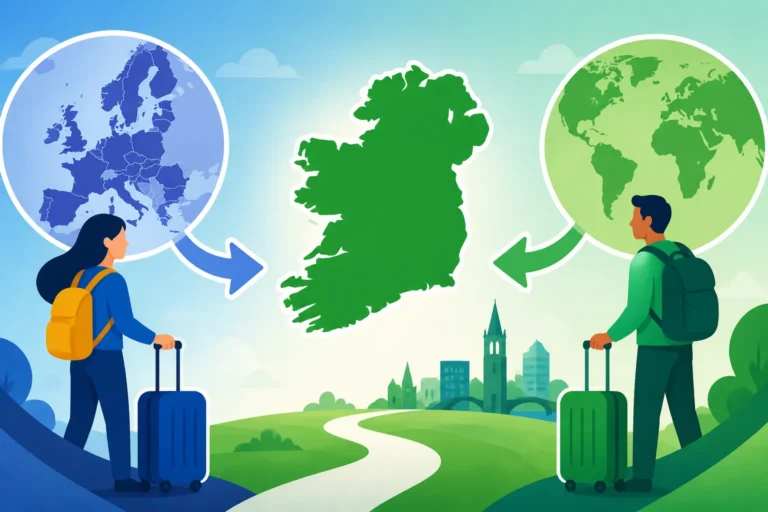
It's easy to get confused when planning international travel, especially if you're also visiting other European countries. As mentioned earlier, Ireland is not part of the Schengen Area, which consists of 27 European countries that have abolished passport and any other type of border control at their common borders.
The Schengen 90/180-Day Rule
In the Schengen Area, most non-EEA nationals (including Americans, Canadians, Australians, etc.) are permitted a short stay of up to 90 days within any 180-day period. This is a rolling period, meaning you can't just leave for a day and come back; the clock continues to tick.
How Ireland Differs
Because Ireland isn't Schengen, your 90-day visa-free stay in Ireland is completely separate from any time you spend in the Schengen Area.
Example Scenario:
Let's say you spend 80 days travelling around France, Italy, and Germany (Schengen countries). You then fly to Dublin. Your 90-day limit in Ireland starts fresh on your arrival in Ireland. The 80 days you spent in Schengen don't count towards your Irish limit, and vice-versa. This is a significant advantage for those who want to explore both the UK/Ireland and the Schengen Area on separate trips.
Important Note: While your visa-free time is separate, some types of visas can allow entry to both. For instance, a UK-issued short-stay visa might sometimes allow entry to Ireland under the British-Irish Visa Scheme (BIVS), but this is for specific nationalities and requires a visa, not visa-free travel. Always check the specific scheme and your nationality's eligibility.
Table: Visa-Free Entry Overview for Non-EEA Nationals
| Aspect | Ireland (Visa-Free Nationals) | Schengen Area (Visa-Free Nationals) |
|---|---|---|
| Area Covered | Republic of Ireland (and Northern Ireland via CTA) | 27 European countries (e.g., France, Germany, Spain, Italy) |
| Maximum Stay | Up to 90 days (at discretion of immigration officer) | Up to 90 days within any 180-day period |
| Counting Period | Separate 90-day period for Ireland only | Rolling 180-day period across all Schengen countries |
| Work/Study | Not permitted (requires specific visa/permit) | Not permitted (requires specific visa/permit) |
| Extension | Extremely rare, for genuine emergencies only | Generally not possible from visitor status |
| Visa Scheme | Independent immigration policy | Common visa policy across member states |
| CTA Impact | British citizens can live/work freely; others need permission | No direct impact from CTA |
| Health Insurance | Highly recommended (no reciprocal agreement for most visitors) | Highly recommended; travel insurance often a requirement for visa types |
Understanding this distinction is crucial for planning your travel itinerary to avoid inadvertently breaching immigration rules in either jurisdiction. It's a common source of confusion, but once you grasp that Ireland operates independently, it becomes much clearer.
What to Do Before You Arrive and Before You Depart
Preparation isn’t just for your arrival; it’s for your entire journey, right up to the moment you leave. Being organised can save you a world of stress and potential problems.
Pre-Arrival Checklist
- Check Your Passport Validity: Ensure your passport is valid for at least six months beyond your intended departure date. Some airlines might even have stricter requirements.
- Book Your Return/Onward Ticket: This cannot be stressed enough. Having a confirmed ticket out of Ireland within your 90-day limit is paramount.
- Secure Accommodation: Have your initial accommodation details ready, whether it's a hotel, B&B, or a family member's address.
- Confirm Funds: Make sure you can easily access proof of sufficient funds for your stay.
- Get Travel Health Insurance: As discussed, secure comprehensive travel health insurance that covers medical emergencies and repatriation. It’s peace of mind you absolutely need.
- Understand Your Purpose: Be crystal clear about your reason for visiting and ensure it aligns with your visa-free status. Don't imply you're looking for work or study unless you have the appropriate long-stay visa already in hand.
- Pack Essential Documents: Keep your passport, ticket, accommodation details, insurance, and proof of funds in an easily accessible carry-on bag.
Before You Depart Ireland
- Check Your Departure Date: Double-check the stamp in your passport and calculate your absolute last day to leave Ireland. Do not overstay.
- Confirm Your Flight: Ensure your departure flight is confirmed and there are no unexpected cancellations that might cause you to overstay.
- Keep Records: It's good practice to keep copies of your boarding passes or any other proof of your departure from Ireland, just in case there are future queries about your travel history.
- Settle Your Affairs: Make sure all your bills are paid, you've said your goodbyes, and you've returned any rented items. If you opened a temporary Irish bank account or mobile phone plan, close it or ensure it's properly managed for your departure.
Following these steps will help ensure your visa-free stay in Ireland is smooth, enjoyable, and completely compliant with Irish immigration law. It's all about being a responsible traveller and showing respect for the country's rules.
Disclaimer
The information provided in this guide is for general informational purposes only and does not constitute legal advice. Immigration laws and policies in Ireland are subject to change. While every effort has been made to ensure accuracy, the author and publisher are not responsible for any errors or omissions, or for the results obtained from the use of this information. It is strongly recommended to consult the official website of the Irish Immigration Service Delivery (ISD) or seek advice from a qualified immigration solicitor for up-to-date and personalised advice regarding your specific circumstances.