How Do I Apply for Citizenship by Descent in Ireland?
Navigating the labyrinth of international paperwork can feel like a full-time job, especially when you're trying to connect with your roots and secure Irish citizenship. For many of us living abroad, the idea of having an Irish passport is a powerful link to our heritage, but figuring out "How Do I Apply for Citizenship by Descent in Ireland?" can seem daunting. This guide is here to untangle the process, offering practical, empathetic advice from someone who’s been there, helping you understand the steps, prepare your documents, and successfully claim your birthright.
Understanding Irish Citizenship by Descent: What It Means for You
There's a special kind of pride that comes with tracing your ancestry back to Ireland, a sense of belonging to a land steeped in history, culture, and a legendary Céad Míle Fáilte. For many expats, this isn't just about a romantic ideal; it's about a tangible connection, and the Irish government provides a pathway for those with Irish lineage to claim citizenship through descent. It’s not quite as simple as just having an Irish surname, but it’s certainly achievable if you meet the criteria.
What is Citizenship by Descent Exactly?
At its heart, citizenship by descent means you are recognised as an Irish citizen because one of your parents or, more commonly, one of your grandparents was an Irish citizen at the time of your birth. This is fundamentally different from How to Apply for Irish Citizenship by Naturalisation, which is for those who have lived in Ireland for a certain period. With citizenship by descent, you don't need to have ever set foot on Irish soil. Your connection is purely familial, a birthright passed down through generations.
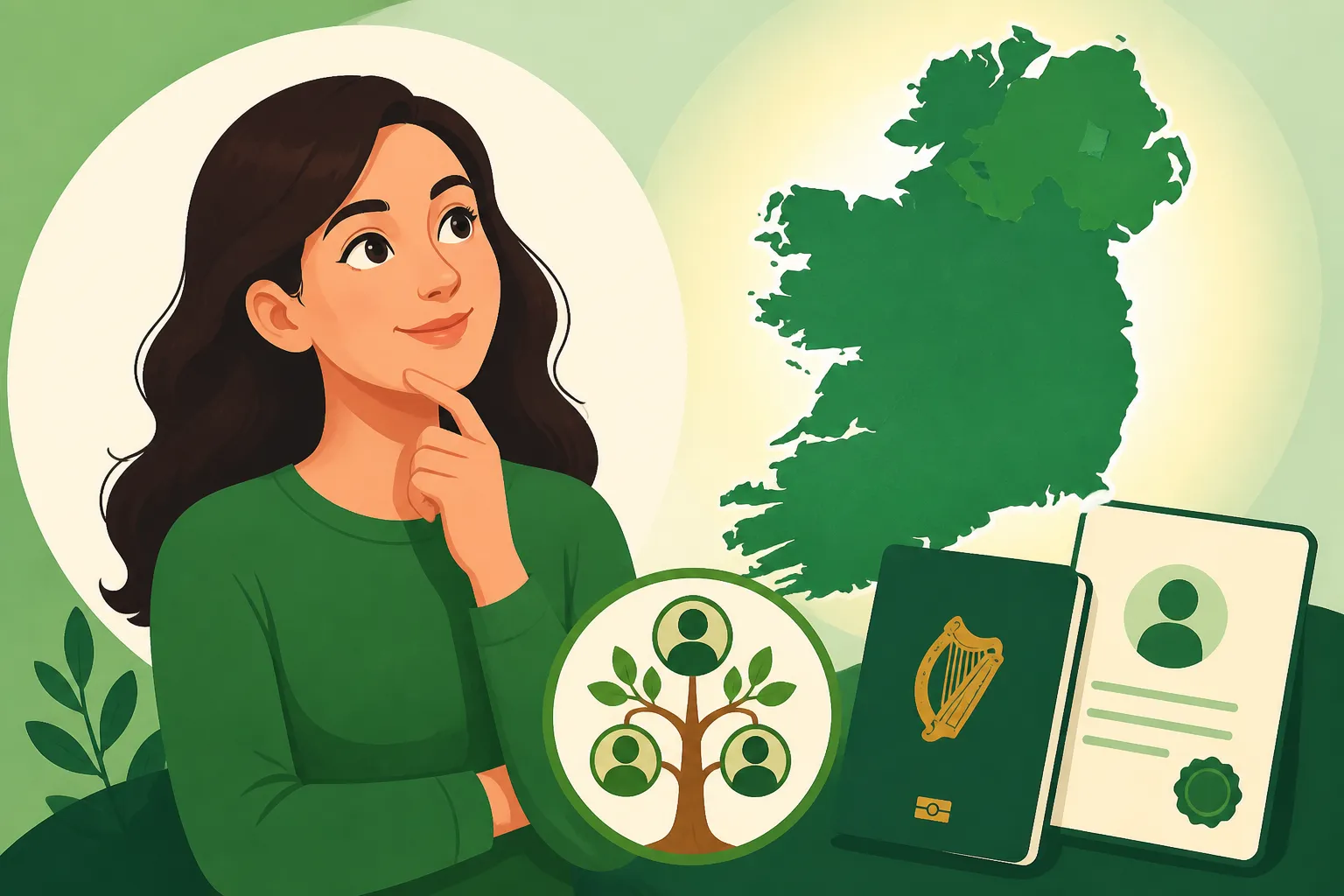
The key mechanism for this process, especially if your Irish ancestor wasn't your parent, is the Foreign Births Register (FBR). Think of the FBR as a national ledger that records the birth of Irish citizens born outside the island of Ireland. Once you're entered into this register, you are officially recognised as an Irish citizen, and crucially, you can then apply for an Irish passport. It’s a bit like an official family tree where your name gets added, solidifying your place as part of the wider Irish family.
Why Apply for it? More Than Just a Passport
While an Irish passport is often the primary goal, the benefits of gaining citizenship by descent stretch far beyond hassle-free travel. Holding an Irish passport grants you European Union (EU) citizenship, which means you have the right to live, work, and study in any of the 27 EU member states, as well as Iceland, Liechtenstein, Norway, and Switzerland. This opens up a world of opportunities that are simply not available to non-EU citizens. Imagine the freedom to pursue a job in Berlin, study in Paris, or retire to the sunny coasts of Spain, all without needing a visa or complex residency permits.
Beyond the practical perks, there's the undeniable emotional value. For many, it's about reclaiming a part of their identity that might have felt distant. It provides a deeper connection to Irish culture, history, and a sense of belonging. Plus, once you secure your citizenship, you can pass it on to your own children (under specific conditions, which we'll delve into). It’s about forging a legacy and ensuring your family's link to Ireland endures. If you're pondering a full move, understanding How EU/EEA and Non-EEA Citizens Move to Ireland: The Full Guide (2027) can give you a broader picture of what awaits, but citizenship by descent provides an independent pathway.
Eligibility Criteria for Citizenship by Descent
This is where the rubber meets the road. While many dream of an Irish passport, the eligibility criteria are quite specific, designed to maintain a clear line of descent. It’s not simply a matter of having an Irish great-grandparent; the connection needs to be direct and properly documented through a specific chain.
Direct Parentage: The Simplest Path
You are automatically an Irish citizen if:
- One of your parents was an Irish citizen born in Ireland at the time of your birth. This is the most straightforward scenario. You don't need to be entered into the Foreign Births Register; you are already an Irish citizen by law. You can simply apply for an Irish passport directly.
- One of your parents was an Irish citizen through naturalisation or descent (i.e., they were themselves registered in the Foreign Births Register) at the time of your birth, regardless of where you were born. In this case, your parent’s citizenship and their FBR entry (if applicable) prove your eligibility.
It’s crucial that your parent was an Irish citizen at the time of your birth. If your parent became an Irish citizen after you were born, this direct path usually doesn't apply to you.
Grandparent Rule: The Foreign Births Register is Key
This is the path most commonly explored by those applying for citizenship by descent. You are eligible for citizenship if:
- One of your grandparents was born in Ireland (including Northern Ireland before 2005) AND
- Your parent (the child of that Irish-born grandparent) was registered in the Foreign Births Register before you were born.
This second point is the absolute lynchpin. Many people get stuck here. If your parent, who was born outside Ireland to an Irish-born grandparent, was not registered in the Foreign Births Register, then you cannot claim citizenship through that grandparent. In such cases, your parent would need to apply to be registered first. Only once their registration is complete can you then apply for your own entry into the FBR. It's a generational relay race – each generation born abroad must register before the next can. This highlights the importance of understanding the specific timelines and requirements outlined in the broader Irish Citizenship: Naturalisation and Citizenship by Descent Explained (2027) guide.
Great-Grandparent Rule: A More Complex Scenario
Can you claim citizenship through a great-grandparent? Not directly, unfortunately. The general rule is that Irish citizenship by descent can only be passed down through one generation born outside Ireland.
However, there's a workaround that essentially means your great-grandparent's Irish lineage must have already resulted in your grandparent's and then your parent's registration. In practical terms, this means if your great-grandparent was born in Ireland, your grandparent (their child, born abroad) would have needed to be registered in the FBR. Then, your parent (child of that FBR-registered grandparent, also born abroad) would have also needed to be registered in the FBR before your birth. It's a sequence of registrations that effectively makes your parent an Irish citizen by descent, thus allowing you to claim citizenship through them. If any link in that chain of FBR registration is missing, the chain is broken, and you cannot claim citizenship.
The Application Process: Step-by-Step
Alright, let’s get down to the nitty-gritty. The application process, while detailed, is manageable if you tackle it systematically. It primarily involves gathering a significant amount of documentation, accurately filling out the application form, and then submitting it to the Department of Foreign Affairs.
Gathering Your Documents: The Paper Chase
This is arguably the most time-consuming part, and where most people encounter their biggest headaches. The Irish authorities require a clear paper trail to prove your lineage. Expect to need certified copies of the following, at minimum:
- Your own documents:
- Your full civil birth certificate (showing parents' names).
- Your current civil marriage certificate (if applicable).
- Proof of your current address (e.g., utility bill, bank statement – though this usually isn't the primary focus for FBR).
- Proof of identity (e.g., a clear colour copy of your current passport or government-issued ID).
- Two colour passport-style photographs, one of which must be signed and dated by a witness.
- Your Irish citizen parent's documents (if applicable to your claim):
- Their full civil birth certificate.
- Their civil marriage certificate (if applicable).
- Their Irish passport or their Certificate of Entry to the Foreign Births Register (if they were born outside Ireland).
- A certified copy of their death certificate, if deceased.
- Your Irish-born grandparent's documents (if applicable to your claim):
- Their full civil birth certificate (showing parentage in Ireland).
- Their civil marriage certificate.
- A certified copy of their death certificate, if deceased.
Important Notes on Documents:
- Certified Copies: Most documents will need to be certified true copies by a solicitor, notary public, or sometimes an embassy official. This means they need to physically compare your original document to the copy and stamp/sign it to confirm it’s a true likeness. Do not send original documents unless specifically requested.
- Translations: If any of your documents are not in English or Irish, you will need to provide certified translations.
- Civil Records: Ensure all birth and marriage certificates are civil certificates, not religious ones. You can often obtain these from the General Register Office or equivalent body in the country where the event occurred. For Irish records, the General Register Office (GRO) is your point of call.
- Apostille/Legalisation: Depending on the country your documents originate from, you may need to get them apostilled or legalised. This is an international certification that verifies the authenticity of a document. If you're unsure, check the requirements for How to Get Your Documents Apostilled for Irish Immigration.
Here's a simplified document checklist to give you an idea of the core documents required for common scenarios:
| Document Type | Claiming through Irish-born Parent | Claiming through Irish-born Grandparent (Parent NOT FBR-registered) | Claiming through Irish-born Grandparent (Parent IS FBR-registered) |
|---|---|---|---|
| Your Birth Certificate | Required | Required | Required |
| Your Passport/ID | Required | Required | Required |
| Your Parents' Marriage Cert | If applicable | If applicable | If applicable |
| Your Parent's Birth Cert | Required | Required | Required |
| Your Parent's Passport/ID (if applicable) | Required | Required | Required |
| Your Parent's Irish Passport/FBR Cert | Required | Not applicable (they need to apply first) | Required |
| Your Grandparent's Birth Cert (Irish-born) | Not applicable | Required | Required |
| Your Grandparent's Marriage Cert | Not applicable | Required | Required |
| Your Grandparent's Death Cert | Not applicable | If deceased | If deceased |
Completing the Application Form
The application form for the Foreign Births Register is available online through the Department of Foreign Affairs website (or through Irish embassies/consulates abroad). It's a comprehensive form, and it's essential to fill it out accurately and completely.
- Read Instructions Carefully: Before you even start, read the entire guidance document. It contains critical information and often answers many common questions.
- Be Meticulous: Every box needs to be filled. If a section doesn't apply, mark it as "N/A" rather than leaving it blank. Inconsistencies or omissions are the fastest way to delay your application.
- Consistency is Key: Ensure names, dates, and places match exactly across all submitted documents. Even a minor discrepancy can trigger a query.
Submitting Your Application
Once you have all your documents certified and your form meticulously completed, you're ready to submit.
- Online Portal vs. Postal: The Department of Foreign Affairs usually offers an online portal for starting your application, which helps generate the necessary forms and payment instructions. You will then typically need to send hard copies of your certified documents by registered post to the relevant Irish embassy or consulate for your region, or directly to the Foreign Births Registration Unit in Dublin. Always check the most up-to-date submission method on the official website.
- Fees: There is a non-refundable application fee. This fee can change, so verify the current amount on the Department of Foreign Affairs website. Payment is usually made online as part of the initial application process.
- Processing Times: Ah, the million-dollar question. Processing times for the Foreign Births Register can be notoriously long, sometimes extending beyond a year or even two, especially for complex cases or during periods of high demand. This is a common frustration, and one that resonates deeply with many expats. Be prepared for a wait, and try to factor this into any long-term plans you might have, such as using services like Sirelo for moving your belongings to Ireland. It's important to remember that delays don't necessarily mean there's an issue with your application, but simply that the department is working through a significant backlog. The good news is that they are constantly working to improve these times. For a general understanding of immigration timelines, you might find Understanding the Cost and Timeline of the Immigration Process in Ireland helpful, though FBR has its own specific cadence.
Registering in the Foreign Births Register
It’s important to clarify that applying for citizenship by descent is the process of applying to be entered into the Foreign Births Register. Once your application is approved and processed, you receive a Certificate of Entry to the Foreign Births Register. This certificate is your official proof of Irish citizenship. You can then use this certificate to apply for your first Irish passport. It's a two-step process: FBR entry first, then passport application.
Common Challenges and How to Overcome Them
The path to Irish citizenship by descent, while rewarding, isn't always a smooth one. Many applicants hit bumps along the way. Having lived through these kinds of administrative hurdles myself, I can tell you that a little foresight and a lot of patience go a long way.
Missing or Incorrect Documents
This is perhaps the biggest pitfall. Older family records might be missing, names might be misspelled, or dates might be incorrect. It's a common scenario, particularly for those whose ancestors left Ireland generations ago.
- Solution: Don't give up! The first step is to contact the relevant civil registration offices in the country where the birth, marriage, or death occurred. For Irish records, the General Register Office (GRO) of Ireland is your friend. Their website has extensive guides on how to order historical records. If a document truly cannot be found, or there are irreconcilable discrepancies, you might need to provide supplementary evidence, such as census records, church records, or sworn affidavits, to bridge the gap. It's about providing as much supporting evidence as possible to convince the Department of Foreign Affairs of the correct lineage.
- Pro Tip: Start this search early. Requesting historical documents can take weeks or even months, especially if you're dealing with multiple international jurisdictions.
Long Processing Times
As mentioned, waiting can be excruciating. You've sent off your meticulously prepared package, and then… silence. It's easy to get anxious, wondering if something went wrong.
- Solution: Patience is genuinely key here. The Department of Foreign Affairs processes thousands of these applications annually. They will contact you if they need more information or if there's an issue. Regularly check their official website for updated processing time estimates. You can also use the application tracking system (if available, usually through the online portal you initiated the application with) to monitor its progress. While it's tempting to bombard them with emails or calls, doing so rarely speeds things up and can actually hinder their work. Stick to their advised communication channels and timelines.
- Perspective: Remember, securing your The Complete Guide to Irish Visas and Immigration Permission for Expats (2027) is a significant step, and such processes inherently take time worldwide.
Complex Family Trees and Name Changes
Sometimes, the lineage isn't a straight line. Marriages, divorces, adoptions, or simply different naming conventions across generations can make the family tree look like a tangled vine.
- Solution: For every name change (e.g., a woman taking her husband's surname), you'll need to provide the relevant marriage certificate. For divorces, provide the divorce decree. If there are adoptions, the legal adoption papers are necessary. Each step that alters a name or a direct biological link needs to be legally documented. If you're dealing with a truly complex scenario, or if you feel overwhelmed, consider consulting a specialist immigration solicitor in Ireland. They often have experience with these unique cases and can advise on the best way to present your evidence.
High Fees and Costs
While the application fee itself isn't exorbitant, the cumulative costs can add up.
-
Application Fee: This is a fixed, non-refundable cost for processing.
-
Document Procurement: Each civil birth, marriage, or death certificate you order from government agencies will have a fee. If you need multiple copies or records from several countries, this can quickly mount.
-
Certification Fees: Solicitors and notaries charge for certifying documents. These fees vary widely.
-
Translation Fees: Professional, certified translations are not cheap, especially for multiple documents.
-
Postage/Courier: Sending your valuable documents via registered post or courier adds another layer of expense.
-
Legal Advice: If you opt for professional legal assistance, this will be the most significant cost.
-
Solution: Budget for these costs upfront. Prioritise which documents you need and try to get multiple copies certified at once to save on individual certification fees. Compare prices for translations and certifications if possible. Consider whether the assistance of an immigration solicitor is a worthwhile investment for your particular case, weighing the cost against the potential for error and delay in a complex application.
After You've Applied: What to Expect
Once you've submitted your carefully curated packet of documents and the application form, you enter the waiting period. It's a time of quiet anticipation, but it's helpful to know what communications to expect and what steps come next.
Confirmation and Communication
Typically, after your application is received, you should receive an acknowledgement. This might be an email or a formal letter, confirming that your application has been logged and is awaiting processing. This acknowledgement often includes a reference number, which is vital for any future correspondence or tracking.
- What to Expect: Beyond the initial acknowledgement, communication from the Department of Foreign Affairs tends to be sporadic until they reach your application. They will usually only contact you if they require further information or clarification on your documents. If you haven't heard anything for a very long time (beyond their stated processing times), you can respectfully follow up using the contact details provided in your acknowledgement or on their official website. Avoid calling too frequently; their resources are finite.
- Staying Informed: Keep an eye on your email (and spam folder!) and physical post. Sometimes, crucial requests for additional information can get missed.
Receiving Your Certificate of Entry
If your application is successful, the most significant outcome will be the issuance of your Certificate of Entry to the Foreign Births Register. This is a physical document, a formal certificate that states you have been entered into the Foreign Births Register and are therefore an Irish citizen by descent. This isn't your passport, but it's your definitive proof of citizenship. Hold onto this document very carefully, as it's irreplaceable in proving your status.
The Next Step: Applying for Your Irish Passport
With your Certificate of Entry in hand, you are now officially an Irish citizen. The next exciting step is to apply for your first Irish passport.
- Passport Application Process: This is a separate application, usually submitted through the Irish Passport Service. You will need your Certificate of Entry, your current passport/ID, new passport-style photographs, and potentially a new fee. The passport application process generally has shorter processing times than the FBR application, but it still requires careful completion of forms and adherence to photographic standards.
- First-Time Passports: Be aware that applying for a first-time Irish passport (even with FBR certification) can sometimes involve slightly more scrutiny than a renewal, simply because it's the first time you're formally obtaining the travel document.
- Preparing to Live in Ireland: If you plan to eventually move to Ireland, your Irish passport makes entry seamless. You won't need to worry about Understanding the Irish Immigration Stamp System (Stamp 1, 2, 4) (2027) or other residency permits, at least from an immigration perspective. However, you will still need to handle practicalities like getting a How to Get a PPS Number in Ireland? and sorting out your The Expat Guide to Opening a Bank Account in Ireland. And if you're thinking about insurance for your journey or once you land, global providers like Cigna Global offer comprehensive plans designed for expats.
Maintaining Your Irish Citizenship and Passing it On
Once you're registered in the Foreign Births Register, your Irish citizenship is permanent. There's no ongoing "maintenance" required, provided you don't do anything that would cause you to renounce or lose it (which is rare and usually requires specific, intentional actions).
A fantastic benefit is that you can now pass this citizenship on to your own children, even if they are born outside Ireland, provided you register their births in the Foreign Births Register before they turn 18 (or if they are born after your own FBR registration). This ensures that your efforts create a lasting legacy for future generations, keeping the Irish connection alive and thriving. It’s a truly powerful gift to give your family, extending your heritage and opening up possibilities for their future.
Disclaimer
The information provided in this guide is intended for general informational purposes only and does not constitute legal advice. While we strive to keep the content accurate and up-to-date, immigration laws and application processes can change frequently. For specific advice regarding your individual circumstances, it is highly recommended to consult with the official Irish Department of Foreign Affairs website, an Irish embassy or consulate, or a qualified immigration solicitor.