Understanding the Cost of Private and International Schools in Ireland
Moving to a new country like Ireland with children brings a whole new layer of considerations, and for many expat families, one of the biggest anxieties revolves around education. While the public school system is widely available, many consider private or international schools for various reasons, often without a clear understanding of the financial commitment involved. This guide is here to cut through the confusion, providing a realistic, in-depth look at the costs associated with private and international education in Ireland, so you can make informed decisions for your family.
Deciphering Ireland's Private School Landscape
When you first arrive in Ireland, you'll quickly learn that the education system has its own unique flavour. Navigating the choices for your children can feel like a maze, especially when trying to understand the difference between public and private options, and what each entails financially.
The 'Fee-Paying' School System Explained
In Ireland, what we often refer to as "private schools" are officially known as 'fee-paying schools'. This might seem straightforward, but it's important to understand what truly sets them apart from the vast majority of secondary schools in the country. Most secondary schools are publicly funded and do not charge tuition fees, although many ask for 'voluntary contributions' which can sometimes feel mandatory. Fee-paying schools, on the other hand, charge explicit tuition fees for attendance.
These schools come in various forms. Many have a long-standing tradition, often associated with a particular religious ethos (Catholic, Protestant, etc.), though they welcome students from all backgrounds. Then there are also non-denominational private schools that focus purely on academic excellence, specific educational philosophies, or an international curriculum. Unlike some countries where private schools might operate entirely outside state oversight, fee-paying schools in Ireland still generally follow the national curriculum and participate in state examinations like the Junior Cycle and Leaving Certificate. The key difference, beyond the fees, often lies in smaller class sizes, a wider array of extracurricular activities, enhanced facilities, and sometimes a particular academic focus or ethos. For expat families, choosing a private school can sometimes offer a perceived easier transition, especially if they are coming from a similar system abroad.
Typical Fee Structures and What They Include
Understanding the fee structure for private schools in Ireland requires a bit of digging, as it's rarely a single, all-inclusive figure. You'll find that the "headline" tuition fee is just the starting point.
Firstly, the tuition fees themselves vary considerably. As of 2024, these could range from roughly €4,000 to €8,000 per year for day students at the primary level, and significantly higher for secondary school, often from €6,000 to €15,000 per year, depending on the school's reputation, location (Dublin schools generally being pricier), and facilities. These fees typically cover the core educational provision – teaching staff, use of school facilities, and basic classroom materials.
However, brace yourself for the 'mandatory extras'. These are costs you simply cannot avoid. Uniforms are almost always required, and a full school uniform, including sports gear, can easily set you back €300-€700 upfront, with ongoing costs for replacements. Books and stationery are another recurring expense, often totalling €200-€400 annually. Many schools now also integrate technology into their learning, requiring students to have specific devices (laptops, tablets) or charging an annual 'tech levy' or 'device management' fee. Some schools might also have compulsory charges for certain sports, arts programmes, or even an annual school tour.
Then there are the 'optional extras' that, let's be honest, often feel necessary to ensure your child has the full school experience. These can include private music lessons, specific coaching for competitive sports, school trips (day trips and international excursions), after-school clubs, and sometimes even optional exam revision classes. These can add hundreds, if not thousands, of euros to your annual bill. It’s crucial to get a full breakdown of all potential costs when inquiring with schools, not just the basic tuition, to avoid nasty surprises down the line.
Exploring International School Options and Their Costs
For many expat families, especially those on shorter assignments or who anticipate further international moves, the continuity and familiarity of an international school curriculum can be a huge draw. Ireland has a growing number of international schools, offering alternatives to the traditional Irish system.
The Appeal of International Curricula for Expats
International schools in Ireland cater specifically to the globally mobile community, offering curricula such as the International Baccalaureate (IB) Programme, the British A-Levels, or the American High School Diploma. The primary appeal lies in this curriculum continuity. If your child has been studying the IB in Singapore or the American curriculum in Germany, moving to an IB school in Dublin means they can seamlessly pick up where they left off, often with minimal disruption to their academic progression. This is a massive relief for parents who want to ensure their children's education path remains consistent, regardless of which country they find themselves in.
Beyond the curriculum, international schools often boast a highly diverse student body and faculty, which can create a very welcoming and understanding environment for children who are new to Ireland. Many also offer excellent English as an Additional Language (EAL) support, which can be invaluable for non-native English speakers. The focus is often on a broader, more holistic education, with a strong emphasis on critical thinking, global citizenship, and a wide range of extracurricular activities that expose students to different cultures and experiences. For some, the smaller class sizes and more individualised attention also contribute significantly to the appeal, especially if they're used to a more intimate learning environment.
Understanding the Premium Pricing of International Schools
It's no secret that international schools generally come with a higher price tag than their private counterparts following the national curriculum. This premium pricing is a reflection of several factors. Firstly, the operational costs for these schools tend to be higher due to specialised curricula requiring specific accreditations and resources, smaller class sizes, and a higher teacher-to-student ratio. Teachers are often recruited internationally, bringing diverse experiences but also commanding higher salaries.
Prominent international schools in Ireland include St. Kilian's German School, which offers a German and an Irish curriculum, and the Nord Anglia International School Dublin, which offers the International Baccalaureate. John Scottus School in Dublin also offers an alternative curriculum with a unique educational approach based on philosophical and spiritual principles, though it is not strictly an "international" curriculum in the same vein as IB or A-Levels.
Let's look at some examples of typical costs based on recent data. For a primary school child at Nord Anglia International School Dublin, annual tuition could easily start from €18,000 and go up to €25,000+. For secondary students, these figures climb further, potentially reaching €25,000 to €30,000+ per year. St. Kilian's German School can have fees in a similar range for its German stream. These figures can fluctuate yearly, so always confirm directly with the school.
On top of tuition, international schools frequently have additional, often substantial, fees. These can include:
- Application Fees: A non-refundable fee charged just to process your application, typically €100-€300.
- Enrolment/Registration Fees: A one-time fee to secure your child's place once accepted, which can be thousands of euros, sometimes partially refundable.
- Capital Levies/Development Funds: Some schools charge an annual or one-off fee dedicated to facility maintenance and development. This can range from €500 to several thousand euros.
- Technology Fees: As with private schools, there can be specific charges for devices, software, and IT support.
- Bus Services: Many international schools offer extensive bus routes, but this comes at an extra cost, which can be significant depending on your location.
When budgeting for an international school, it’s vital to consider all these components as they add a considerable amount to the overall annual cost. You're paying not just for the education, but for the entire infrastructure, specialised services, and global perspective that these institutions offer. If you're pondering how to budget for these significant expenses, remember that understanding The Complete Guide to Cost of Living in Ireland for Expats (2026) can provide a broader financial context for your planning.
A Detailed Look at School Fees: What to Expect
Let's get down to the brass tacks and really break down what these school fees look like on an annual basis, covering both day and boarding options, and those pesky hidden costs.
Annual Tuition Fees for Day Students
For day students, the annual tuition fees are the core expense. As an expat, you’ll notice a significant range depending on whether you opt for a primary or secondary school, and crucially, its location.
Primary School (ages 4/5 – 12): Fees for private primary schools typically fall between €4,000 and €8,000 per year. For international primary schools, as mentioned, you’re looking at €18,000 to €25,000+. Schools in Dublin and other major urban centres tend to be at the higher end of this scale due to higher operational costs and demand. Schools in more rural or less densely populated areas might offer slightly lower fees.
Secondary School (ages 12 – 18): This is where the costs really escalate. Private secondary school fees generally range from €6,000 to €15,000 per year for day students. International secondary schools can command fees anywhere from €25,000 to €30,000+ annually. The prestige of the school, its academic results, facilities (e.g., swimming pools, extensive sports grounds, science labs), and teacher-to-student ratios all play a role in determining the final figure. Some schools might also have different fee scales for junior cycle (first three years) versus senior cycle (final two years) due to varying subject choices and resource requirements.
Most schools will offer a choice of payment schedules: a single upfront annual payment (sometimes with a small discount), or payments spread across two or three terms. It’s important to understand these terms when you are comparing schools, as cash flow can be a real consideration, especially when you're just getting settled in Ireland.
Boarding Fees: An Alternative for Some Families
While day schooling is the norm, Ireland has a long tradition of boarding schools, particularly at the secondary level. For some expat families, especially those in remote parts of Ireland or those who travel frequently for work, boarding can be a viable and attractive option, offering a structured environment and continuity.
Boarding options usually fall into two categories:
- Full Boarding: Students live at the school seven days a week, returning home only during holidays.
- Weekly Boarding: Students live at the school during the week and return home for weekends.
The cost of boarding is, naturally, significantly higher as it encompasses not just tuition but also accommodation, all meals, laundry, supervision, and a range of evening and weekend activities. Full boarding fees for private secondary schools in Ireland typically range from €15,000 to €25,000 per year. For example, well-known boarding schools like Clongowes Wood College, Blackrock College (for boys), and Alexandra College (for girls) often have fees towards the higher end of this spectrum. Weekly boarding might be slightly less, perhaps €12,000 to €20,000 annually.
When considering boarding, ask detailed questions about what's included. Are all meals covered, including snacks? Is there an allowance for pocket money or a system for managing student funds? What kind of pastoral care and medical support is available on-site? Are weekend trips or activities part of the fee, or are they extra? These details can significantly impact the true cost and the quality of the boarding experience. For families who need to coordinate an international move to Ireland, services like Sirelo can be useful in planning logistics, though they won't help with school fees, of course!
The Hidden Costs and Additional Expenses
Oh, the dreaded "hidden costs"! These are the little devils that nibble away at your budget and can collectively add up to a substantial amount, often catching newcomers off guard.
- Uniforms: As mentioned, these are almost always mandatory. You'll likely need a formal uniform, a sports uniform, and possibly specific items for particular activities. Some schools have designated suppliers, which can limit your options for finding cheaper alternatives. Budget for initial outlays and then annual top-ups as children grow or items wear out.
- Textbooks and Stationery: While some schools might have a digital textbook programme, many still rely on physical books. These need to be purchased new each year, and the cost of textbooks, workbooks, and a full complement of stationery (pens, notebooks, art supplies, scientific calculators) can easily run into a few hundred euros per child.
- Technology: Most schools now expect students to have a laptop or tablet. While some provide these, many require parents to purchase them to specific specifications. Beyond the device itself, there might be software licenses, cybersecurity subscriptions, or specific apps that incur annual charges.
- Extracurricular Activities: This is a big one. While many private and international schools boast a vast array of clubs and societies, specialised activities like advanced music lessons, competitive sports coaching, drama productions, or international trips (e.g., ski trips, cultural exchanges) almost always come with additional fees. These can range from €50-€100 for a termly club to thousands for an overseas trip.
- Transport: Unless you live within walking distance, you'll need to factor in transport. Many schools offer dedicated bus services, which are convenient but costly, often €800-€2,000 per year depending on the route. Otherwise, you'll be relying on public transport, which has its own costs (e.g., a student Leap Card), or the cost of driving your child.
- Lunches and Snacks: While some boarding fees include all meals, day students usually need to bring their own lunch or purchase it at the school canteen. Canteen meals can add €5-€10 per day, quickly becoming a significant weekly expense.
- Exam Fees: For secondary students sitting state exams (Junior Cycle, Leaving Certificate) or international exams (IB, A-Levels), there are typically examination registration fees, though sometimes these are absorbed by the school.
It’s truly a good idea to build a buffer into your budget for these unforeseen, yet common, expenses. Before you jump into choosing a school, it's wise to understand the various aspects of the Irish education system. For more in-depth information, you can read Understanding the School System (Primary, Secondary, Educate Together).
Financial Aid, Scholarships, and Bursaries
The idea of high school fees can be daunting, but it's important to know that many private and international schools offer various forms of financial assistance. It’s not always just for the ultra-wealthy; sometimes, it’s for families who demonstrate both need and potential in their child.
Navigating Scholarship Opportunities
Scholarships are typically awarded based on merit, recognising a student's exceptional talent or academic promise. They usually provide a reduction in tuition fees, sometimes a full waiver, for the duration of the student's time at the school, provided they maintain their performance.
- Academic Scholarships: These are the most common type. Schools often hold entrance exams or assess a student's previous academic record to identify high achievers. These scholarships are highly competitive and are usually awarded for entry into secondary school (e.g., at age 12/13 or 16/17). They might cover a percentage of tuition or a fixed amount.
- Sports Scholarships: For students with outstanding athletic abilities, especially in sports that the school excels in (e.g., rugby, hockey, rowing, equestrian sports). The school will typically look for students who can contribute significantly to their sports teams.
- Music, Art, and Drama Scholarships: These are for students who show exceptional talent in the creative and performing arts. Portfolios, auditions, or performances will be required as part of the application process.
The application process for scholarships is rigorous and usually involves specific deadlines, often a year or more in advance of enrolment. It's essential to check each school's website for their specific scholarship programmes, eligibility criteria, and application timelines. Don't be shy about enquiring directly with the admissions office. They can guide you through the process and clarify what opportunities might be available for your child.
Bursaries and Hardship Funds
Bursaries, unlike scholarships, are primarily awarded based on financial need, although academic potential or other talents might also be a consideration. They are designed to make private education accessible to families who might not otherwise be able to afford it.
- Means-Tested Bursaries: Most schools offering bursaries will conduct a thorough assessment of a family's financial situation, taking into account income, assets, and liabilities. The level of bursary awarded will depend on the family's demonstrated need and the funds available from the school.
- Discretionary Funds: Some schools also have discretionary funds that can be used to support families facing sudden or unexpected financial difficulties (e.g., job loss, illness) who are already part of the school community. These are usually decided on a case-by-case basis.
Applying for a bursary is a confidential process and often requires providing extensive financial documentation. Schools are typically very discreet about this. If you believe you might qualify, it's always worth contacting the admissions or finance department of the school to understand their bursary policy and application procedure. Don't let the sticker price deter you from exploring all options, as many schools are committed to fostering a diverse student body and genuinely want to support talented students from various backgrounds.
Comparing Public, Private, and International School Costs
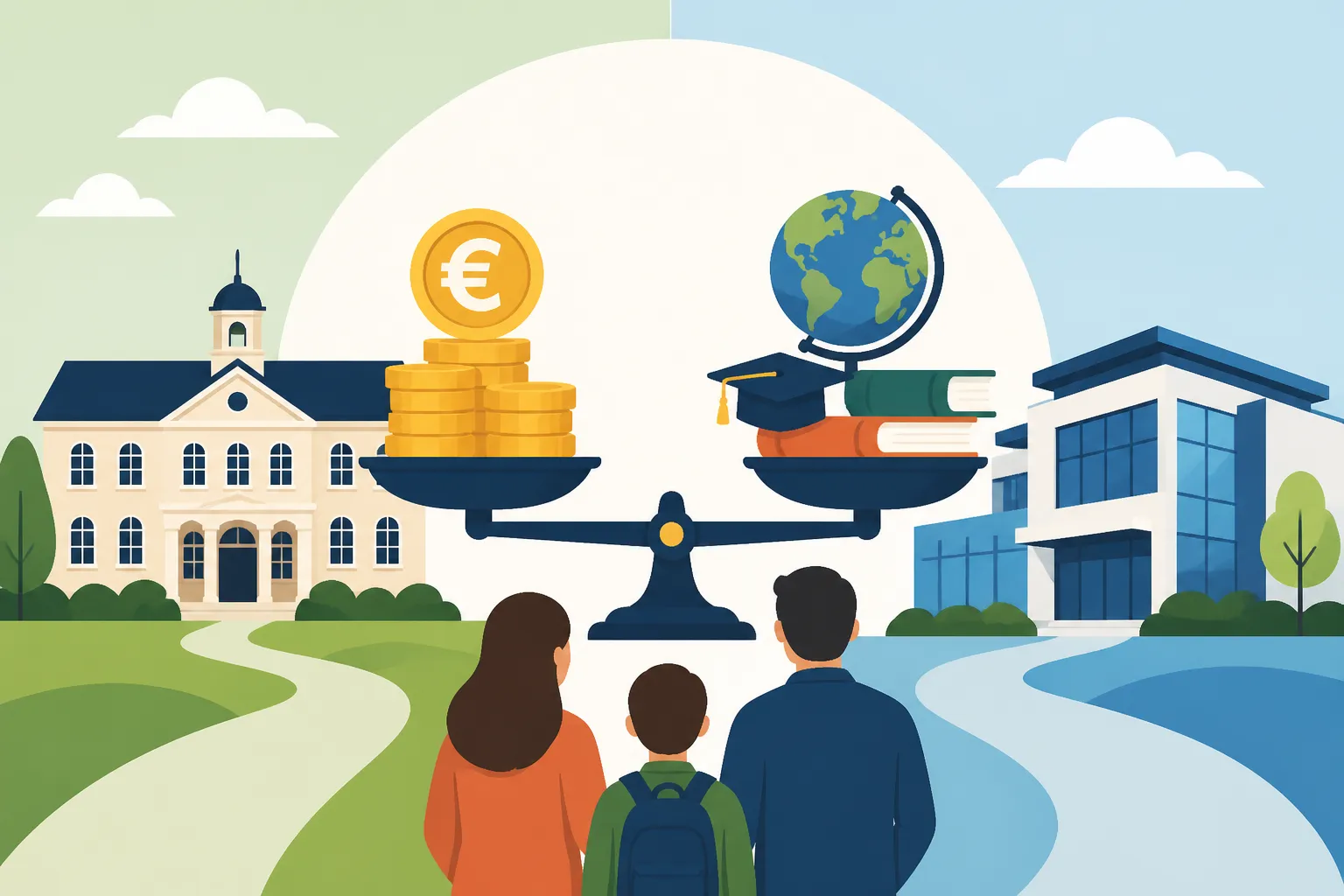
One of the big dilemmas for expat families in Ireland is weighing up the different school types. It's not just about money, of course, but the financial implications are often a major factor in the decision.
The 'Free' Public School Reality vs. Private Fees
The Irish constitution guarantees free primary and secondary education. This is often a huge relief for expat families coming from countries with expensive public systems. However, "free" in Ireland doesn't always mean entirely free.
Public schools do not charge tuition fees. The state covers teacher salaries and core operational costs. However, you will still encounter costs, often framed as 'voluntary contributions' which schools rely on to fund extras like sports equipment, art supplies, IT upgrades, and maintenance. These contributions can range from €100 to €500+ per year, per child. While technically voluntary, there can be social pressure to pay them.
Beyond that, you'll still have expenses for:
- Uniforms: Mandatory in almost all public schools, similar costs to private schools.
- Books and Stationery: Purchased annually, similar costs.
- Extracurricular Activities: Many clubs and sports teams will have fees.
- School Trips: Excursions, both day and overnight, will incur costs.
- Exam Fees: For state exams, though some schools cover parts of this.
So, while significantly cheaper than private education, public schooling in Ireland is not entirely without cost. The major cost saving, however, comes from the absence of substantial tuition fees. If you're comparing your options, getting clarity on all potential expenses from prospective public schools is just as important as for private ones. Before you can even get to this stage, you'll need to understand How to Enrol Your Child in an Irish School as the process can differ from what you might be used to.
Decision-Making Factors Beyond Just Money
While cost is a huge factor, it shouldn't be the only factor. Making an informed decision about your child's education in Ireland involves a holistic look at various elements.
- Academic Reputation and Ethos: Research the school's academic performance, but also its overall ethos. Does it align with your family's values? Is it focused purely on exams, or does it promote a broader, more holistic development? For international schools, consider if the curriculum (IB, A-Levels, etc.) is the best fit for your child's learning style and your long-term plans.
- Class Sizes and Teacher-to-Student Ratio: Private and international schools typically boast smaller class sizes, which can mean more individualised attention for your child. This can be particularly beneficial for students who need extra support or who thrive in more intimate learning environments.
- Curriculum Choice: This is perhaps the biggest differentiator for expats. Public and many private schools follow the Irish Junior Cycle and Leaving Certificate. If you plan to remain in Ireland long-term, this is a perfectly valid and respected pathway. However, if you foresee future international moves or want your child to have a globally recognised qualification that allows for easier university application abroad, an IB or A-Level curriculum might be more suitable.
- Facilities and Resources: Private and international schools often have superior facilities – dedicated sports halls, swimming pools, modern science labs, art studios, and extensive IT infrastructure – due to their fee income. This can significantly enhance a child's educational experience and opportunities.
- Community and Social Integration: Consider the student body. An international school will have a very diverse mix of nationalities, which can be great for global exposure but might mean your child is one of many "new kids." A local public or private school might offer a more immediate connection to Irish culture and community, though your child might be one of the few expats. Which environment do you feel will help your child thrive and integrate best?
- Proximity and Logistics: Don't underestimate the daily grind. How far is the school from your home? What are the transport options? A fantastic school across the city might seem appealing on paper, but a two-hour round trip commute every day can quickly become exhausting for both you and your child.
| School Type (Example) | Annual Tuition (approx.) | Mandatory Extras (approx.) | Typical Curriculum | Key Benefit for Expats |
|---|---|---|---|---|
| Public Primary | Free | €100-€500 | Irish Primary | Very low cost, local integration |
| Public Secondary | Free | €200-€700 | Irish Junior/Leaving Cert | Low cost, local integration, broad subject choice |
| Private Primary | €4,000-€8,000 | €500-€1,500 | Irish Primary | Smaller classes, enhanced facilities, specific ethos |
| Private Secondary | €6,000-€15,000 | €800-€2,500 | Irish Junior/Leaving Cert | Smaller classes, enhanced facilities, specific ethos, strong alumni |
| International Primary | €18,000-€25,000+ | €1,500-€4,000 | IB/American/British | Curriculum continuity, diverse student body, EAL support |
| International Secondary | €25,000-€30,000+ | €2,000-€5,000 | IB/American/British | Global recognition, university prep, diverse community, language options |
| Boarding Secondary | €15,000-€25,000 | €1,000-€3,000 | Irish Junior/Leaving Cert | Structured environment, full care, often for rural locations |
Note: All figures are approximate annual estimates for 2024 and can vary significantly by individual school, location, and specific programme. Always verify directly with the schools.
Practical Considerations for Expats Choosing a School
Beyond the financial outlay, there are several practical hurdles and nuances that expats should be aware of when navigating the Irish school system.
Timing Your Application and Enrolment
Unlike some countries where school places are abundant, popular schools in Ireland – particularly reputable private and international schools – can have long waiting lists. This isn't something you can leave until the last minute.
- Early Application is Key: For highly sought-after schools, especially in Dublin, it's not uncommon for parents to put their child's name down years in advance, sometimes even at birth for primary places! While this might seem extreme, it illustrates the competition. As an expat, you might not have that luxury, so apply as soon as you know you're moving to Ireland, even if you don't have a confirmed address yet.
- Application Windows: Many schools have specific application windows, particularly for entry into key years (e.g., Junior Infants for primary, or First Year and Fifth Year for secondary). Missing these deadlines can mean your child won't be considered for that academic year.
- Required Documents: You'll typically need to provide a range of documents, including your child's birth certificate or passport, previous school reports, sometimes vaccination records, and proof of address (once you have it). For international schools, academic transcripts and recommendations from previous teachers are standard. Ensure all documents are translated into English if necessary.
- Entrance Exams and Interviews: For many private and international secondary schools, prospective students will need to sit an entrance exam, often covering English, Maths, and sometimes Irish (for Irish curriculum schools). Interviews with the student and parents are also common, particularly for more selective institutions.
Don't underestimate the administrative burden of school applications. It can feel like a full-time job at times, particularly if you're applying to multiple schools simultaneously. Being organised and proactive is your best weapon.
Tax Implications and Reliefs for School Fees
Now, this is an area where many expats hold misconceptions, often based on their home country's tax systems. In Ireland, direct tax relief for primary and secondary school fees is generally not available.
- No Direct Tax Relief for Tuition: Unfortunately, unlike in some jurisdictions where education expenses can be tax-deductible, the vast majority of private and international school tuition fees for primary and secondary education are not eligible for tax relief in Ireland. This means you cannot claim a percentage back on your annual tax return.
- Limited Exceptions (Very Specific Cases): There are extremely narrow exceptions, usually related to specific special educational needs where a school has been specifically prescribed by a medical professional to cater to a severe disability. Even then, it's not a blanket relief and applies only in very particular circumstances, usually for qualifying third-level courses or very specific learning difficulties at certain institutions. It's not applicable for general private school attendance.
- Consider Other Education-Related Reliefs: While direct tuition relief is scarce, there are other, albeit indirect, education-related tax reliefs in Ireland, mainly focused on third-level education (university/college). For instance, certain fees paid for approved third-level courses can qualify for tax relief. If you have children with specific health needs, some medical expenses (like speech therapy or psychological assessments) might be eligible for general medical expense relief, but this is separate from school fees.
Always consult with a tax advisor in Ireland, especially if your family has complex financial arrangements or unique educational circumstances, but generally, do not factor in tax relief when budgeting for private or international school fees. For a broader understanding of how taxes work in Ireland, and other potential reliefs you might be eligible for as an expat, be sure to check out The Complete Guide to Taxes in Ireland for Expats (2027).
Disclaimer
Please remember that the information provided in this guide is for general informational purposes only and is subject to change. Fees, policies, and availability of scholarships or bursaries can vary significantly between individual schools and may be updated annually. We strongly advise you to contact the schools directly for the most current and accurate information regarding their fees, application processes, and financial aid options. Tax information is also general; always seek professional advice from a qualified Irish tax consultant for your specific situation.