Can I Get Fibre Broadband Anywhere in Ireland?
Moving to Ireland, you probably imagine settling into your new home, getting your Wi-Fi hooked up, and instantly streaming your favourite shows or working remotely without a hitch. The reality, however, can often be a bit of a rude awakening when it comes to broadband, especially if you're venturing outside the main urban hubs. This guide will walk you through the nitty-gritty of fibre broadband availability in Ireland, helping you understand what to expect and how to secure reliable internet, no matter where you plan to put down roots.
The Reality of Fibre Broadband Across Ireland
Let's be blunt: while fibre broadband is becoming more widespread, it's not universally available in Ireland. For expats accustomed to ubiquitous high-speed internet, this can be a real point of frustration, and rightly so. You've navigated the visa process, found a place, and perhaps even started working remotely, only to find your internet speed reminiscent of dial-up.
The Urban-Rural Divide in Connectivity
The starkest truth about fibre broadband in Ireland is the significant urban-rural divide. If you're settling in Dublin, Cork, Galway, Limerick, or Waterford, or one of the larger commuter towns, you'll likely have a decent choice of fibre providers. These areas have seen substantial investment from commercial operators, meaning competitive speeds and packages are generally available. You might even have multiple fibre-to-the-home (FTTH) options right at your doorstep, offering lightning-fast downloads and uploads that make remote work or binge-watching a breeze.
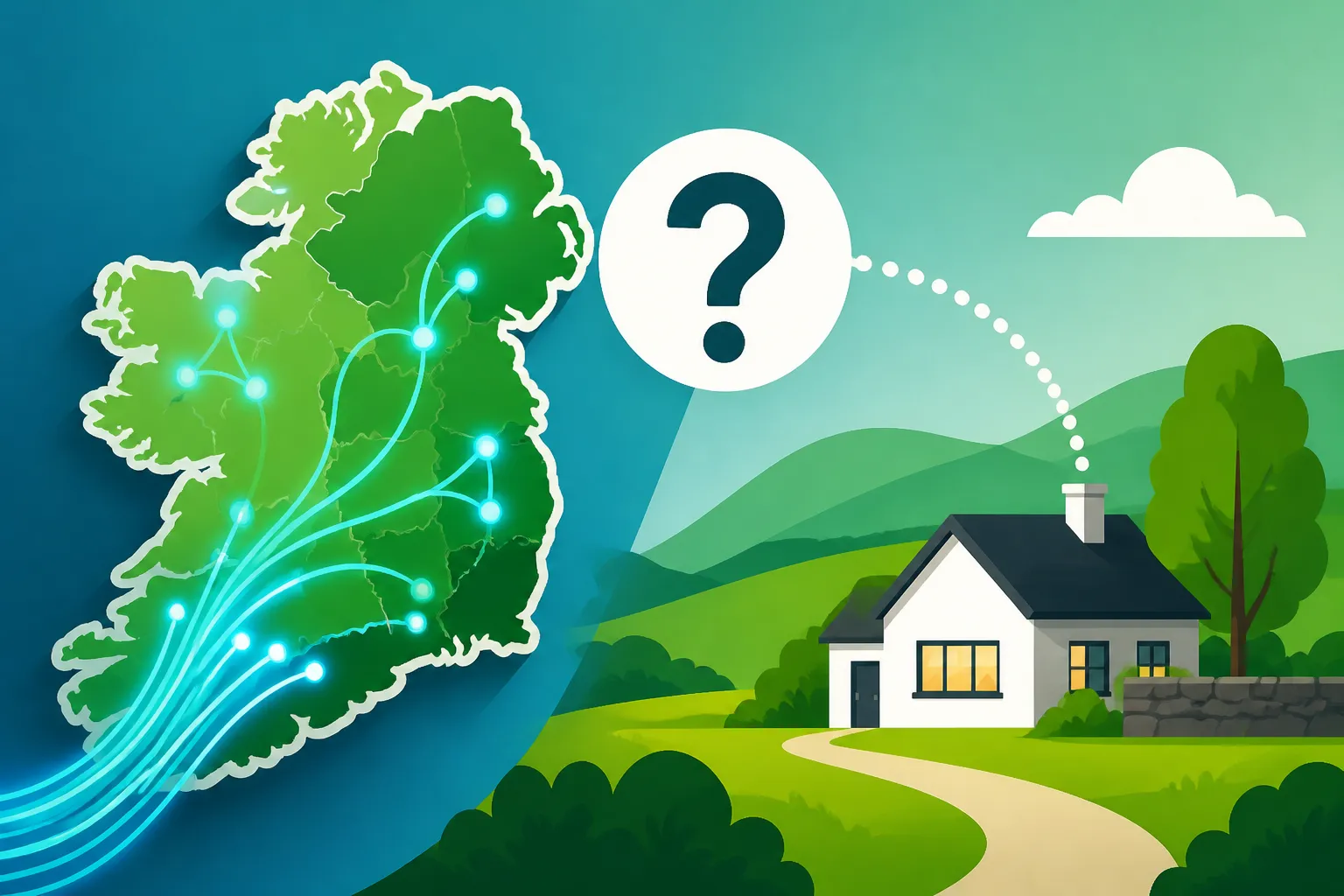
However, once you venture into the picturesque but more sparsely populated rural landscapes – the very places many expats dream of for a quieter life – the story changes dramatically. Here, broadband infrastructure can be patchy at best, and non-existent at worst. Many homes might still rely on older copper lines, resulting in speeds that are a fraction of what fibre offers. This isn't just an inconvenience; it can genuinely impact your ability to work, study, or even stay connected with family back home. It's a common lament among expats, and it's a valid one.
Understanding Different Fibre Technologies
When you're looking into broadband, you'll hear terms like FTTH and FTTC thrown around. It’s important to understand the difference, as it directly impacts the speed and reliability you'll experience.
Fibre-to-the-Home (FTTH), sometimes called Fibre-to-the-Premises (FTTP), is the gold standard. This means that fibre optic cables run directly from the exchange right into your house or apartment. This setup offers the fastest, most stable speeds, often ranging from 500 Mbps up to 1 or even 2 Gbps. This is what you want if you can get it. With FTTH, there's no copper element to degrade the signal, ensuring consistent, high performance even during peak usage times. For anyone with heavy internet demands – think multiple users streaming 4K content, online gaming, large file uploads for work, or regular video calls – FTTH is an absolute game-changer. It means you can realistically expect to enjoy all your online activities without frustrating buffering or lag.
Fibre-to-the-Cabinet (FTTC), on the other hand, is a hybrid solution. With FTTC, fibre optic cables run from the exchange to a street cabinet, but the final connection from the cabinet to your home is still made using older copper telephone lines. While significantly faster than old-school ADSL (which is entirely copper-based), FTTC speeds are limited by the length and quality of that copper connection. You might get speeds up to 100-200 Mbps, which is decent for many households, but it's not the full fibre experience. The further you are from the cabinet, the slower your speeds will be. This technology is often seen as an interim step before full FTTH rollout, or as the primary "fibre" option in areas where FTTH is not yet commercially viable or planned by certain providers. Knowing which type of fibre is available in your area is crucial when comparing providers and setting your expectations.
Key Players and Initiatives Driving Fibre Rollout
The landscape of Irish broadband providers can be a bit of a maze, with different companies operating their own networks or sharing infrastructure. Understanding who does what will help you navigate your options.
The National Broadband Plan (NBP) and Its Impact
Recognising the severe digital divide, the Irish government launched the National Broadband Plan (NBP). This ambitious, long-term initiative aims to deliver high-speed fibre broadband to every single home, farm, and business in the country that isn't served by commercial operators. It's a massive undertaking, and it's being rolled out by National Broadband Ireland (NBI). The NBP specifically targets the approximately 540,000 premises in what they call the "intervention area" – essentially, the hard-to-reach rural and isolated areas that commercial providers wouldn't touch due to low population density and high costs.
Progress on the NBP has been, shall we say, steady rather than lightning-fast, but it is making headway. Thousands of premises are being passed each month, and NBI provides an excellent National Broadband Plan (NBP) Rollout Map. You can enter your specific Eircode on their website to see if your address is included in the NBP intervention area, and if so, what the estimated timeline is for connection. For anyone considering a move to a truly rural part of Ireland, checking this map is absolutely non-negotiable. It could be the difference between having blazing-fast internet and relying on patchy mobile signals.
Commercial Providers and Their Coverage
Beyond the NBP, several commercial providers are active in Ireland, primarily in urban and more densely populated suburban areas. These are the names you'll most commonly come across when looking for broadband.
Eir is Ireland's largest telecommunications company and has the most extensive fibre network, reaching millions of homes across the country. They offer both FTTH and FTTC services, making them a significant player in both urban and some semi-rural areas. Their fibre rollout is ongoing, and they often lead the charge in new fibre installations in commercially viable areas.
Virgin Media operates its own independent network, which is a mix of fibre and coaxial cable, offering some of the fastest speeds in their service areas, particularly in larger towns and cities. They are a strong contender for high-speed broadband in urban environments, often bundling TV and phone services. Their network doesn't extend as widely as Eir's, but where it is available, it's very competitive.
Siro is a wholesale open-access network that builds FTTH infrastructure using the existing ESB (Electricity Supply Board) electricity network poles and underground ducts. This means they don't sell directly to consumers; instead, various retail providers like Vodafone, Sky, and Digiweb use the Siro network to offer their own fibre broadband packages. Siro is aggressively expanding its network, particularly in regional towns and cities, bringing true FTTH to many locations that previously only had FTTC or slower options. They are a game-changer for many towns across Ireland.
Other providers like Sky, Vodafone, and Digiweb also offer fibre broadband, often utilising Eir's or Siro's wholesale networks in addition to their own infrastructure in some cases. This means you might find multiple providers offering services at your address, but they could all be using the same underlying physical fibre connection. The key is to check which providers actually serve your specific address with their best fibre offerings.
Understanding these different players is crucial. Just because a provider operates in Ireland doesn't mean they can connect your specific home. Always, always check by Eircode.
How to Check Fibre Broadband Availability at Your Address
The single most important piece of advice I can give you as an expat looking for broadband in Ireland is this: do not assume anything. Never sign a lease or commit to a property before checking its broadband availability. Trust me, learning How to Set Up Broadband and TV in Ireland starts with knowing what's actually possible at your new address.
Utilising Online Availability Checkers
The good news is that most major broadband providers have excellent online tools to check availability. This is where your property's Eircode becomes your best friend. An Eircode is a unique seven-character code for every address in Ireland, far more precise than a traditional postcode.
Here’s how you typically go about it:
- Gather Your Eircode: Make sure you have the exact Eircode for the property you're interested in. You can find it on the property listing, or by using the official Eircode Finder website.
- Visit Provider Websites: Go to the websites of the main providers like Eir, Virgin Media, Sky, Vodafone, and also Siro (though for Siro, you'll need to then go to their retail partners like Vodafone or Sky to see packages). Most will have a prominent "Check Availability" or "Enter Eircode" section on their homepage.
- Enter Your Eircode: Type in the Eircode accurately and hit search.
- Review Results: The websites will usually tell you what services (fibre, DSL, mobile broadband) are available at that specific address, along with the maximum estimated speeds. Some will even indicate whether it's FTTH or FTTC.
- Check the National Broadband Plan Map: As mentioned, if you're in a rural area, also consult the National Broadband Ireland (NBI) rollout map. This will confirm if your address is in the intervention area and give you a timeline for fibre rollout under the NBP.
It's a process, but it’s invaluable. You'd be surprised how often a property might be described as having "high-speed internet" when, in reality, it's still on an old copper line with speeds that feel positively ancient. This step is as crucial as understanding The Cost of Living in Ireland: A Complete Breakdown for Foreigners (2026) when budgeting for your move.
What to Do If Fibre Isn't Available
So, you've checked, and the dreaded news is in: no fibre broadband for your dream cottage in the countryside. Don't despair entirely! While not ideal, there are still options to get connected, though they come with their own set of compromises.
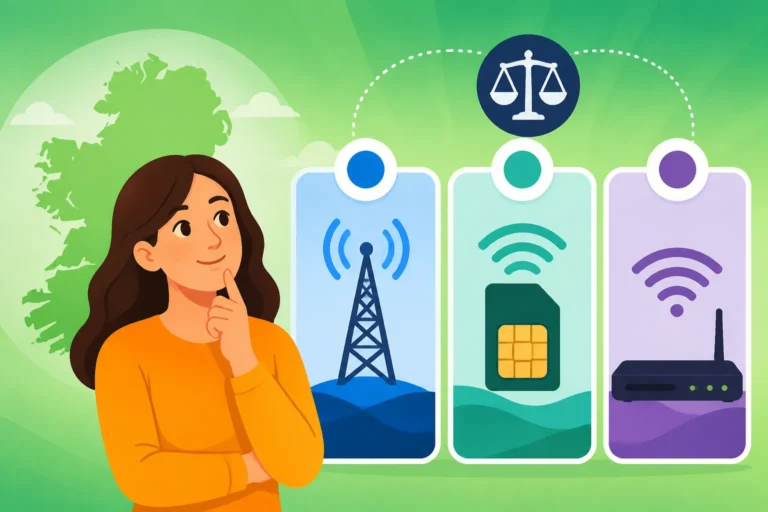
Fixed Wireless Broadband (FWA): This is often the next best thing in areas without fibre. FWA uses radio signals transmitted from a mast to a receiver on your home. Providers like Imagine Broadband or local wireless providers (often smaller, regional companies) offer this service. Speeds can vary wildly depending on your line of sight to the mast, distance, and network congestion, but it's generally much faster than DSL and can offer decent performance for everyday use. Installation usually involves an external antenna, so make sure your landlord is okay with it if you’re renting.
Satellite Broadband: For the truly remote locations where even FWA isn't feasible, satellite broadband is an option. Starlink, from SpaceX, has emerged as a strong contender here. It offers relatively high-speed, low-latency internet via a dish installed on your property, connecting to satellites in low Earth orbit. While it's more expensive for equipment and monthly fees than traditional fibre, it can be a lifesaver for very isolated homes. The speeds are impressive for satellite, often comparable to decent urban broadband, making it a viable solution for those who want to live off the beaten path without being cut off from the digital world.
Mobile Broadband: This uses the 4G or 5G mobile networks to provide internet access, either through a dongle, a mobile hotspot device (MiFi), or even a dedicated 4G/5G router in your home. Providers like Vodafone, Three, and Eir all offer mobile broadband plans. The key here is checking mobile signal strength at your specific address. You can often get good speeds if you have a strong 4G/5G signal, but it can be prone to congestion during peak times and data caps might be an issue for heavy users. It’s a great interim solution while you're getting settled, or as a backup. For a temporary solution, or if you travel a lot, a digital SIM like Airalo can be really useful to ensure you're always connected, even if your home broadband isn't ideal. This way, you're not completely reliant on fixed lines while figuring things out, especially in your first few days as you're completing The Complete Guide to Moving to Ireland: Your First 90 Days (2027).
Choosing the Right Fibre Broadband Plan for Your Expat Life
Once you’ve established that fibre broadband is available at your address, the next step is to choose a plan that fits your needs and lifestyle. It’s not just about the biggest number in Mbps; there are several other factors to weigh up.
Factors to Consider Beyond Speed
As an expat, your broadband needs might be slightly different from those of a long-term resident. Here’s what to keep in mind:
- Contract Length: Many providers offer 12 or 24-month contracts. If you’re unsure about your long-term stay or the property you’re in, a shorter contract (if available, often at a slightly higher monthly cost) might offer more flexibility. Cancelling a long-term contract early can incur significant penalties, which is a headache you definitely don’t need while managing other aspects of your relocation. This is something to consider alongside your rental agreement, as Understanding the Irish Rental Market and the Housing Shortage (2027) will highlight the fluidity of accommodation for many newcomers.
- Installation Fees: Some providers offer free installation, especially if fibre is already available at the property. Others might charge a one-off fee. Always confirm this upfront.
- Bundled Services: Many providers try to entice you with bundles that include TV packages, landline phone services, or even mobile phone plans. Evaluate if you genuinely need these. With streaming services like Netflix, Disney+, and live TV apps, a traditional TV package might be redundant for you. Similarly, most expats rely on mobile phones rather than landlines. Don't pay for what you won't use.
- Customer Service Reputation: This is often overlooked but can be a lifesaver if things go wrong. Search expat forums and online reviews for feedback on customer service, especially for technical support. Dealing with internet outages or billing issues in a new country can be extra stressful, so choosing a provider with a reputation for good support is wise.
- Upload Speeds: While download speeds get all the glory, if you work remotely and frequently upload large files, participate in video conferences, or back up to cloud storage, good upload speeds are vital. Fibre (especially FTTH) offers symmetrical or near-symmetrical speeds, meaning uploads are almost as fast as downloads. This is a huge advantage over older technologies.
Comparing Providers and Packages
With several providers offering fibre, it pays to shop around. Don't just pick the first one you see. Look at promotional offers, introductory rates, and what the price reverts to after the initial period.
Here’s a simplified table comparing some general characteristics of major providers. Remember, specific packages, speeds, and prices are constantly changing, and availability is address-dependent.
| Provider | Network Type | Typical Speeds Available | Key Features / Considerations | Best For |
|---|---|---|---|---|
| Eir | FTTH, FTTC, DSL | 100 Mbps – 1 Gbps (Fibre) | Extensive network, often bundled with mobile/TV, strong presence in rural FTTC areas. | Widespread availability, good for bundles, reaching more rural areas. |
| Virgin Media | Fibre-Coaxial Hybrid | 250 Mbps – 2 Gbps | Very fast speeds in urban areas, robust network, strong TV/broadband bundles. | Urban dwellers, high-speed users, those wanting TV bundles. |
| Siro | FTTH (Wholesale) | 100 Mbps – 2 Gbps | Pure fibre, open-access (resold by partners), very reliable. Growing rapidly in regional towns. | Future-proofing, reliability, top speeds; choose via a retail partner. |
| Sky | FTTH (via Eir/Siro), FTTC | 100 Mbps – 1 Gbps (Fibre) | Strong TV bundles, good customer service reputation, uses multiple underlying networks. | Bundled entertainment, good support, wide range of speed options. |
| Vodafone | FTTH (via Eir/Siro), FTTC | 100 Mbps – 1 Gbps (Fibre) | Often bundles with mobile phone plans, competitive pricing, good for mobile users. | Mobile plan integration, competitive pricing, urban/regional fibre. |
When you're trying to compare, think about your daily usage. Do you just browse and check emails, or are you a heavy streamer, gamer, or remote worker constantly on video calls? This will dictate the minimum speed you truly need. A 100 Mbps connection might be perfectly fine for a single person, but a family of four with multiple devices and heavy usage will struggle with anything less than 500 Mbps, particularly if it's FTTC. Comparing providers and reading reviews, perhaps even on sites like Sirelo for relocation services which often have insights on utility providers, can give you a better overall picture of satisfaction levels and service quality. If you're looking for flexibility for mobile data while travelling or setting up, Airalo eSIMs can be a great option for immediate connectivity without physical SIM cards.
Always look for a "no hidden fees" guarantee, and carefully read the terms and conditions, especially around installation, equipment, and contract exit clauses. It’s a bit of homework, but it will save you headaches down the line. And remember, registering with a utility like broadband is a key part of getting your new life sorted, much like sorting your power and gas, which you can read about in The Expat Guide to Setting Up Utilities (Electricity, Gas, Water) in Ireland.
Disclaimer
The information provided in this guide is for general informational purposes only and does not constitute professional advice. Broadband availability, speeds, pricing, and terms and conditions can change frequently. Always verify the most current information directly with service providers and official government sources before making any decisions. We aim to provide accurate and up-to-date information, but cannot guarantee its absolute correctness or completeness at all times.