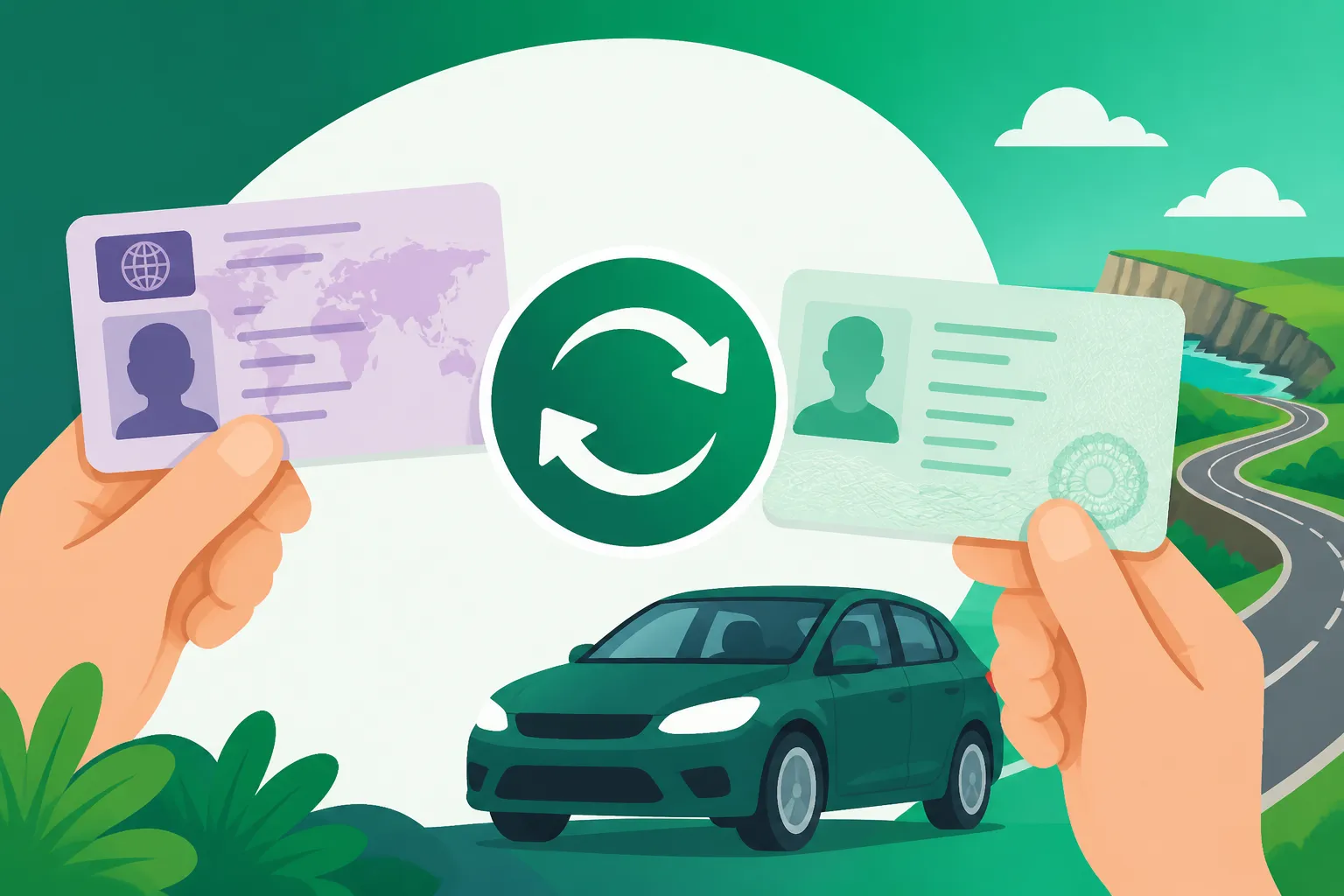
How to Exchange a Foreign Driving Licence in Ireland
One of the first things that hits you when you move to Ireland, right after the initial culture shock and the quest for a proper cuppa, is the sheer mountain of administrative tasks. And if you’re planning on driving, getting your head around the foreign driving licence exchange process can feel like an insurmountable challenge, filled with confusing rules and seemingly endless paperwork. Don't worry, you're not alone in feeling this way. This guide is here to cut through the jargon and provide a clear, empathetic roadmap to help you exchange your foreign driving licence in Ireland, so you can hit the open roads without a hitch.
Understanding Ireland's Driving Licence Rules for Expats
Navigating the rules for driving on a foreign licence in Ireland can be a real head-scratcher, especially when you’re still getting your bearings. It’s not as simple as just showing up and driving indefinitely. There are specific timelines and conditions that apply, and getting it wrong can lead to serious headaches, including fines or even car insurance issues. Let's break down what you need to know from the moment you land.
Initial Driving Rights with a Foreign Licence The Grace Period
When you first arrive in Ireland, you generally get a grace period during which you can drive on your existing foreign licence. This is fantastic for those initial weeks when you're trying to find your feet, sort out accommodation, and perhaps even secure a job. For visitors, this period can extend for the duration of their stay, provided their licence remains valid. However, for those of us moving here for the long haul – becoming "ordinarily resident" – the clock starts ticking the moment you establish that residency.
Most non-EU/EEA licences that are recognised for exchange (we'll get to that in a moment) allow you to drive for up to 12 months from the date you become ordinarily resident. For EU/EEA citizens, the rules are much more straightforward: you can drive on your valid EU/EEA licence until it expires, at which point you’ll need to exchange it for an Irish one. Think of that initial 12-month period for non-EU/EEA folks as your window of opportunity. It’s enough time to settle in, but definitely not enough time to procrastinate. Many expats find it useful to keep their phone data topped up with a reliable eSIM from providers like Airalo when they first arrive, as they'll need to navigate unfamiliar roads and look up information on the go while making the most of this initial driving period.
The Importance of "Ordinary Residence" and What It Means for You
The term "ordinary residence" is crucial here, and it’s where many expats get tripped up. It's not about how long you've physically been in Ireland, but rather when you've established your primary place of abode and your intention to reside here for a period. Generally, you become "ordinarily resident" for driving licence purposes if you live in Ireland for at least 185 days in a calendar year. This is often linked to the date you moved here, started working, or enrolled in a long-term course.
The National Driver Licence Service (NDLS) and the Gardaí (Irish police) will consider factors like where you pay tax, where your family lives, where you own property, or where your main employment is based. For example, if you moved to Dublin for a job on September 1st, 2023, you’d become ordinarily resident on that date, and your 12-month window for driving on your foreign licence would run until August 31st, 2024. After that, your foreign licence is no longer valid for driving in Ireland, even if it's perfectly valid in your home country. This distinction is vital because it directly impacts your legal right to drive and, crucially, your car insurance coverage. Insurers are very particular about this, and driving without a legally recognised licence can void your policy entirely, leaving you in a very precarious situation if an accident occurs.
The Consequences of Not Exchanging Your Licence on Time
So, what happens if you miss that 12-month deadline for non-EU/EEA licences? Simply put, you become an unlicensed driver in Ireland. This isn’t just a slap on the wrist. Driving without a valid Irish licence (or a valid exchangeable foreign licence within the grace period) carries severe penalties. You could face fines of up to €5,000, imprisonment for up to six months, or both. Your vehicle could be seized, and you’ll accumulate penalty points on your record, which could impact future insurance premiums and even your ability to get an Irish licence down the line.
Beyond the legal ramifications, the practical consequences are also daunting. Your car insurance becomes null and void. Imagine having an accident, even a minor one, and discovering your insurer won't cover you because you weren't legally licensed to drive. The financial implications could be catastrophic. It’s not just about avoiding trouble; it’s about peace of mind and ensuring you’re fully covered. Many expats moving larger belongings with services like Sirelo often overlook these local nuances in their initial planning, but they are critical for a smooth transition into daily life. Trust me, the bureaucracy here can be frustrating, but ignoring these rules is a far greater headache. To better understand the overarching rules, take a look at our comprehensive guide on Driving in Ireland: Licences, Registration and Rules for Expats (2027) – it really dives deep into all these aspects.
Eligibility and Documentation: What You'll Actually Need
Right, now that we’ve hammered home the "why," let’s get into the "how" and "what." The process of exchanging your foreign driving licence in Ireland heavily depends on where your original licence was issued. Ireland has agreements with certain countries, making the exchange relatively straightforward, while others require you to go through the full Irish driving test. Understanding which category you fall into is your first critical step.
Countries with Exchange Agreements Recognised States
If you're lucky enough to hold a driving licence from a "recognised state," the exchange process is significantly simpler. These are countries with whom Ireland has a mutual recognition agreement, meaning they trust the validity and standards of your original driving test. As of my last check, these typically include all EU/EEA member states, Australia, Canada, Gibraltar, Guernsey, Isle of Man, Japan, Jersey, South Africa, South Korea (for specific categories), Switzerland, Taiwan, the UK, and the USA (for specific states/territories).
For these recognised licences, you usually don't need to take a driving test. You simply apply to exchange your foreign licence for the equivalent Irish one. It's a bit like swapping one valid ID for another, though with a fair bit more paperwork. The key is that your licence must be current and valid, and you must have held it for a certain period, usually at least six months. This category includes common expat origins like the USA, so if you're coming from New York or California, you're generally in luck. This makes life a lot easier, allowing you to focus on other pressing matters like setting up utilities. Check out The Expat Guide to Setting Up Utilities (Electricity, Gas, Water) in Ireland for help with that.
Non-Recognised States The Test Route
If your licence isn't from one of the recognised states, then I’m afraid it’s going to be a bit more involved. This means you’ll need to go through the full process of obtaining an Irish driving licence, which includes taking both the theoretical Driver Theory Test and the practical driving test. Your foreign licence will allow you to drive for up to 12 months as an ordinarily resident person (as discussed above), but after that, it's back to basics.
This means applying for an Irish learner permit, displaying L-plates on your car, being accompanied by a fully qualified driver (who has held their full licence for at least two years) at all times, and undertaking mandatory driving lessons with an Approved Driving Instructor (ADI). It’s a significant commitment of time and money, but it’s the only legal route to driving in Ireland if your country doesn't have an exchange agreement. So, if you’re coming from India, Brazil, or the Philippines, for instance, you'll need to prepare for the tests. It’s certainly not ideal, and I know it's a source of immense frustration for many skilled drivers who feel their experience is being undervalued. But them’s the rules, unfortunately.
Gathering Your Paperwork The Full Checklist
Regardless of whether your country is recognised for exchange or not, the NDLS loves its paperwork. Being organised is key to avoiding delays. Here’s a general checklist of what you’ll typically need:
- Your current foreign driving licence: This must be original, valid, and show your categories. If it's not in English, you'll need a certified translation.
- Proof of your identity: Usually your passport.
- Proof of your address in Ireland: A utility bill (gas, electricity, landline), bank statement, or official letter from a government department, dated within the last six months. Mobile phone bills are generally not accepted, which is a common source of confusion.
- Proof of your PPS Number: This is your Personal Public Service Number, essential for nearly all administrative tasks in Ireland. If you don't have one yet, that's your first priority. You can learn more about this in our guide on How to Register for Tax and Get a PPS Number in Ireland.
- Certificate of Professional Competence (CPC): If you're exchanging a bus or truck licence, you might need this.
- Medical Report: If you have certain medical conditions, or if you're applying for a truck or bus licence, you'll need a medical report filled out by a registered Irish medical practitioner.
- Application Form: The official NDLS application form, which you can usually download online or get at an NDLS centre.
- Fee: There's a fee for the exchange, which varies depending on the licence duration (usually 10 years).
Table: Foreign Driving Licence Exchange Eligibility in Ireland
| Licence Origin Category | Exchange Process | Key Requirements | Notes for Expats |
|---|---|---|---|
| EU/EEA Countries | Direct Exchange | Valid, current licence from any EU/EEA state. | No test required. Drive until expiry, then exchange. |
| Recognised States | Direct Exchange | Valid, current licence; held for min. 6 months. | No test required. Must exchange within 12 months of becoming 'ordinarily resident'. |
| Non-Recognised States | Full Irish Test | Apply for Learner Permit; pass Driver Theory Test & Practical Test. | Must take tests. Can drive on foreign licence for 12 months (ordinarily resident). |
Always double-check the latest requirements on the official NDLS website, as rules can change. It's a good idea to gather all these documents before you even set foot in an NDLS centre, as missing one item means you'll be sent away and have to start the queue all over again.
The Step-by-Step Process for Exchanging Your Licence
Alright, you’ve figured out your eligibility and painstakingly collected all your documents. Now comes the moment of truth: the actual application. The process itself is fairly streamlined, but it requires patience and attention to detail.
Where to Apply The NDLS Centre Experience
The entire process of exchanging your driving licence happens at a National Driver Licence Service (NDLS) centre. These are dedicated centres across Ireland, not your local Garda station or post office, so don't waste your time queuing at the wrong place. You can find your nearest centre on the NDLS website.
While some aspects of the application can be started online, the final submission and identity verification must be done in person at an NDLS centre. You’ll need to book an appointment in advance, which is highly recommended to avoid long waits, though walk-ins are sometimes accommodated if they have availability. Remember to bring all your original documents with you; photocopies won't cut it. When you get there, you'll present your documents, have your photograph taken, and provide an electronic signature. It’s all very official, but it’s usually quite efficient once you’re called. Just be prepared for a bit of a wait even with an appointment, as these centres can get busy, especially in larger cities like Dublin, Cork, or Galway. Many people find themselves using apps to kill time, so having a good mobile plan from a provider like Airalo is always handy.
Navigating the Application Form and Online Portal
The NDLS has an online portal that allows you to kickstart your application, which can save you a bit of time at the centre. You can input your details, select the type of licence you're applying for (in this case, an exchange), and even upload some supporting documents. However, as mentioned, the full application requires an in-person visit.
The application form itself is fairly standard but can feel a bit overwhelming with its numerous sections. Take your time filling it out, ensuring all details match your supporting documents exactly. Any discrepancies, even minor ones, can lead to your application being rejected. Pay close attention to the sections asking about your PPSN, previous addresses, and your existing licence details. If your foreign licence is from a non-recognised state, you'll be applying for a first-time Irish learner permit, which has its own specific form and requirements, including proof of passing the Driver Theory Test. It's a detailed process, but following the instructions carefully will save you a lot of back-and-forth.
What Happens After You Apply Waiting Game and Collection
Once you've submitted your application at the NDLS centre, you hand over your foreign licence. Yes, that's right – they keep it! This is because you can only hold one full driving licence at a time. They'll issue you with a temporary permit (a paper receipt) which you can use for driving until your new Irish licence arrives. This temporary permit isn't universally recognised abroad, so if you plan any international travel shortly after applying, be aware you won't have your physical licence with you.
The NDLS states that it generally takes about 5-10 working days for your new Irish driving licence to be processed and posted to you. However, based on expat experiences, this can sometimes be longer, especially during peak periods or if there are any issues with your application. It will be sent directly to the address you provided. If it doesn't arrive within the stated timeframe, you should contact the NDLS customer service line. Once it arrives, you’re officially an Irish-licensed driver! Keep your temporary permit safe until your new card arrives, as it's your only proof of driving permission in the interim.
Common Challenges and Troubleshooting for Expats
Even with the best intentions and meticulous planning, the path to getting an Irish driving licence isn't always smooth. Expats often encounter specific hurdles that can delay the process or cause significant stress. Let's tackle some of these common challenges head-on.
Dealing with Lost or Expired Foreign Licences
One of the trickiest situations is trying to exchange a foreign licence that's either expired or, even worse, lost. The NDLS generally requires a valid and current foreign licence for exchange. If your licence has expired, most recognised states will require you to renew it in your home country first before it can be exchanged in Ireland. This can be a major logistical nightmare if you're already settled here and don't have immediate plans to return home.
If your foreign licence is lost, you'll need to obtain an official statement or letter from the issuing authority in your home country confirming its validity and details. This letter must clearly state the licence number, class, issue date, and expiry date. Without this, the NDLS is unlikely to process your application. In some cases, if you cannot provide a valid, current licence or verifiable proof of one, you might be pushed into the "non-recognised state" category, meaning you'd have to take the full Irish driving test, regardless of your origin country. This is a brutal blow for many, but it highlights the importance of keeping your foreign licence safe and up-to-date until you've successfully exchanged it.
The Driving Test Hurdle for Non-Recognised States
If your licence is from a non-recognised state, the driving test hurdle is a significant one. It's not just about knowing how to drive; it's about knowing how to drive in Ireland and how to pass the specific Irish driving test. The test often differs in structure and emphasis from what you might be used to. For instance, the focus on mirror checks, indicating, and specific road rules like turning left at a junction with a cycle lane might be more stringent than in your home country.
You'll need to study the 'Rules of the Road' thoroughly and undertake lessons with an Approved Driving Instructor (ADI). These lessons are crucial not just for skill development but for familiarising you with the test routes and expectations of Irish examiners. Waiting times for the driving test can also be notoriously long, sometimes extending for several months, particularly in busy urban centres. This means you need to factor in this delay when planning your application. Applying for your learner permit and booking your theory test should be among your top priorities if you fall into this category, ideally within the first few weeks of arriving to maximise your 12-month grace period.
Understanding Different Licence Categories and Restrictions
Another area of confusion can be the different licence categories. Your foreign licence might show a single "full" category, but in Ireland, there are distinct categories for cars (B), motorcycles (A), vans (B+E), trucks (C), and buses (D), among others. When you exchange your licence, the NDLS will typically exchange it for the equivalent Irish category based on the information on your foreign licence.
However, sometimes there can be slight differences or restrictions. For example, if your foreign motorcycle licence only allows you to drive certain engine sizes, your Irish licence might reflect that restriction initially. Similarly, if your truck or bus licence requires a Certificate of Professional Competence (CPC) in Ireland, you'll need to ensure you meet those additional requirements. Always clarify with the NDLS if you have any doubts about what categories your new Irish licence will cover. It's not uncommon for expats with commercial driving experience to find themselves needing to take additional tests or courses to gain full Irish recognition for their advanced categories.
Beyond the Exchange: Getting Used to Driving in Ireland
Getting your Irish driving licence is a huge achievement, but it's just the beginning of your journey on Irish roads. The driving environment here has its own unique flavour, and adapting to it takes time, patience, and a good sense of humour.
The Quirks of Irish Roads and Driving Culture
Driving in Ireland, especially if you're coming from a country that drives on the right, is a significant adjustment. We drive on the left, our cars are right-hand drive, and the gear stick is on your left. This alone can feel like learning to drive all over again. Beyond that, the roads themselves can be an adventure. You'll encounter narrow country roads, often with hedges that seem to reach out and grab your wing mirrors, and the infamous 'pothole lottery'. In urban areas, roundabouts are ubiquitous, and navigating multi-lane ones can be daunting at first.
Drivers in Ireland are generally courteous, but you'll also encounter a fair share of hurried commuters. Learning to anticipate, using your mirrors constantly, and getting comfortable with the smaller, often faster-moving traffic on country roads is key. Signage is generally good, but sometimes the "local" interpretations of speed limits or parking rules can be a bit… flexible. For a much deeper dive into the nuances of driving here, our post on Driving in Ireland: Licences, Registration and Rules for Expats (2027) covers everything from road signs to local driving habits. And don't forget, if you're navigating new areas, having a fully charged phone with a data plan is essential – think about those times Airalo has saved you from getting lost!
Car Insurance: A New Hurdle for New Drivers
Getting car insurance in Ireland can be a monumental headache for expats, even with a brand new Irish driving licence. Many Irish insurers are wary of foreign driving experience, even if you have years of no-claims bonus from your home country. Some might not recognise it at all, or only partially, leading to significantly higher premiums for your first few years here.
It's crucial to gather a letter from your previous insurer in your home country, detailing your no-claims bonus history (number of years, whether it was continuous, and any claims made). This letter should be on official company letterhead and ideally in English. Even with this, you might find yourself starting from scratch or with only a few years credited. Shop around extensively. Major insurers like Liberty, Aviva, and AIG all operate here, but also consider brokers who can compare multiple policies for you. Be prepared for a shock when you get your first quotes; car insurance in Ireland is notoriously expensive, especially for new drivers or those without a long Irish driving history. Learn more about typical costs in our article, How Much Is Car Insurance in Ireland?.
Vehicle Registration, Motor Tax, and the NCT
Once you have your licence sorted and hopefully a car, there are still a few more administrative hoops. Every vehicle in Ireland needs to be registered with Revenue, pay annual motor tax, and undergo a National Car Test (NCT) if it's over a certain age.
- Vehicle Registration: If you're importing a car, you'll deal with Vehicle Registration Tax (VRT) and the initial registration. This is a complex process in itself, with potentially significant costs.
- Motor Tax: This is an annual tax based on your car's engine size or CO2 emissions. You can pay it online, at your local motor tax office, or in certain post offices. Displaying your current motor tax disc is mandatory.
- NCT: Similar to an MOT or TÜV, the NCT is a mandatory roadworthiness test. Cars generally need their first NCT when they are four years old, and then every two years until they are ten, after which it becomes annual. Driving without a valid NCT is illegal and can void your insurance.
This trio of registration, tax, and testing ensures your vehicle is legal and safe on Irish roads. Don't underestimate the time and effort involved in keeping these up-to-date, especially if you're used to a simpler system in your home country. For a comprehensive overview, check out our guide on Understanding Motor Tax, Insurance and the VRT in Ireland.
Your Future Driving Life in Ireland
Congratulations! You've successfully navigated the bureaucratic labyrinth and are now a fully-fledged Irish-licensed driver. But the journey doesn't end there. Like any official document, your Irish driving licence will need to be renewed, and you might want to add new driving privileges down the line.
Renewing Your Irish Driving Licence
Your Irish driving licence is usually valid for 10 years, though shorter durations apply for older drivers or those with specific medical conditions. Approximately three months before your licence is due to expire, the NDLS should send you a reminder. However, as an expat, it's always best to keep track of this yourself, just in case the letter goes astray in the post.
Renewing your licence is generally simpler than the initial exchange. You can often do it online via the NDLS website if your details haven't changed and your photo is recent enough, or you can still make an appointment at an NDLS centre. You'll need proof of identity, proof of your PPS number, and potentially a medical report if you've developed any new conditions or are over a certain age. There will, of course, be a fee for the renewal. Don't let your licence lapse, as driving on an expired licence carries the same penalties as driving without one.
Adding New Categories to Your Licence
Perhaps you moved to Ireland with just a car licence (Category B), but now you fancy getting a motorcycle or even a light truck licence. To add new categories to your existing Irish driving licence, you'll need to go through the full learner permit and testing process for that specific category. This means applying for a learner permit for the new category, undertaking mandatory lessons with an ADI, and then passing both the Driver Theory Test (if applicable for the new category) and the practical driving test for that vehicle type.
For example, if you want to add a motorcycle licence, you'd apply for a Category A learner permit, display L-plates on your motorbike, complete the Initial Basic Training (IBT) with an instructor, and then take the practical motorcycle test. It’s a completely separate process from your car licence, but at least you’re already familiar with the NDLS system!
Driving Abroad with Your New Irish Licence
One of the great perks of holding an Irish driving licence is its validity across the European Union and European Economic Area. Your Irish licence is recognised throughout these countries, making cross-border road trips a breeze. You generally won't need an International Driving Permit (IDP) when driving within the EU/EEA.
However, if you plan to drive outside of the EU/EEA, such as in the USA, Canada, or Australia, it's always a good idea to check the specific requirements of that country. Many countries have reciprocal agreements, but some might require an International Driving Permit in conjunction with your Irish licence, or even a local licence if you're staying for an extended period. An IDP is essentially a translation of your Irish licence and can be easily obtained from the AA Ireland or your local post office for a small fee. It’s always best to be prepared to avoid any unexpected issues when travelling internationally.
Disclaimer
The information provided in this guide is for general informational purposes only and does not constitute legal or professional advice. Driving licence regulations and requirements can change, and individual circumstances vary. Always consult the official National Driver Licence Service (NDLS) website or seek advice from a qualified professional for the most up-to-date and accurate information relevant to your specific situation.