Can I Apply for an Irish Passport After Naturalisation?
So, you've been through the wringer, haven't you? You've navigated the visa maze, counted your days of residence like a hawk, and finally, after what often feels like an eternity of paperwork and waiting, you've received that coveted certificate of naturalisation. It's a huge milestone, a moment of genuine belonging. But then comes the next thought: "Right, now what about the actual Irish passport?" This guide is for you, the seasoned expat who has earned their stripes and is ready to take the final, incredibly satisfying step to securing an Irish passport after naturalisation.
Understanding Naturalisation: Your First Step to an Irish Passport
Getting naturalised in Ireland isn't just a formality; it's a testament to your commitment to this island, its people, and its unique way of life. It's a journey filled with anticipation, the odd bureaucratic hiccup, and ultimately, immense pride. You've officially transitioned from a long-term resident to a bona fide citizen, and that's something to celebrate. But before you can wave that green passport around, there are a few more steps, and understanding the foundation of your naturalisation is key.
The Journey to Becoming an Irish Citizen by Naturalisation
Naturalisation, in simple terms, is the legal process by which a non-Irish national can become an Irish citizen. For many of us who've made Ireland our home, it's the culmination of years spent contributing to the economy, building a life, and putting down roots. It’s not just about ticking boxes; it’s about integrating into the community, raising families, and navigating everything from the subtle nuances of local slang to the often-baffling public transport system.
The process of becoming an Irish citizen by naturalisation itself is outlined in articles like How to Apply for Irish Citizenship by Naturalisation. It typically involves demonstrating "reckonable residence" – proving you've lived here for a certain period – along with being of good character and intending to continue residing in Ireland. You submit your detailed application to the Department of Justice, wait for it to be processed, and hopefully, receive a positive decision. Once approved, you attend a citizenship ceremony, take an oath of fidelity to the nation, and are officially welcomed as an Irish citizen. It’s a truly moving experience, a moment where all those years of effort really sink in. It’s a moment of relief, joy, and often a touch of exhaustion from the sheer volume of documentation.
Meeting the Reckonable Residence Requirements
This is where the rubber meets the road for naturalisation. "Reckonable residence" is the total period of time you've legally resided in Ireland for immigration purposes, which counts towards your citizenship application. It's not just about being physically present; it's about having valid immigration permission. Understanding the nuances of Understanding the Irish Immigration Stamp System (Stamp 1, 2, 4) (2027) is crucial here, as different stamps accumulate reckonable residence in different ways.
Generally, for most adult applicants, you need to have:
- One year of continuous residence in Ireland immediately before the date of your application.
- Four years of residence in Ireland during the eight years preceding that one-year period.
- This makes for a total of five years of reckonable residence in the nine years immediately prior to your application date.
There are exceptions, of course. If you're married to or in a civil partnership with an Irish citizen, the residence requirement can be three years of reckonable residence in the five years preceding the application. If you’re a minor born in Ireland to non-Irish citizens, different rules apply, and your parents might apply on your behalf.
It's absolutely vital to keep meticulous records of your residency. Every IRP card, every stamp in your passport, every official letter confirming your address and presence counts. I remember helping a friend gather his documents for naturalisation, and the sheer volume of bank statements, utility bills, and employment letters spanning nearly a decade was astounding. It truly felt like building a legal case for his right to be here. This detailed proof is what the Department of Justice will scrutinise.
Let's look at a common scenario to illustrate reckonable residence requirements:
| Scenario | General Requirement | Married/Civil Partner to Irish Citizen |
|---|---|---|
| Total Years of Reckonable Residence | 5 years | 3 years |
| Immediately Preceding Application | 1 year continuous | 1 year continuous |
| Prior to That Year (within 8 years) | 4 additional years | 2 additional years |
| Total Period to Consider | 9 years | 5 years |
This table shows why careful planning and record-keeping are so important. Missing a few weeks or months here and there, or having gaps in your immigration permission, can genuinely set you back. It’s best to be over-prepared than under-prepared, a lesson many of us learn the hard way when dealing with Irish bureaucracy. For a deeper dive into this, you might find Understanding the Reckonable Residence Requirement for Citizenship in Ireland incredibly useful.
Applying for Your Irish Passport After Naturalisation: The Practicalities
Congratulations, you've been through the naturalisation process, received your certificate, and perhaps even attended a citizenship ceremony. You might think the hardest part is over, and in many ways, it is. But now comes the final hurdle: actually getting that beautiful, green Irish passport. While it might seem like a mere formality after becoming a citizen, it's still an application process that requires attention to detail, the right documentation, and a healthy dose of patience.
The Essential Documentation You'll Need
After naturalisation, applying for your first Irish passport requires specific documents to verify your identity, your citizenship, and often, your address. It's not as extensive as the naturalisation application, thankfully, but it's still crucial to get it right.
Here’s a typical list of what you'll need:
- Your Original Certificate of Naturalisation: This is the most critical document. It's your proof that you are now an Irish citizen. Make sure it's the original, not a photocopy, as the Passport Office will need to see it.
- Your Current Foreign Passport (if you have one): This is used for identity verification. It helps establish your identity against your naturalisation certificate.
- Proof of Identity: This could be a driver's licence, public services card (PSC), or other government-issued ID.
- Proof of Address: A recent utility bill (electricity, gas, landline phone), bank statement, or official letter from a government department, usually dated within the last three to six months. Yes, more bills! They just love seeing that you’re properly rooted.
- Proof of Name: If your name on your naturalisation certificate, foreign passport, or other ID documents doesn't match exactly, you might need a marriage certificate, civil partnership certificate, or deed poll to explain the discrepancy.
- Two Identical Passport Photographs: These must meet specific requirements (colour, plain background, no shadows, specific dimensions). It's always best to get these done professionally at a photo shop that's familiar with Irish passport specifications. Trying to take them yourself with a phone can lead to frustrating rejections.
- Witness/Garda Signature and Stamp: For first-time passport applications, a witness is required to sign the application form and one of your passport photos. This witness must be a member of An Garda Síochána (the Irish police force), a doctor, solicitor, peace commissioner, or a specified member of the clergy. They also need to stamp the application form with their official stamp. Finding a Garda (police officer) who has the time and an official stamp can sometimes be a bit of a mini-quest, especially in busy urban centres. Don't be afraid to try smaller stations or go during off-peak hours.
- The Completed Application Form: This can be done online or obtained as a paper form.
Remember, the Passport Office is rigorous. Any missing or incorrect documentation will result in your application being returned, prolonging the wait. It's a headache none of us need after getting through the naturalisation process! Many expats have experienced the frustration of submitting what they thought was a complete application, only for it to be sent back for a minor detail, like a photo that's slightly off or a witness signature that's not quite right. Double-check everything before sending it off.
Navigating the Application Process
There are two main ways to apply for your Irish passport after naturalisation:
-
Online Application (Passport Online): This is generally the quickest and most efficient method.
- You'll go to the Passport Online portal (passport.ie).
- Select "First Time Passport Application – Adult."
- Upload your digital passport photo.
- Fill in all your personal details, including your naturalisation certificate number.
- You'll then be given a summary and prompted to pay the fee.
- Crucially, even with an online application, you will still need to print a declaration form at the end, get it witnessed and signed by an eligible person (a Garda, for example), and then mail it, along with your original naturalisation certificate and any other required original documents, to the Passport Office. This is the part that often catches people out – it's not entirely digital for first-time applicants.
-
Paper Application (Passport Express): While still an option, this method is generally slower and involves more manual work.
- You'll need to obtain a paper application form from a Garda station or Post Office.
- Fill out the form by hand, ensuring legibility.
- Affix your physical passport photos (one signed by the witness).
- Get the form witnessed and stamped by an eligible person.
- Gather all your original supporting documents.
- Submit the complete package at a Post Office using the Passport Express service, or mail it directly to the Passport Office.
Whichever method you choose, make sure you keep copies of everything you send, especially your naturalisation certificate. Losing that document would be a nightmare beyond words!
For many new citizens, understanding the entire scope of The Complete Guide to Irish Visas and Immigration Permission for Expats (2027) was their initial headache, and applying for the passport feels like the final chapter. It truly is the grand finale of your immigration journey.
Anticipating Processing Times and Potential Delays
Ah, processing times. The bane of every expat's existence! While Passport Online applications are generally faster, especially for renewals, a first-time application after naturalisation still requires more scrutiny due to the need to verify original documents like your naturalisation certificate.
Current processing times can fluctuate significantly depending on demand (peak season, holidays, etc.) and operational capacity. As of my last check, first-time applications after naturalisation can take anywhere from 20 working days to 8 weeks or more. It's not uncommon for it to stretch a bit longer.
Factors that can cause delays:
- Incomplete or incorrect application: This is the number one culprit. A tiny error can send your application back to square one.
- Issues with photographs: Incorrect size, shadows, or an unsuitable background.
- Unclear witness signatures or stamps: If the Passport Office can't clearly verify your witness, they'll query it.
- Peak seasons: Summer months, pre-Christmas, and periods after major holidays often see higher volumes of applications.
- Postal delays: The old-fashioned snail mail can add its own layer of unpredictability, especially when sending original documents.
- Complexity of your case: If there are any discrepancies or unusual circumstances with your documents, it may take longer for a Passport Officer to review.
The Passport Service provides a useful online tracker, so once you have your application number, you can keep an eye on its progress. Just remember, the status updates aren't always real-time, so a little patience (a lot, actually!) goes a long way. This is just another administrative hurdle in a long line you've already jumped, so you're well-practised in the art of waiting. Remember the wait for your Critical Skills Employment Permit or the processing of your IRP card? This is similar, just for the grand prize!
What an Irish Passport Means for You: Life After the Ceremony
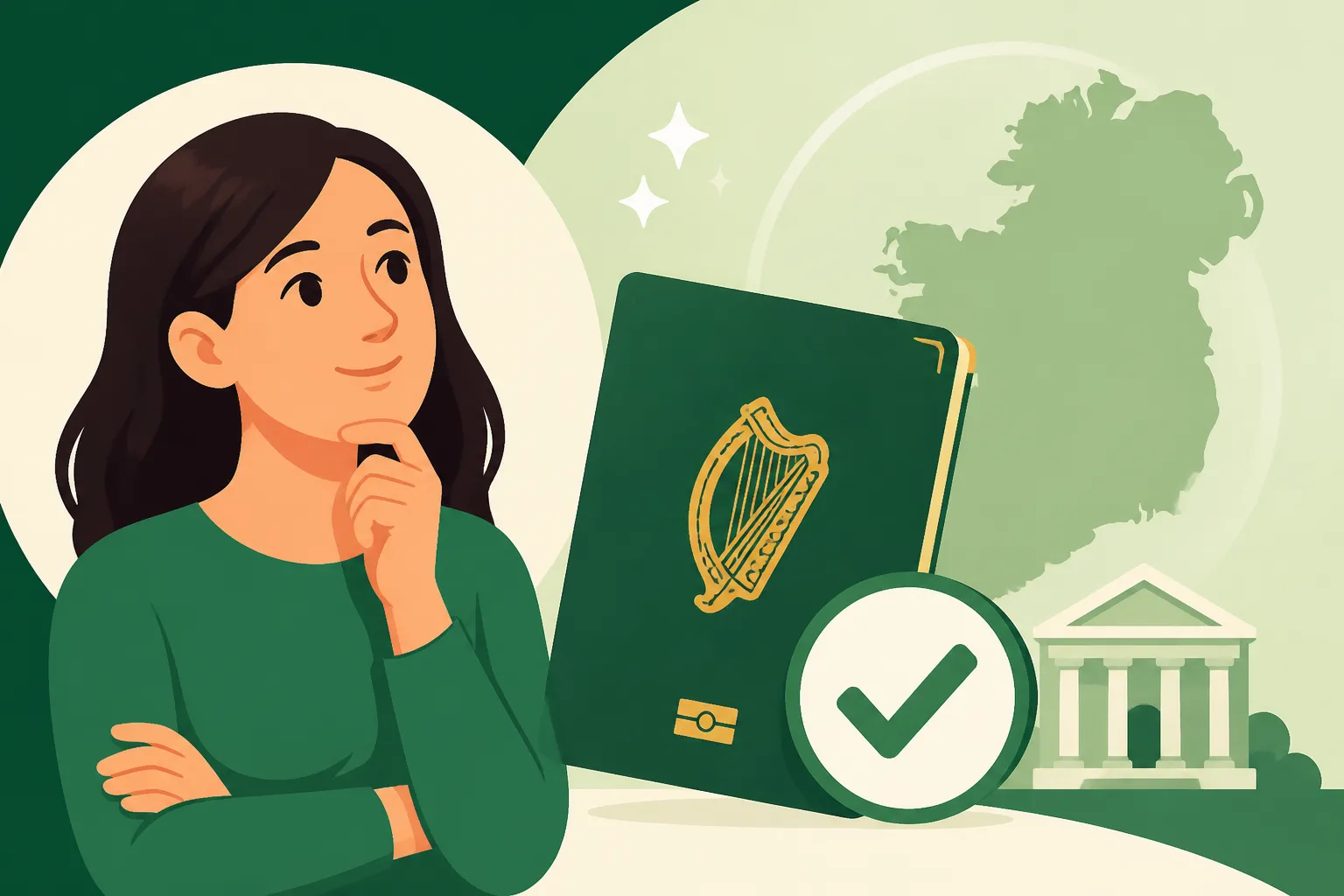
After all the forms, the waiting, the interviews, and the ceremony, holding that green booklet in your hand is a profound moment. It's not just a travel document; it's a tangible symbol of your new identity and your deep connection to Ireland. For those of us who came here and built a life from scratch, it's the ultimate validation.
The Freedom and Benefits of Irish Citizenship
An Irish passport is a powerful document, opening up a world of opportunities and freedoms that were once out of reach.
- Unrestricted Travel: As an Irish citizen, you can travel, live, and work freely within the European Union and the European Economic Area. This is a massive benefit, particularly for those who previously faced visa restrictions. Imagine the ease of spontaneous weekend trips to Paris or longer stints working in Berlin without any immigration hurdles.
- Consular Protection: Should you find yourself in a bind abroad, the Irish government, through its embassies and consulates worldwide, will offer you consular assistance. This provides a safety net that can be incredibly reassuring when travelling in unfamiliar territories.
- No More Immigration Worries in Ireland: This is, for many, the biggest relief. The constant worry about renewing your IRP card, ensuring your immigration stamps are valid, and proving your right to reside in Ireland becomes a thing of the past. You are here to stay, as a citizen, with full rights and responsibilities. The days of religiously checking The Complete Guide to the IRP Card and Registering with Immigration (2027) are behind you!
- Voting Rights: You gain the right to vote in all elections and referendums in Ireland, including Dáil (national parliament) elections, European Parliament elections, and local elections. This gives you a direct say in the future of the country you now call home.
- Full Access to Public Services: While as a resident you likely had access to many services, citizenship solidifies your standing. This includes things like access to healthcare services without the complexities sometimes faced by non-EU nationals, as detailed in The Complete Guide to Healthcare in Ireland for Expats (2027). You're no longer an expat navigating the system; you're simply Irish.
- A Sense of Belonging: Beyond the practicalities, there's an undeniable emotional component. Becoming an Irish citizen is about feeling truly at home, connected to the history, culture, and community in a deeper way. It means being able to fully embrace your identity as an Irish person, while still cherishing your heritage.
Maintaining Your Irish Citizenship and Passport
Irish citizenship, once granted, is generally for life. However, your passport needs to be renewed periodically.
- Passport Renewal: Adult Irish passports are typically valid for 10 years. You'll need to renew it before it expires. Renewals are a much simpler process, often done entirely online, and generally have quicker processing times, as your citizenship is already established. You won't need your naturalisation certificate again for renewals, but you will need your old passport.
- Responsibilities: With citizenship come responsibilities, such as adhering to Irish law and, if you choose, participating in the democratic process. There are very few ways to lose Irish citizenship, mainly through renunciation (if you choose to give it up) or in extremely rare cases of serious disloyalty to the State or fraud in the naturalisation application.
Holding an Irish passport means carrying a piece of Ireland with you wherever you go. It’s a wonderful feeling after so many years of paperwork and patience.
Important Considerations for Naturalised Citizens
The journey to naturalisation and acquiring an Irish passport is a significant one. While it brings many freedoms and a profound sense of belonging, there are still a few important considerations for new citizens, especially regarding dual nationality and future plans.
Dual Citizenship: Holding Onto Your Original Passport
One of the most common questions and a significant relief for many new Irish citizens is regarding dual citizenship. Ireland does allow dual citizenship. This means that, in most cases, you do not have to renounce your original citizenship when you become an Irish citizen. This is a huge benefit for many expats, allowing them to maintain ties with their country of origin and enjoy the rights and privileges of both citizenships.
However, it's crucial to remember that while Ireland permits dual citizenship, your country of origin might not. Some countries require you to formally renounce your previous citizenship upon acquiring a new one. If you fail to do so, you could potentially lose your original citizenship automatically, or face other legal ramifications in your birth country.
Therefore, before you even apply for naturalisation, it is imperative that you research the laws of your country of origin regarding dual nationality. Consult with an embassy or consulate of your original country if you're unsure. This step is often overlooked in the excitement of Irish naturalisation, but it can have long-term consequences. I've known people who were genuinely shocked to find out their home country automatically stripped them of their citizenship once they became Irish, so please, do your homework!
Planning for the Future: Relocation and Family Considerations
With an Irish passport in hand, your future possibilities expand considerably.
- Ease of Relocation within the EU/EEA: As mentioned, your Irish passport grants you the right to live and work in any other EU/EEA country without needing additional visas or permits. This can be a huge advantage if your career path takes you to another European city or if you simply fancy a change of scenery. If you're considering moving within Europe, companies like Sirelo can help with the logistics of international moves, making the transition much smoother now that you have full EU citizen rights.
- Family Reunification: If you have family members who are not yet Irish citizens, your new status can simplify certain family reunification processes, particularly if they are also eligible for EU/EEA rights. For non-EU family members, while you now have a stronger standing, specific visa requirements still apply, but your Irish citizenship often makes the process more straightforward than when you were a non-EU resident. Articles like Family Reunification in Ireland: Bringing Your Spouse and Children (2027) might still be relevant for your loved ones.
- Healthcare and Insurance for Travel: With the freedom to travel more extensively, reconsidering your health insurance needs is a smart move. While your Irish citizenship gives you access to the public health system (HSE) in Ireland, for travel outside the country (even within the EU where you get EHIC benefits), comprehensive travel insurance or international private health insurance might be something to look into. Providers like Cigna Global offer plans tailored for global citizens who travel frequently, ensuring you're covered no matter where your Irish passport takes you. It's about protecting that newfound freedom!
- Passing on Citizenship: A wonderful benefit of your Irish citizenship is the ability to pass it on to your children, even if they are born outside of Ireland (under certain conditions, typically if you register their birth in the Foreign Births Register). This creates a lasting legacy for your family and ensures they too can enjoy the benefits of Irish nationality.
Your Irish passport is more than just a document; it’s a key to a wider world, both in terms of global mobility and a deeper integration into your chosen home. It truly marks the end of one journey and the exciting beginning of another.
Disclaimer
Please remember that I am an expat blogger and not a legal professional. While I strive to provide accurate and up-to-date information based on my experiences and publicly available resources, immigration laws and passport application procedures in Ireland can change. Always consult the official websites of the Irish Department of Foreign Affairs and the Department of Justice, or seek advice from a qualified immigration solicitor or legal expert for personal guidance and the most current regulations. This guide is for informational purposes only and should not be considered legal advice.