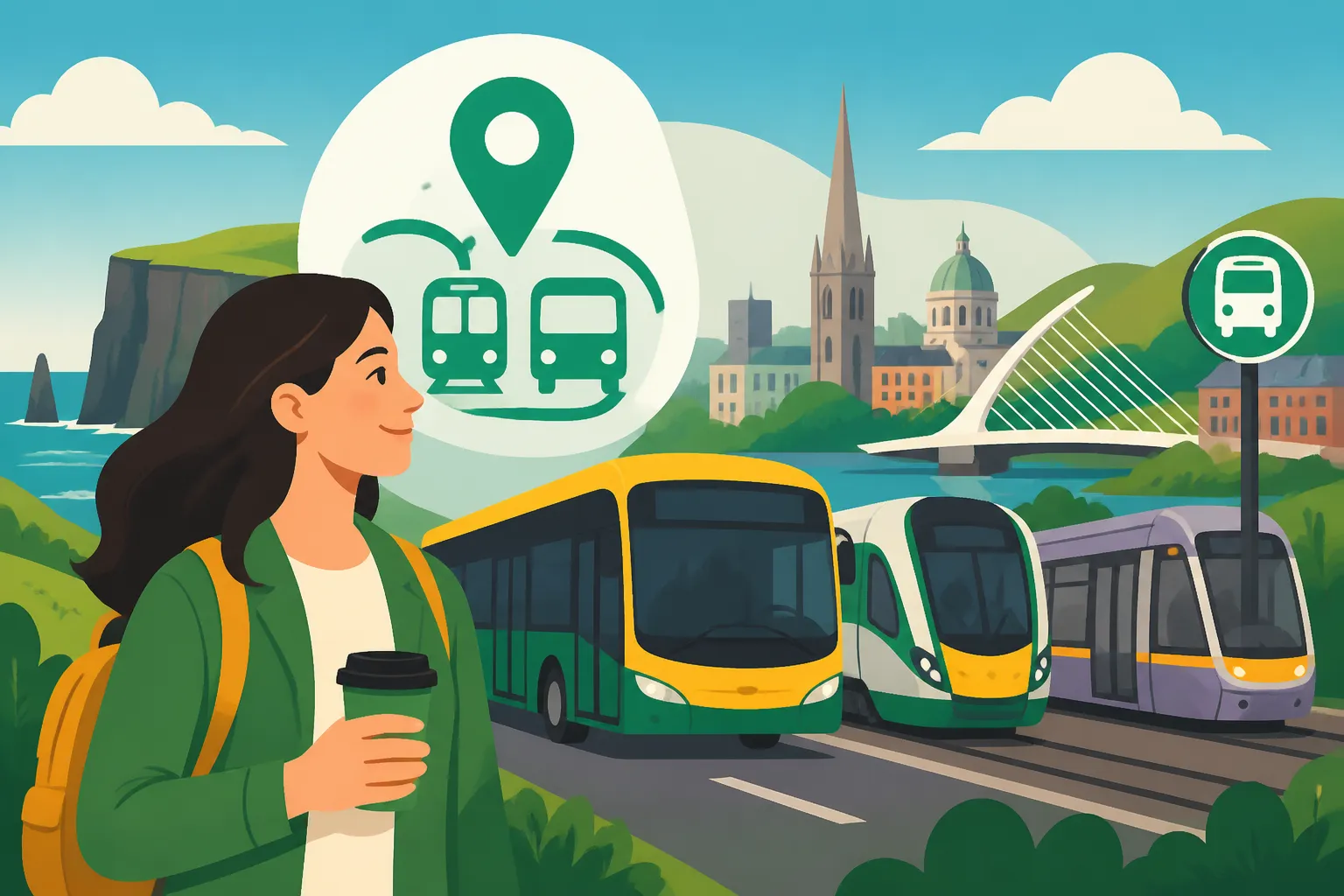
The Expat Guide to Public Transport in Ireland
Oh, the joy of figuring out public transport in a new country, eh? It’s one of those things that seems so simple on paper, until you’re standing at a bus stop in the rain, peering at a timetable that makes no sense, and wondering if that bus is ever actually going to show up. Believe me, I’ve been there – more times than I care to admit. The Irish public transport system has its own unique flavour, a mix of surprisingly efficient city services and charmingly (or frustratingly, depending on your mood) unpredictable rural routes. This guide is here to untangle all of that for you, from deciphering the infamous Leap Card to understanding why some buses have "expressway" in their name but still take forever.
Understanding Ireland's Public Transport Landscape
When you first arrive in Ireland, you might be picturing a seamless network of trains and buses zipping you from picturesque village to vibrant city. The reality is a bit more nuanced, much like everything else here. There’s a core national framework, then a more intense, integrated system within the larger cities, particularly Dublin. Getting your head around these layers is the first step to truly mastering your commute or weekend adventures.
The National Overview: Bus Éireann and Irish Rail
Think of Bus Éireann and Irish Rail (Iarnród Éireann) as the backbone of national transport. Bus Éireann is the main inter-city and regional bus operator, reaching practically every corner of the island. You'll see their green buses everywhere, from the bustling streets of Dublin to the tiniest towns in the west. They operate two main types of services: Expressway, which are faster, more direct routes connecting major towns and cities, and local services, which stop more frequently and serve smaller communities.
The Expressway routes are generally quite reliable for longer distances, though traffic can certainly throw a spanner in the works. They're usually comfortable, with reclining seats and sometimes even Wi-Fi. However, once you venture onto the local services, things can get a bit more… flexible. Schedules might be less frequent, especially on weekends or in more remote areas. For instance, if you're trying to get from a small town in Donegal to a slightly larger town nearby, you might find yourself with only one or two buses a day, requiring careful planning. This is where you quickly learn the importance of checking timetables meticulously, perhaps even double-checking with a local if you can!
Irish Rail, on the other hand, manages the country's train network. Their routes are fewer but generally more efficient and often more comfortable for inter-city travel, especially if you're lugging luggage. The main arteries radiate out from Dublin, connecting to Cork, Galway, Limerick, Waterford, and even Belfast in Northern Ireland. The trains themselves are modern, offer good legroom, and often have a catering trolley or a small shop. For those longer journeys, particularly if you value comfort and the ability to stretch your legs, Irish Rail is often the preferred choice. The scenery along some routes, like the Dublin to Belfast line or parts of the west, can also be a real treat.
Localised Systems: Dublin Bus, Luas, DART, and Regional City Buses
Step into any of Ireland's major cities, and you’ll find a more concentrated and generally more frequent public transport offering. Dublin, as the capital, has the most extensive and integrated system. Here, Dublin Bus is king. Its network is vast, covering the entire city and its sprawling suburbs, running routes day and night. While brilliant for coverage, navigating Dublin traffic can make even a short bus journey feel like an epic odyssey during peak hours. You quickly learn to factor in "Irish time" when estimating arrival.
Then there’s the Luas, Dublin's tram system. It operates on two distinct lines, the Red and the Green, slicing through the city centre and connecting key areas. The Luas is generally quite reliable and quick, a godsend for commuters heading to specific parts of the city without getting bogged down in traffic. Finally, the DART (Dublin Area Rapid Transit) is a commuter rail service that hugs the beautiful coastline from Greystones in County Wicklow all the way up to Howth and Malahide in North County Dublin. It’s not only a vital commuter link but also offers stunning views and access to charming seaside towns, making it perfect for a weekend day trip. You can find more details on how these services weave together in our guide to Understanding the Dublin Luas, DART and Bus Network.
Outside Dublin, cities like Cork, Galway, Limerick, and Waterford also have their own robust city bus networks, primarily operated by Bus Éireann or private companies under contract. While not as extensive as Dublin's, they effectively cover the urban areas and immediate suburbs. For example, in Cork, the local Bus Éireann services are crucial for getting around the city centre and out to places like UCC or Cork Airport. The key difference here is usually frequency; smaller cities tend to have fewer routes and less frequent services outside of peak times compared to Dublin.
Essential Payment Methods for Public Transport: The Leap Card
Let's talk about money, or more specifically, how to pay for your travel. One of the first things you need to sort out is your payment method, and in Ireland, that almost certainly means getting a Leap Card. Seriously, don't even think about relying solely on cash.
What is a Leap Card and Why You Need One
The Leap Card is your absolute best friend for public transport in Ireland. It's a reusable, pre-pay smart card that makes travelling on most public transport services a breeze. Think of it like an Oyster Card in London or a CharlieCard in Boston, but for Ireland. You top it up with credit, and then simply tap it on and off the readers as you board and alight your chosen service.
Why is it so essential? Firstly, convenience. Fumbling for exact change (which is often required on buses, and they don't give change back!) or dealing with paper tickets is a hassle you don't need. With a Leap Card, it’s a quick tap and go. Secondly, and perhaps most importantly, it saves you money. Almost universally, fares paid with a Leap Card are significantly cheaper than cash fares. For instance, a short bus journey in Dublin might cost €2.00 with Leap but €2.60 in cash. Over time, those savings really add up.
There are different types of Leap Cards too:
- Adult Leap Card: The standard card for most adults.
- Student Leap Card: If you're studying full-time, this offers substantial discounts on fares. You'll need to apply for this with proof of your student status.
- Child Leap Card (under 16 & 16-18): Specific cards for younger travellers, again offering reduced fares.
- Visitor Leap Card: A short-term option for tourists, valid for 1, 3, or 7 days with unlimited travel.
Understanding these options can seriously reduce your The Complete Guide to Cost of Living in Ireland for Expats (2026), especially your transport costs.
How to Get and Top Up Your Leap Card
Getting your hands on a Leap Card is straightforward. You can purchase one at most convenience stores (like Centra or Spar) that display the Payzone or PostPoint logo, as well as at DART stations, Luas stops, and selected transport main offices. The initial purchase usually involves a small fee (around €5) which is added to your first top-up.
Once you have your card, topping it up is just as easy:
- At Retail Outlets: Again, look for Payzone or PostPoint signs in shops. Simply ask the cashier to top up your Leap Card with your desired amount.
- Online: You can register your Leap Card on the official Leap Card website. This allows you to check your balance, view your travel history, and top up online. Crucially, if you top up online, you'll need to collect that top-up credit by tapping your card at a Leap Card reader (usually on a bus, at a Luas stop, or a DART station) before it becomes active. This can be a bit confusing at first, as it’s not an instant transfer.
- Leap Top-Up App: This is a game-changer! Download the official Leap Top-Up App on your smartphone (available for both Android and iPhone). If your phone has NFC capability, you can top up your card instantly by simply placing your Leap Card against the back of your phone. No more waiting to collect the top-up. This app is incredibly handy and highly recommended.
- Auto Top-Up: If you're a regular commuter, you can set up an auto top-up feature when you register your card online. This automatically adds a set amount of credit to your card when its balance drops below a certain threshold. It means you never have to worry about running out of credit mid-journey.
Remember, always make sure you have enough credit before you travel. There’s nothing worse than getting on a bus and realising your card is empty, especially if you don't have the exact cash fare.
Navigating Dublin's Integrated Transport Network
Dublin's transport system, while sometimes frustrating, is quite comprehensive once you get the hang of it. It’s designed to work together, though some connections are smoother than others. Mastering it will make your daily life and explorations much easier.
Dublin Bus: Your Workhorse for City Travel
Dublin Bus is truly the workhorse of the city. With hundreds of routes crisscrossing the entire urban and suburban landscape, it's virtually impossible to live in Dublin without using it at some point. The buses are generally modern, double-deckers for the most part, which offer a great vantage point for sightseeing (or for spotting traffic jams ahead).
The sheer number of routes can be daunting at first. My advice? Don't try to memorise them all. Instead, focus on the routes that serve your home, workplace, and most frequent destinations. The Dublin Bus app is indispensable for this. It provides real-time information, route maps, and journey planners. Similarly, the TFI Live app (which covers all public transport in Ireland) is excellent for tracking your bus and estimating arrival times. Knowing when your bus is actually due, rather than just relying on the scheduled time, can save you a lot of waiting in the unpredictable Irish weather.
A key thing to remember with Dublin Bus is the tapping on system. You tap your Leap Card on the reader just inside the door as you board. Unlike the Luas or DART, you generally don't tap off unless you're travelling outside of the city's core zones, or you're using a specific type of fare. The system automatically calculates the correct fare up to a daily or weekly cap, which is a fantastic feature. If you're paying cash, be sure to have the exact fare as drivers cannot give change, and any overpayment is lost. For late-night travel, Dublin Bus operates Nightlink services on weekends, which are lifesavers for getting home after a night out, though they usually run less frequently and might have slightly different routes.
Luas: The Tram System Explained
The Luas, Dublin's light rail system, offers a sleek and generally speedy alternative to buses, especially for routes that align with its two lines: the Red Line and the Green Line. The Red Line primarily serves the west and southwest of the city, connecting areas like Tallaght and Saggart with the city centre (O'Connell Street, Abbey Street) and continuing towards the Docklands. The Green Line runs from the deep south of Dublin (Bride's Glen, Sandyford) through the city centre (St. Stephen's Green, Dawson Street) and up to Broombridge in the northwest.
What's crucial for the Luas is the tap-on and tap-off system. You must tap your Leap Card on the validator at the tram stop platform before you board, and again when you alight at your destination. If you forget to tap off, you'll be charged the maximum fare for that line, which is a frustrating mistake many expats make early on. Inspectors do patrol the trams, and you'll face a hefty fine if you don't have a validated ticket or correctly tapped-on Leap Card. The Luas is generally quite reliable, less susceptible to traffic than buses, and offers a comfortable ride. It’s perfect for getting across the city quickly and efficiently, bypassing the worst of the notorious Dublin traffic.
DART & Commuter Rail: Coastal and Suburban Connections
The DART (Dublin Area Rapid Transit) is a delight, especially on a sunny day. This electric commuter train service runs along Dublin's stunning coastline, connecting popular towns like Howth, Malahide, Dún Laoghaire, and Bray with the city centre. It's not just a commute; it's often a mini-scenic tour, offering gorgeous views of Dublin Bay. For expats living in these coastal towns, the DART is an absolute lifesaver for getting into the city quickly and comfortably.
Beyond the DART, Irish Rail's commuter services extend further out from Dublin, connecting to larger towns in Kildare, Meath, and other surrounding counties. These lines are often used by those who live further afield but commute into Dublin for work.
Like the Luas, the DART and commuter rail lines use a tap-on and tap-off system with the Leap Card. You tap your card at the entry gate/validator at your departure station and again at the exit gate/validator at your destination. If the gates are open, still make sure to tap the validator, otherwise, you might get caught with an incomplete journey and an incorrect charge. The DART is generally punctual and comfortable, making it a very appealing option for those who live along its route.
Getting Around Outside Dublin: Regional Transport
While Dublin might hog the transport spotlight, getting around the rest of Ireland is perfectly doable, although it requires a slightly different approach and perhaps a touch more patience.
Bus Éireann: Connecting Towns and Rural Areas
As mentioned earlier, Bus Éireann is your primary mode of transport for inter-city and regional journeys outside of Dublin. Their services range from the faster Expressway routes that connect major cities like Galway, Cork, Limerick, and Belfast, to the local routes that serve smaller towns and villages.
When planning a journey with Bus Éireann, especially if it’s an Expressway service, I highly recommend booking your tickets online in advance, particularly during peak travel times or holidays. This guarantees you a seat and can sometimes be slightly cheaper. You can either print your ticket or show it on your phone. For local services, you can usually just buy your ticket directly from the driver using your Leap Card (if valid on that route, check first!) or cash (exact change usually preferred).
The reality of rural bus transport can be a bit challenging. Frequencies might drop dramatically in the evenings and on weekends. Some routes might only run once or twice a day. This means meticulous planning is key. Don't assume you can just show up at a bus stop and catch a bus; you might be waiting a very long time! Always check the Bus Éireann website for up-to-date timetables and plan your journey accordingly. If you’re considering The Best Places to Live in Ireland for Expats: A Complete Guide (2027), definitely factor in the public transport options (or lack thereof) in your chosen area.
Irish Rail: Inter-City Journeys and Scenic Routes
For journeys between Ireland's larger cities, Irish Rail is often the superior choice. The comfort, speed, and general reliability of the train service make it a pleasant experience, especially compared to navigating potential traffic on the roads. The main inter-city routes include:
- Dublin Heuston to Cork Kent Station: A frequent and popular route.
- Dublin Heuston to Galway Ceannt Station: Another busy line, connecting the capital to the vibrant west coast.
- Dublin Heuston to Limerick Colbert Station.
- Dublin Connolly to Belfast Lanyon Place: An international service, usually very efficient.
- Dublin Connolly to Rosslare Europort and Sligo Mac Diarmada.
- Dublin Heuston to Waterford Plunkett Station.
Booking Irish Rail tickets in advance online is highly recommended, especially for peak times and weekend travel. Not only can you often secure cheaper fares (the earlier you book, the better), but you can also reserve your seat, which is a major plus on a busy train. You can choose from standard or first-class options on some routes. Tickets can be printed at home, collected at the station, or shown on your phone. For the best value, look out for "web fares" or "low fares" when booking online.
The trains are generally comfortable, offering good legroom, and many have power outlets and Wi-Fi, making them suitable for longer journeys or even working while you travel. Compared to bus travel for the same distance, the train often feels quicker and less prone to delays once it's on the tracks.
Local Link and Other Community Transport Schemes
Here's where things get a bit more granular, and often, more essential for expats living outside the main urban hubs. For truly rural areas, or places where Bus Éireann services are sparse, Ireland has a network of Local Link services. These are community-based, often demand-responsive transport services designed to connect isolated communities with local towns and services.
Local Link services are not always walk-up; sometimes you need to book them in advance, either by phone or through an app, so they can plan their routes based on demand. They might use smaller vehicles and often offer door-to-door or near door-to-door service. While they fill a crucial gap, they aren't as frequent as urban public transport. If you find yourself in a very rural setting, researching your local Local Link service (check the National Transport Authority website, tfi.ie, and search for 'Local Link' by county) is a must. This can be a vital lifeline for accessing appointments, shopping, or connecting to larger transport hubs. It's a testament to the challenges of providing comprehensive public transport across a geographically diverse country, and something you'll definitely appreciate if you choose a more serene, less connected locale to live in.
Planning Your Journey: Apps, Websites, and Real-Time Info
In this day and age, a smartphone is almost as important as your Leap Card for navigating public transport. Digital tools are your best friends for planning, tracking, and staying informed.
The Power of the TFI Live App and Google Maps
The undisputed champion for public transport planning in Ireland is the TFI Live App. TFI stands for Transport for Ireland, and this app aggregates real-time information for Dublin Bus, Bus Éireann, Irish Rail, Luas, and even some Local Link services. It's a single point of truth for journey planning. You can:
- Plan a Journey: Enter your start and end points, and it will give you options across all modes, including estimated travel times and connections.
- View Real-Time Departures: See exactly when the next bus, train, or tram is due at your stop. This is critical for managing expectations and avoiding long waits.
- Save Favourites: Pin your regular stops or journeys for quick access.
- Access Maps: View routes on a map, which is incredibly helpful for visual learners.
I cannot stress enough how vital this app is. It's saved me from countless unnecessary waits and rerouted me around unexpected disruptions more times than I can count.
Of course, Google Maps is another powerhouse. While the TFI Live App is official and often more accurate for real-time arrival data, Google Maps is excellent for its broader context. It integrates public transport options seamlessly with walking and cycling directions. You can easily see how different transport modes compare in terms of time and effort, and it's brilliant for unfamiliar areas. Many expats, myself included, often cross-reference between TFI Live for exact timings and Google Maps for overall route planning and discovery. Don't forget, when you're busy navigating, having a reliable data connection is key. Providers like Airalo offer convenient eSIM data plans that can keep you connected without fuss, ensuring you always have access to these essential apps.
Official Websites and Customer Support
Beyond the apps, the official websites are still important resources:
- TFI.ie: The main Transport for Ireland website, a hub for all national transport information, including fare structures, news, and policies.
- DublinBus.ie: Specific information for Dublin Bus routes, timetables, and news.
- Luas.ie: Everything about the Luas, including service updates and fare zones.
- IrishRail.ie: For train schedules, booking, and disruptions.
- Buseireann.ie: For national bus services, timetables, and ticket booking.
These websites are particularly useful for detailed timetables that might not be fully displayed on smaller apps, or for checking planned disruptions (like engineering works on a DART line over a weekend).
When things go wrong – a missed connection, a lost item, or a general query – don't hesitate to use customer support. Each operator has its own customer service channels, usually via phone or email. For example, if you lose your Leap Card, you can report it on the Leap Card website and get it blocked and transferred to a new card, saving your remaining credit. For lost property on a bus or train, contact the specific operator's lost and found department as quickly as possible. Having all your wits about you when you're new in the country, especially when dealing with public services, can be a lot. Remember that persistence and a polite attitude usually get you where you need to be.
Tips, Tricks, and Expat Realities for Irish Public Transport
Living in Ireland, you quickly learn that some things are just… different. Public transport is no exception. Here are a few insider tips and realities to help you adapt.
Understanding Peak Hours and Delays
Let's not sugarcoat it: traffic in Ireland, especially in Dublin, can be an absolute nightmare. This directly impacts public transport. Peak hours, generally 7:30 AM to 9:30 AM and 4:30 PM to 6:30 PM on weekdays, see buses crawling, Luas trams packed, and DART trains standing room only. If you have any flexibility in your schedule, try to travel outside these times. A bus journey that takes 20 minutes off-peak could easily take 45-60 minutes during rush hour.
Always, always factor in extra time. If you have an important appointment, aim to arrive significantly earlier than you think you need to. The real-time apps help immensely, but they can only tell you a bus is stuck in traffic; they can’t make it fly. This is one of the biggest adjustments for expats coming from countries with highly punctual transport systems. Embrace a bit of zen, listen to a podcast, and remind yourself that everyone else is in the same boat (or bus).
Weather is another major factor. Heavy rain (which, let's be honest, happens quite a bit) or, rarer but more disruptive, snow or ice, can cause significant delays and even cancellations across all transport modes. Always check for service updates on the TFI Live App or operator websites during adverse weather.
Essential Safety and Etiquette
Generally speaking, public transport in Ireland is very safe. However, like any city, it's always wise to be aware of your surroundings, especially late at night. Keep your valuables secure and be mindful of your phone when using it on platforms or at stops.
As for etiquette, here are a few unspoken rules:
- Priority Seating: Seats near the doors on buses and trams are reserved for the elderly, pregnant women, and those with disabilities. If you’re young and able, offer your seat to someone who might need it more.
- Buggies and Wheelchairs: On buses, there's usually a dedicated space for buggies and wheelchairs. If you're standing in that area without either, be prepared to move if someone needs it. On Luas and DART, spaces are also marked.
- Noise: While there's no official rule, keep phone conversations and music volume reasonable. Nobody wants to hear your entire chat with your mum or your banging techno.
- The "Thank You" to the Bus Driver: This is a truly Irish tradition. As you alight from a bus, it’s customary to say a quick "thank you, driver!" It's a small gesture, but it’s part of the local charm and acknowledges their work.
Learning these small cultural nuances can make your public transport experience much smoother and help you feel more integrated into Irish life.
Connectivity on the Go: Staying Connected
In today's world, being connected on the go isn't a luxury, it's a necessity. Whether it's to check your next bus, respond to a work email, or just stay entertained, mobile data is crucial. While many of the newer Irish Rail trains and some Bus Éireann Expressway services offer onboard Wi-Fi, it can be patchy or slow. On city buses and Luas, public Wi-Fi is generally not available.
This means your own mobile data plan is your most reliable option. While you're figuring out How to Set Up a Mobile Phone Plan in Ireland with a local provider, or if you travel frequently, an eSIM solution can be a lifesaver. Brands like Airalo provide digital eSIMs that allow you to get local data access instantly, without needing a physical SIM card. This ensures you can access your TFI Live app, check maps, or communicate with friends and family without worrying about roaming charges or searching for unreliable public Wi-Fi. Having that constant connection, especially when you're relying on real-time updates for your journey, brings immense peace of mind.
Cost of Public Transport and Saving Money
Let's face it, daily commutes can eat into your budget quickly. While Ireland’s public transport isn't always the cheapest, there are definitely ways to keep costs down, especially if you're a regular user.
Fare Zones, Caps, and Saving with Leap
As we discussed, the Leap Card is your number one tool for saving money. Fares paid with Leap are always cheaper than cash fares. But it goes beyond just individual journeys. The system is designed with fare capping. This means that no matter how many journeys you make within a set period (daily or weekly), you won't pay more than a certain maximum amount. Once you hit that cap, all subsequent journeys within that period are free.
For example, in Dublin, there are integrated fare zones. A single adult journey within the "Short Hop Zone" (which covers most of Dublin city and some surrounding areas) might be €2.00 on Leap. There are daily and weekly caps that ensure you pay no more than, say, €7.50 a day or €27.50 a week (these figures change, so always check TFI.ie for the most current rates). This is incredibly beneficial for frequent commuters or those exploring the city for a few days. You simply tap on and off (or just on for Dublin Bus), and the system does the calculation for you.
For students, a Student Leap Card offers even further reduced fares, often around half the adult rate. If you're eligible, definitely apply for one. It's a significant saving over the course of a year. Also, look out for specific deals or bundled tickets on Irish Rail or Bus Éireann if you're planning longer, less frequent journeys. Sometimes purchasing a return ticket is cheaper than two singles.
Tax Saver Commuter Tickets
This is a fantastic scheme that many expats aren't aware of initially, but it can lead to substantial savings for regular commuters. The Tax Saver Commuter Ticket scheme allows employees to purchase annual or monthly public transport tickets through their employer, directly from their gross salary. The brilliant part is that because the cost is deducted before tax, PRSI (Pay Related Social Insurance), and USC (Universal Social Charge) are applied, you don't pay tax on the portion of your salary used to buy the ticket. This can lead to savings of between 31% and 52% on your annual travel costs, depending on your tax band.
How it works:
- Your employer registers for the scheme (most do).
- You choose your preferred annual or monthly ticket (e.g., an annual Luas/Bus/DART combo ticket).
- Your employer purchases the ticket for you.
- The cost of the ticket is deducted from your gross salary over the year (for an annual ticket) or each month (for a monthly ticket).
- You then enjoy significant tax relief.
This is undoubtedly the most cost-effective way to pay for your commute if you're in full-time employment and use public transport regularly. Discuss it with your HR or payroll department as soon as you start your new job. It truly makes a noticeable difference to your overall How Much Income Tax Will I Pay in Ireland in 2026? and disposable income.
The Alternative: When Public Transport Isn't Enough
Sometimes, despite your best efforts and the extensive network, public transport just won't cut it. This is particularly true if you live in a very rural area, have a specific commute, or simply value the freedom of your own wheels.
Car Ownership and Its Complexities
For many expats, especially those with families or living outside of Dublin, owning a car becomes a necessity. Public transport outside the major cities can be sparse, infrequent, and simply not practical for daily life. However, opting for car ownership in Ireland comes with its own set of significant complexities and costs.
First, there's the administrative hurdle of getting your Driving in Ireland: Licences, Registration and Rules for Expats (2027). Depending on where your licence was issued, you might be able to exchange it, or you might have to go through the full Irish driving test process. Then there's the cost of purchasing a car. Used cars in Ireland can be quite expensive, and importing one can incur significant Vehicle Registration Tax (VRT).
But the real kicker for many expats is car insurance. Ireland has some of the highest car insurance premiums in Europe, particularly for new drivers or those with no "no-claims bonus" history in Ireland. Even if you have decades of accident-free driving experience from your home country, convincing Irish insurers to recognise it can be a challenge. Expect to pay a hefty sum in your first few years. You can learn more about this in our guide on How Much Is Car Insurance in Ireland?. Beyond that, you'll need to pay annual motor tax, NCT (National Car Test – the Irish equivalent of an MOT or roadworthiness test), and, of course, fuel, which is also on the pricier side.
The convenience of having a car is undeniable, especially for exploring Ireland's stunning countryside or for those living in areas with limited bus services. But be prepared for the financial outlay and the administrative hoops. If you're making a big move and considering bringing your car, or other large items, remember that services like Sirelo can help you compare quotes from various moving companies, easing the logistics of international relocation.
Taxis, Ride-Sharing, and Cycling
When public transport isn't convenient, but car ownership isn't feasible, what are your other options?
- Taxis and Ride-Sharing: Ireland has a well-regulated taxi service. You can hail taxis on the street (look for the roof light), find them at designated taxi ranks (especially outside train stations, airports, and busy areas), or book them via phone. The most popular app-based service, akin to Uber, is FreeNow. It allows you to book and pay for taxis and private hire vehicles through your smartphone. It’s incredibly convenient, shows you estimated fares, and allows you to track your driver. For late nights or when you're in a hurry, FreeNow is often the go-to.
- Cycling: Cycling has seen a boom in Irish cities, particularly Dublin, Cork, and Galway. While some main roads can be busy, cities are increasingly investing in cycling infrastructure, with more dedicated bike lanes emerging. Dublin Bikes is a popular public bike-sharing scheme with numerous stations across the city, perfect for short hops. Many other cities and towns also have private bike rental shops for longer-term rentals or day trips. It's an environmentally friendly, healthy, and often surprisingly fast way to get around the city, especially avoiding traffic. Just remember your helmet and a good lock!
Choosing the right mode of transport – or combination of modes – will depend entirely on your specific location, commute, budget, and lifestyle. Ireland’s transport network is a mixed bag, but with a bit of planning, a trusty Leap Card, and the right apps, you’ll be zipping around like a local in no time.
Disclaimer
The information provided in this guide is for general informational purposes only and does not constitute professional advice. While we strive to keep the information up-to-date and accurate, public transport services, fares, schemes, and regulations in Ireland can change. Always verify information with official sources such as Transport for Ireland (TFI), Dublin Bus, Irish Rail, and Bus Éireann, or consult with relevant authorities for the most current and specific details.