How to Choose a Mobile and Broadband Provider in Ireland
Moving to Ireland means dealing with a whole new set of administrative hurdles, and getting connected – really connected, with reliable mobile and broadband – is often one of the first, and most frustrating, challenges. You've just landed, you need to contact friends and family, and perhaps even start work remotely, but suddenly your old phone plan doesn't cut it, and figuring out what’s what with Irish providers can feel like navigating a maze blindfolded. This guide is here to untangle the jargon, compare your options, and walk you through how to choose the best mobile and broadband provider for your new life in Ireland.
Understanding the Irish Connectivity Landscape
When you first arrive, the sheer number of companies offering mobile phone and internet services can feel overwhelming. It’s not just a case of picking the cheapest; you need to consider coverage, speed, data allowances, and how it all fits into your new expat budget and lifestyle. Knowing the lay of the land will save you a lot of headaches, and probably some euros too.
The Main Players in Mobile and Broadband
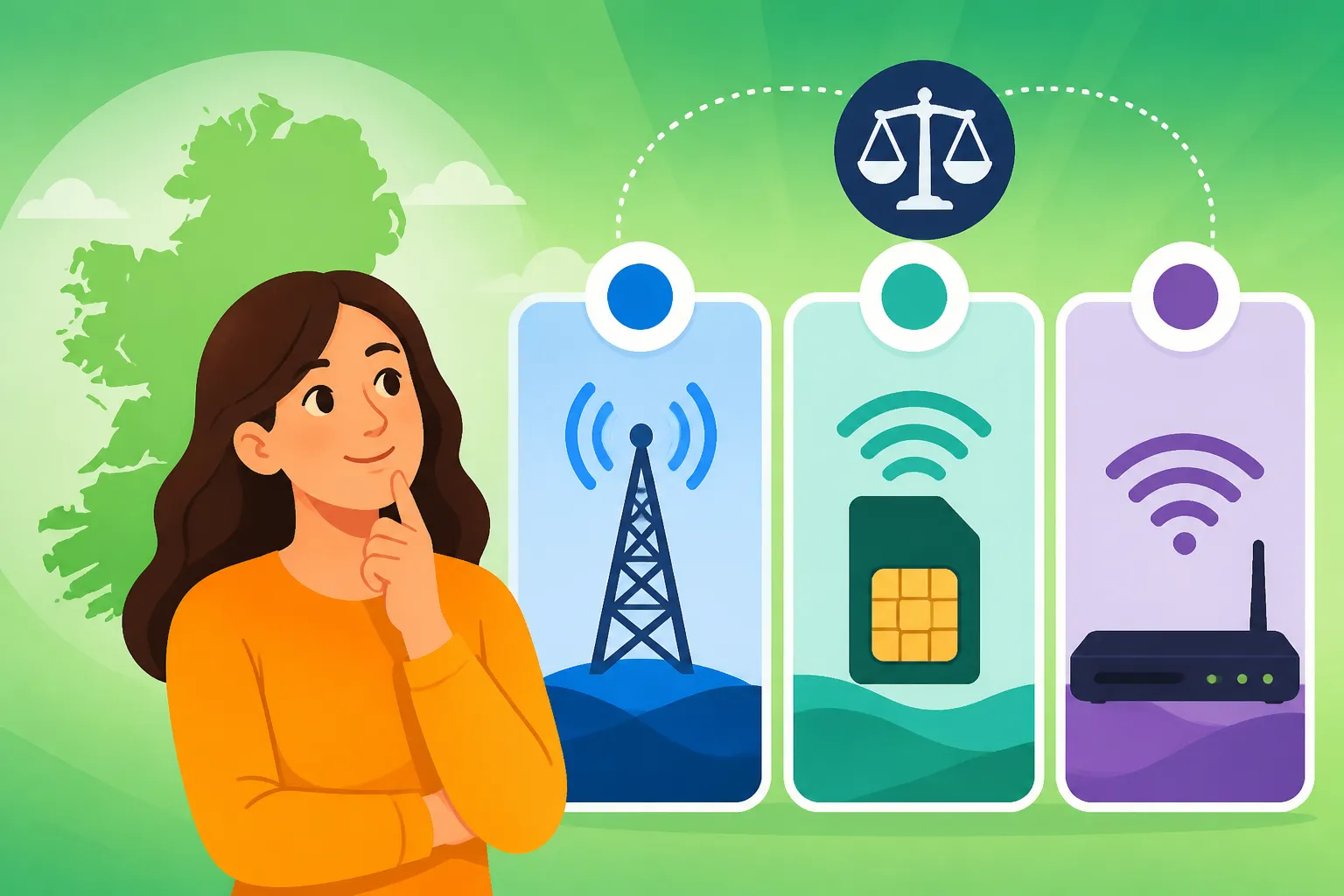
Ireland’s telecommunications market, while smaller than some other countries, has a healthy level of competition. For mobile services, you'll primarily encounter Vodafone, Three (3 Ireland), and Eir. These are the big three, owning and operating their own network infrastructure. Then you have a host of Mobile Virtual Network Operators (MVNOs) like Virgin Media, Tesco Mobile, Lycamobile, and GoMo, which use the infrastructure of the larger networks but offer their own plans and customer service. Often, these MVNOs can be a more budget-friendly option, especially if you're not a heavy user or don't need all the bells and whistles.
When it comes to broadband, the landscape is similar. Eir and Vodafone are major players, often offering fibre-to-the-home (FTTH) services. Virgin Media operates its own separate cable network, offering very fast speeds, particularly in urban areas. Sky and Pure Telecom are also significant providers, generally utilising Eir's or Siro's fibre network. Understanding who owns which network can be crucial, as it often dictates the speeds and reliability you can expect in a given area.
Connectivity Challenges in Rural vs. Urban Areas
One of the biggest realities you'll quickly discover in Ireland is the stark difference in connectivity between bustling city centres and the tranquil countryside. In Dublin, Cork, Galway, Limerick, and other major towns, you'll generally find excellent mobile signal, widespread 4G and 5G coverage, and a multitude of high-speed broadband options, including fibre-to-the-home (FTTH) and Virgin Media's extensive cable network. Providers are constantly competing for customers, driving down prices and increasing speeds.
However, venture into many rural parts of Ireland, and the story changes dramatically. Mobile "not-spots" are still a thing, where signal strength can be patchy or non-existent, even with the major networks. Broadband options can also be limited, often relying on older DSL technology (which uses copper phone lines) or satellite internet, both of which offer significantly slower speeds and higher latency compared to fibre. If you're planning on living outside the main urban hubs, or even in some of the smaller towns, it's absolutely vital to check coverage and available broadband services for your specific address before you commit to a property. Many expats, myself included, have learned this the hard way after moving somewhere beautiful only to find ourselves struggling to stream a simple Netflix show. Companies like Siro are rapidly expanding their fibre network, but it's not everywhere yet.
Key Terminology You'll Encounter
Navigating the world of Irish mobile and broadband means getting familiar with a few key terms. Here’s a quick primer:
- Fibre Broadband (FTTH/FTTC): This is the gold standard. Fibre-to-the-Home (FTTH) means fibre optic cables run all the way to your property, offering super-fast, reliable internet. Fibre-to-the-Cabinet (FTTC) means fibre goes to a street cabinet, and then copper wires complete the connection to your home, which is faster than pure DSL but not as fast as FTTH. Look for providers that offer genuine FTTH.
- DSL (Digital Subscriber Line): Uses traditional copper telephone lines. It's widely available but much slower than fibre, with speeds diminishing the further you are from the exchange.
- Cable Broadband: Offered primarily by Virgin Media, this uses coaxial cables (like those for old TV antennae) to deliver high speeds. It's generally very fast in areas where it's available.
- 4G/5G: These refer to mobile network generations. 4G provides fast mobile data; 5G is the latest, offering even faster speeds and lower latency, but its coverage is still expanding, particularly outside major cities.
- SIM-only vs. Bill Pay (Contract) vs. Prepay (Pay As You Go): These are your mobile plan choices. SIM-only is often a rolling monthly contract where you get a new SIM but keep your own phone. Bill pay involves a longer contract (e.g., 12 or 24 months), often with a subsidised phone. Prepay means topping up credit as you need it, giving you flexibility.
- MVNO (Mobile Virtual Network Operator): As mentioned, these are providers that don't own their own network infrastructure but use another's (e.g., Tesco Mobile uses Three's network).
- Unlimited Data (with Fair Usage Policy): Be wary of "unlimited" claims. Almost all plans, especially mobile, come with a Fair Usage Policy (FUP). This means there's often a hidden cap, or speeds are throttled after a certain amount of data usage (e.g., 100GB or 200GB per month). Always read the small print, or you might find your super-fast connection grinds to a halt unexpectedly.
- Roaming: This refers to using your phone service outside of Ireland. Since Brexit, UK residents need to be careful, as free roaming in the EU/EEA is no longer guaranteed by law for them. For EU/EEA citizens, "Roam Like At Home" rules generally apply, meaning you can use your Irish plan allowances across the EU/EEA without extra charges (within fair usage limits). Always check your provider's specific policy.
Choosing Your Mobile Provider: Plans, Coverage, and Perks
Getting your mobile sorted is usually the first priority. You'll want to be able to make calls, send texts, and access data without breaking the bank or losing signal in important areas.
Prepaid vs. Bill Pay: What Suits Your Needs?
This is often the first decision you'll face when getting an Irish mobile number. Both options have their merits, depending on your circumstances.
Prepaid (Pay As You Go):
- Pros: Incredible flexibility. No contract, no credit checks (which can be a nightmare for new expats with no Irish credit history). You top up with credit, and that credit buys you bundles of data, calls, and texts. This is perfect for short stays, tourists, or if you're just finding your feet and want to keep your options open. Many expats initially opt for a prepaid SIM, often from providers like GoMo or Tesco Mobile, as it offers immediate connectivity without commitment. For those initial few days or weeks before you even get a local SIM, services like Airalo can be a lifesaver, providing an eSIM with data so you're connected from the moment you land.
- Cons: Can be more expensive in the long run if you're a heavy user. You might run out of credit unexpectedly, and some of the best deals for data are reserved for bill pay customers. If you're staying long-term, you'll likely want to switch to a contract.
Bill Pay (Contract):
- Pros: Generally offers better value for money for consistent, heavy usage. You get larger data allowances, sometimes truly unlimited (within fair usage), and often discounted or even "free" handsets if you sign up for a 12- or 24-month contract. This is usually the choice for long-term residents and those who want a predictable monthly bill.
- Cons: Requires a credit check, which can be difficult without an established Irish address or bank account history. You're tied into a contract for a fixed period, and early termination fees can be hefty. Many providers will ask for proof of address, a PPSN, and a valid Irish bank account. Check out our guide on The Expat Guide to Opening a Bank Account in Ireland to get started on that front.
Coverage Maps and Network Quality
There’s nothing worse than thinking you’ve snagged a great deal only to find your phone is a brick every time you step inside your apartment or head to work. Ireland's geography means that network coverage isn't universally perfect. While the major cities and towns are generally well-covered by 4G and increasingly 5G, rural areas can be a lottery.
Before committing to any mobile provider, do your homework. All major providers – Vodafone, Three, Eir, and their MVNOs – publish coverage maps on their websites. Use these to check the signal strength in your new home, your workplace, and any areas you frequent. Better yet, ask friends or colleagues already living in Ireland about their experiences with different networks in your specific location. Word-of-mouth is often more reliable than a coloured map! If you're a remote worker, as many expats in Ireland are, a reliable signal is non-negotiable. Check out our detailed guide on Working Remotely from Ireland: The Definitive Expat Guide (2027) for more insights on connectivity needs.
Data Allowances, Roaming, and International Calls
Most modern mobile usage revolves around data, so this is probably the most critical part of your plan. Do you stream a lot of videos? Work from your phone? Or just browse social media occasionally? Be realistic about your data needs. Many plans offer "unlimited" data, but always, always, check the Fair Usage Policy (FUP). Some providers might throttle your speed after, say, 100GB, which can be frustrating if you rely heavily on mobile data.
When it comes to roaming, for EU/EEA citizens, the "Roam Like At Home" regulations generally mean you can use your Irish allowances within the EU/EEA without extra cost. However, be aware that there are still FUPs in place for roaming too, and excessive use abroad can lead to charges. For non-EU/EEA citizens, roaming charges outside of Ireland can be incredibly high, so if you plan frequent trips home or elsewhere, look for plans that offer international roaming bundles or consider purchasing local SIMs or eSIMs for those trips.
International calls are another consideration. If you frequently call home, look for plans that include international minutes to specific countries, or use VoIP apps like WhatsApp or Messenger over data. Many providers offer add-ons for international calling, so compare these carefully against the base plan costs.
Navigating Broadband Options: Fibre, DSL, and Wireless
Once your mobile is sorted, reliable home internet is the next big step. This is especially true if you’re moving your family over or plan to work from home. Ireland has made huge strides in broadband infrastructure, but what's available to you really depends on your exact address.
Fibre Broadband: The Gold Standard
Fibre broadband, specifically Fibre-to-the-Home (FTTH), is what you should ideally aim for. It uses fibre optic cables all the way to your property, delivering consistently high speeds (often 500 Mbps to 1000 Mbps, or even higher) and incredible reliability. This is perfect for streaming 4K content, online gaming, multiple people working from home, and generally having a seamless internet experience.
In Ireland, the main networks delivering FTTH are Open Eir (Eir's wholesale network) and Siro. Many providers like Vodafone, Eir, Sky, Pure Telecom, and Digiweb resell services over these networks. Virgin Media also offers very high-speed broadband through its own cable network, often competing directly with FTTH providers in terms of speed, though it's technically a different technology. If FTTH or Virgin Media cable is available at your address, these are generally your best bet for a smooth digital life. The future of connectivity is undoubtedly fibre, and if you can get it, snap it up.
DSL and Cable: Older, but Still Around
Before fibre, DSL (Digital Subscriber Line) was the primary way homes got internet via existing copper telephone lines. While significantly slower than fibre (typically offering speeds anywhere from 10 Mbps to 100 Mbps, depending on your distance from the exchange), it's still widely available, especially in older areas or where fibre hasn't yet been rolled out. Providers like Eir still offer DSL, sometimes bundled with phone lines. It might be sufficient for basic browsing, email, and light streaming, but it will struggle with multiple demanding users or high-definition streaming.
Cable broadband, primarily offered by Virgin Media, is a different beast. It uses coaxial cables and can deliver very high speeds, often comparable to entry-level fibre (up to 1000 Mbps in many areas). Virgin Media operates its own network, separate from the Eir/Siro fibre infrastructure. If Virgin Media is available in your apartment block or estate, it's a strong contender for speed and reliability, and often comes with good TV bundles too.
Wireless Broadband and 5G Home Internet
For those living in areas where fibre or high-speed cable isn't available, wireless broadband and 5G home internet can be viable alternatives.
Wireless Broadband (Fixed Wireless Access – FWA): This uses mobile network technology (4G or 5G) to deliver internet to your home via an external antenna or a specialised router. It's often deployed in rural areas where fixed-line infrastructure is poor or non-existent. Providers like Rural WiFi or even some of the main mobile operators offer this. Speeds can vary greatly depending on signal strength and network congestion, but it can provide a decent connection where other options fail.
5G Home Internet: This is a newer offering, typically from mobile network providers like Three or Vodafone. It uses the rapidly expanding 5G mobile network to provide internet to your home via a dedicated 5G router. It's plug-and-play, meaning no installation appointments (often a boon for new arrivals!), and can offer very fast speeds, sometimes comparable to fibre, in areas with strong 5G coverage. The catch, however, is that performance is entirely dependent on your local 5G signal, and these plans often come with a Fair Usage Policy, so truly "unlimited" usage might be capped. This is a great option if you live in a 5G-enabled urban or suburban area and want flexibility or a quick setup.
| Service Type | Typical Speeds (Download) | Pros | Cons | Best For | Major Providers (examples) |
|---|---|---|---|---|---|
| Fibre-to-the-Home | 100 Mbps – 1 Gbps | Super-fast, reliable, low latency, future-proof | Not universally available, requires installation | Heavy users, families, remote workers, gamers | Eir, Vodafone, Sky, Pure Telecom |
| Cable Broadband | 100 Mbps – 1 Gbps | Very fast, reliable, often good bundles with TV | Virgin Media network specific, not everywhere | Heavy users, families, streamers, TV watchers | Virgin Media |
| DSL | 10 Mbps – 100 Mbps | Widely available, uses existing phone lines | Slower, speed depends on distance, older tech | Basic browsing, light use, areas with no other option | Eir |
| 5G Home Internet | 50 Mbps – 500 Mbps | Easy setup, no installation, flexible | Performance depends on 5G coverage, FUPs often apply | Quick setup, renters, areas with good 5G mobile signal | Three, Vodafone |
| Fixed Wireless | 20 Mbps – 150 Mbps | Good for rural areas, fills gaps in fibre/cable | Requires external antenna, variable speeds, weather impact | Rural homes, areas with limited fixed-line infrastructure | Rural WiFi, sometimes major mobile networks |
Bundling Services: The Convenience Factor
Once you've wrapped your head around the individual options for mobile and broadband, you'll start seeing offers to bundle them together. This can seem like a great way to save money and simplify your bills, but it's not always the best choice for every expat.
The Appeal of Combined Deals
Many providers in Ireland offer "triple-play" or "quad-play" bundles, combining broadband, home phone (landline), mobile, and sometimes even TV services into one package with a single monthly bill. The appeal is obvious: convenience and perceived cost savings. For example, Vodafone or Eir might offer a broadband package that includes a mobile SIM-only plan at a reduced rate. Virgin Media is particularly known for its broadband, TV, and mobile bundles.
For families, or those who value simplicity, a bundle can be a fantastic option. It means one customer service contact, one direct debit, and often a slightly lower overall price than purchasing each service individually. If you're managing all the other aspects of How to Set Up a Home in Ireland, simplifying utility bills can be a welcome relief.
Pros and Cons of Bundling
Let’s weigh it up:
Pros:
- Cost Savings: Often, providers offer a discount when you combine multiple services.
- Simplicity: One bill, one provider, one point of contact for customer service.
- Exclusive Deals: Sometimes the best deals on premium TV channels or highest broadband speeds are only available as part of a bundle.
- Loyalty Benefits: Being a bundled customer can sometimes unlock additional perks or better deals on upgrades.
Cons:
- Lack of Flexibility: You're tied to one provider for multiple services. If you're unhappy with one aspect (e.g., mobile coverage), it can be difficult to switch without incurring fees for the other services.
- Hidden Costs: The initial discount might look good, but check the price increases after the introductory period (often 6, 12, or 18 months). They can jump significantly.
- Credit Checks: As with bill pay mobile, bundles typically require a credit check, which can be a hurdle for new arrivals.
- Not Always the Best Value: Sometimes, by shopping around and picking the best-value mobile provider and the best-value broadband provider separately, you might actually save more than with a bundle, especially if your needs are specific. For instance, you might find a brilliant mobile deal with GoMo and an excellent fibre deal with Pure Telecom, which wouldn't be offered together.
Comparing Provider Bundles
If you're considering a bundle, don't just jump at the first offer. You need to compare very carefully. Look beyond the headline price:
- Contract Length: Are you willing to commit for 12, 18, or 24 months? What are the early exit fees?
- Post-Contract Price: What will the monthly cost be after any introductory offer expires? This is crucial for long-term budgeting.
- Included Services: Does the bundle truly meet all your needs? If you don't need a landline, is it adding unnecessary cost? Do you need all those TV channels, or will streaming services suffice? If you’re trying to set up your entire entertainment system, you might want to consider How to Set Up Streaming and the TV Licence in Ireland separately.
- Specific Mobile & Broadband Features: Are the mobile data allowances generous enough? Is the broadband speed truly fibre-to-the-home, or an older technology?
- Customer Service Reputation: Check online reviews. A good deal isn't worth constant frustration if you can't get help when something goes wrong.
Table of Example Bundles (for illustrative purposes, prices vary frequently):
| Provider | Example Bundle | Typical Price (Monthly) | Contract Length | Key Features |
|---|---|---|---|---|
| Vodafone | Fibre Broadband (500Mbps) + Unlimited Mobile SIM-only | €60 – €80 | 12-24 months | Good for all-in-one, strong network. |
| Eir | Fibre Broadband (500Mbps) + Mobile SIM-only + Landline | €55 – €75 | 12-24 months | Often competitive pricing, own network infrastructure. |
| Virgin Media | 500 Mbps Broadband + TV (Mix) + Unlimited Mobile SIM-only | €70 – €95 | 12-18 months | High-speed cable, extensive TV options, separate network. |
| Sky | Fibre Broadband (500Mbps) + TV (Basic) | €50 – €70 | 12-18 months | Good for TV lovers, uses Open Eir/Siro network. |
Remember, these are illustrative and subject to frequent change. Always check the provider's current website for the most up-to-date offers.
Setting Up Your Services: What to Expect
The actual process of getting connected can be straightforward, but like many things in Ireland, it can also involve a bit of a wait and some paperwork. Knowing what to expect can alleviate some of the stress.
The Application Process and Required Documents
Whether you're going for mobile bill pay, broadband, or a bundled package, you'll generally need to provide a few key documents. This is where being a new expat can sometimes be tricky, as you might not have a long credit history or an established address proof right away.
Common documents requested include:
- Proof of Identity: A valid passport or national ID card.
- Proof of Address: A utility bill (gas, electricity – once you've set them up, see How to Set Up Electricity and Gas in Your Irish Home), a bank statement, or a letter from your landlord confirming your residency. Some providers might accept a tenancy agreement.
- PPS Number (Personal Public Service Number): Essential for many administrative tasks in Ireland, and often required for contract services.
- Irish Bank Account Details: For setting up direct debits for bill pay or broadband. This is why getting your The Expat Guide to Opening a Bank Account in Ireland sorted early is so important.
- Proof of Employment/Income: Less common for standard mobile, but sometimes requested for broadband or high-value bundles if you don't have a credit history.
Don't be surprised if there's a slight delay or if you're asked for additional documents as a newcomer. It's part of the process, and providers are simply trying to verify identity and ability to pay. Starting with a prepaid mobile SIM can bypass some of these initial hurdles, giving you time to gather the necessary documentation for more permanent solutions.
Installation and Activation Timelines
Once you've applied and been approved, the waiting game begins.
Mobile Services:
- Prepaid SIM: Often activated instantly if you pick one up in a shop (e.g., Tesco Mobile, Three, Vodafone stores). You can top up and go.
- Bill Pay SIM: If you're porting your number (keeping your existing Irish number) or getting a new one, a SIM card is usually mailed out within a few working days. Activation typically happens within 24 hours of receiving the SIM. If you're purchasing a phone, it will often arrive at the same time.
Broadband Services:
- Fibre (FTTH): This usually requires a technician visit to install the fibre optic line and router. Depending on demand and your location, this can take anywhere from 1 to 3 weeks, sometimes longer in very busy periods. Book an appointment as soon as possible.
- Cable (Virgin Media): If your property is already wired for Virgin Media, it might just be a case of plugging in a self-install kit. If not, a technician will need to visit, and timelines are similar to fibre.
- DSL: If your property has an active phone line, setup can be quick (often a self-install kit). If a new line needs to be activated, it might involve a technician.
- 5G Home Internet/Fixed Wireless: These are often the quickest to get up and running, as they're typically self-install with a router sent to you. Just plug it in and ensure you have a good signal.
Plan ahead, especially if you need internet for work from day one. Don't assume you can move in and have fibre installed the next day. This is where having a reliable mobile data plan (perhaps even with a personal hotspot feature) can be a crucial backup.
Switching Providers (If You're Already Here)
Perhaps you've been in Ireland for a while, and your current provider isn't cutting it, or you've found a better deal. Switching is generally straightforward in Ireland thanks to consumer protection rules.
Mobile: If you're out of contract, you can simply port your number to a new provider. Your new provider will usually handle the transfer. If you're still in contract, check for early termination fees, which can make switching uneconomical.
Broadband: Similarly, if you're out of contract, you can usually switch relatively easily. Your new provider will typically manage the cancellation with your old one (though it's always wise to double-check). If you're on a fibre network (Open Eir/Siro), switching between providers that use the same network is often easier than switching between different physical infrastructures (e.g., from Virgin Media to Eir fibre). Be mindful of any outstanding equipment (routers) that needs to be returned to your old provider to avoid charges.
Always give appropriate notice to your old provider as per your contract terms. Many expats use this opportunity to reassess their needs, especially after a year or two, as new and better deals frequently come onto the market.
Common Pitfalls and How to Avoid Them
Even with the best planning, new expats can sometimes fall into traps when setting up their essential services. Knowing what to watch out for can save you stress and money.
Hidden Fees and Contract Traps
The headline price of a mobile or broadband package can be very appealing, but the devil is always in the details.
- Introductory Offers: Many plans come with a reduced price for the first 6, 12, or 18 months. After this period, the price can jump significantly. Always ask for the full price after the introductory period, and factor that into your long-term budget.
- Activation/Setup Fees: Some providers charge a one-off fee to activate your service or install equipment. Make sure you're aware of these before signing up.
- Router Rental/Purchase: Is the broadband router free, or is there a monthly rental fee? Do you have to buy it outright? What happens if you cancel – do you have to return it or pay a penalty?
- Early Termination Fees: If you sign a 12 or 24-month contract and decide to leave early, you will almost certainly face a substantial early termination fee, which can be the remaining months of your contract or a portion thereof. Be absolutely sure about your commitment, especially if you're not certain about your long-term stay in a particular location. This is especially important for expats who might be considering a move back home or to another country, in which case using a moving service like Sirelo would be the least of your worries.
- Paper Bill Fees: Some providers charge extra if you want a physical paper bill instead of managing everything online. Opt for e-billing to save a few euros.
Always, always read the terms and conditions thoroughly. If something isn't clear, ask the salesperson for clarification and get it in writing if possible.
Understanding Fair Usage Policies
We touched on this earlier, but it's worth reiterating: "unlimited" usually isn't truly unlimited. Most mobile and many wireless broadband plans come with a Fair Usage Policy (FUP). This means there's a certain threshold (e.g., 100GB, 200GB, or even more) after which your speed might be drastically reduced, or you could be charged extra.
The intention is to prevent abuse of the network and ensure everyone gets a reasonable service. However, if you're streaming 4K video all day, downloading huge files, or have multiple devices constantly active, you might hit these limits sooner than you think. Always check the FUP before signing up, especially for any mobile plan you intend to use as a primary internet source (e.g., via hotspot). Ask specific questions like: "What is the actual data cap before speeds are reduced?" and "What speed will it be reduced to?"
Customer Service Expectations and How to Complain
Let's be realistic: customer service in Ireland, across many industries, can be a mixed bag. You might have wonderful experiences, or you might find yourself in a frustrating loop of automated messages and long hold times.
- Online Accounts: Most providers offer online portals where you can manage your account, check bills, and sometimes troubleshoot. Get familiar with these.
- Phone Support: Be prepared for potential wait times, especially during peak hours. Have your account number and relevant details ready.
- Store Visits: For mobile issues, visiting a physical store (e.g., Vodafone or Three retail outlets) can often be the quickest way to get face-to-face help.
- Social Media/Online Chat: Many providers offer support via X (formerly Twitter) or Facebook, or through live chat on their websites. Sometimes these channels can be more efficient for simpler queries.
If you have a serious complaint that isn't being resolved, remember your rights as a consumer. If the provider doesn't resolve your issue to your satisfaction after their internal complaints process, you can escalate it to ComReg (the Commission for Communications Regulation), which is the independent regulatory body for the electronic communications sector in Ireland. They have a formal complaints procedure and can mediate disputes. Don't be afraid to use them if you feel you're being unfairly treated. Getting connected is a right, not a privilege, and you deserve reliable service as much as anyone else.
Disclaimer
The information provided in this guide is for general informational purposes only and does not constitute professional advice. While we strive to keep the information accurate and up-to-date, telecommunications policies, pricing, and availability in Ireland are subject to frequent change. Always consult official government websites, service providers, or a qualified professional for the most current and specific advice tailored to your individual situation.